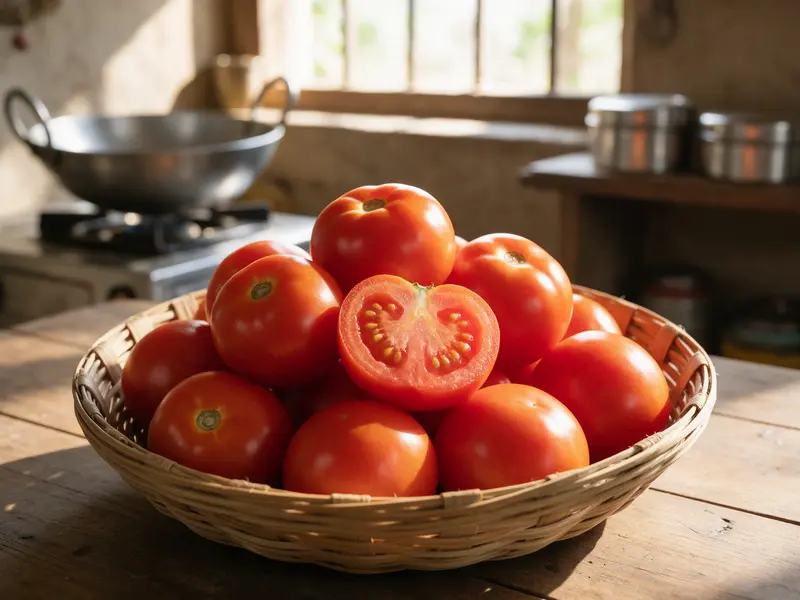
Tomato
Sun-ripened red tomatoes, juicy and tangy, collapsing slowly into a glossy, jammy masala fragrant with ginger, garlic and warm spices.
Also called: tamatar (Hindi), thakkali (Tamil)
Taste: Sour; ripe, red, non-sour tomatoes give gravies colour and flavour.
Texture: Cooks down soft and mushy; Roma tomatoes are pulpier and less juicy.
Getting it ready
Cook it in the onion masala until oil separates and the paste turns glossy and jammy. Add it to beans only once they are tender, since acid keeps them hard.
- Few sources say this.
Cooking with it
- Cook time: 7½ minutes Few sources say this.
- Cook time: 3–4 minutes (electric_pressure_cooker) Few sources say this.
- Cook time: 6½–7½ minutes (open_pot)
Swaps
- dry mango powder: IVC-0298/0353
- kokum: IVC-0298/0353 Few sources say this.
- tomato puree: subject chopped tomato; subject fresh tomatoes
If something goes wrong
Tomatoes turn mealy and bland
- Chilling injury from refrigeration
- Keep whole tomatoes on the counter unless the weather is very hot. to prevent
Tomato soup or gravy too sour
- Tart or unripe tomatoes
- Pick ripe red tomatoes with a sweet-tangy taste, such as Roma or plum types. to prevent
- Balance with a little sugar or 1 to 2 tbsp cream without making it sweet. to rescue Few sources say this.
- Sour tomatoes combined with tamarind
- Cut back the tamarind or raise the spice. to prevent Few sources say this.
Keeping
Keep whole tomatoes on the counter stem side down, as chilling makes them mealy and dull; in hot summers, refrigerate any that must last beyond about three days.
Goes well with
Used to finish
- uttapam, chopped
Used in
Panchmel dal, Varan, Tomato pappu, Tomato rasam, Arhar dal, Dal tadka, Dal and rice, Chapati upma, Onion tomato masala, Cashew poppy seed gravy, Makhani gravy, Sarson da saag, Onion curry paste, Dal rasam, Mor rasam, Mysore rasam, Mulligatawny, Toor dal soup, Bharwan bhindi, Baingan bharta, Lauki sabzi, Paneer bhurji, Kadai paneer, Matar paneer, Gujarati dal, Aloo baingan, Aloo matar, Aloo tamatar, Bagara baingan, Bhel puri, Bhindi do pyaza, Chana dal fry, Chana palak, Chhurpi, Dal makhani, Dum aloo, Gajar matar, Idli, Kaddu ki sabzi, Ker sangri Few sources say this., Khatti meethi dal, Khichdi, Lauki kofta, Lobia masala, Malai kofta, Matki usal, Mirchi bajji, Misal pav, Mixed vegetable soup, Mushroom matar, Navratan korma, Palya, Paneer butter masala, Paneer tikka, Papdi chaat, Pappu charu Few sources say this., Pav bhaji, Rajma masala, Roti, Saaru, Santula Few sources say this., Sev puri, Shahi paneer, Tinda sabzi, Tomato chutney, Tomato rice, Tomato soup, Uttapam, Veg cutlet
Seasons
Monsoon (Jul–Nov), harvest; Winter (Dec–Jun), harvest
Regions
Gujarat, Andhra Pradesh, Madhya Pradesh
Festivals
Onam (Kerala)
Tradition
Tomatoes are a newer arrival to Indian cooking, valued in homes for their sour taste and colour in everyday dishes.
Nutrition
Contains vitamin C and lycopene. Amounts in a finished soup depend on the product and preparation. Demo note, sources to be added.
Questions answered
Useful tips
- Cook the tomato masala until oil separates. Cook the tomato puree in the onion masala until oil starts to separate from it.
- Cook tomato in the tempering base before the dal goes in. In many dals the tomato goes into the tempered onion and ginger-garlic base and cooks until soft before the cooked dal is added.
- Chana dal fry adds tomato only at the end. In one style of chana dal fry, tomato, coriander, garam masala and pepper are added only at the end and simmered for two minutes. Few sources say this.
- Rasam base: boil tamarind with tomato, then strain. For tomato rasam, boil tamarind water with tomatoes, turmeric and often hing for about 5 to 7 minutes, until the raw tamarind smell goes.
- Briefly cook ground spices in the tomato base. Cook the ground spices briefly in the tomato base to take off their raw edge.
- Use tomato sparingly in sambar. Use tomato sparingly in sambar so tamarind stays the main sour note.
- Baking soda to tame tomato acidity. About a quarter teaspoon of baking soda can neutralise excess tomato acidity in a gravy. Few sources say this.
- A little starch stops milk curdling in tomato gravies. Thickening milk with a little flour first makes it less likely to curdle when heated hard or when tomato is added. Few sources say this.
- Cook a blended onion-tomato paste fully before spicing. Soften onion, tomato, chilli, garlic and ginger about 10 minutes, blend, then cook the paste covered on low 10–15 minutes before adding spices. Few sources say this.
- Moong dal suits tomato soup because it cooks in the same time. Split yellow moong dal is the home choice for tomato soup because it cooks in about the same time as the tomatoes and adds protein. Few sources say this.
- Chunky tomato rasam: blend half the tomatoes. For a chunky tomato rasam, blend half the tomatoes smooth, chop the rest, and simmer only 5–7 minutes until the pieces soften. Few sources say this.
- Tomato chutney variations. For a quick tomato chutney, blend raw tomatoes with green chillies and finish with a tempering, like a salsa; adding fresh coriander or mint when grinding freshens it. Few sources say this.
- Semi-smooth texture for tomato-garlic chutney. Pulse tomato-garlic chutney with a hand blender only to a semi-smooth texture. Few sources say this.
- Onion and tomato order in gajar matar. You can skip onion and tomato; when including them, soften onion first, follow with tomato and spices, and add the vegetables last. Few sources say this.
- Curd in ker sangri: use it fresh, or swap in tomato. Use fresh rather than sour curd in ker sangri masala; it can be omitted, with grated tomato added for tang instead. Few sources say this.
- Cook onion or tomato paste until the raw smell goes. If you use onion or tomato paste to thicken a gravy, keep cooking it until it no longer smells raw. Few sources say this.
- Finely cut onion and tomato thicken dal. Cut the onion and tomato small so they dissolve into the dal as it cooks and give it body. Few sources say this.
- Sour dosakaya needs no tomato or tamarind. Taste the yellow cucumber first; a sour one means leaving out tamarind and tomato, or the dal ends up far too sour. Few sources say this.
- Thickening tomato tenga with potato. Tomato tenga can include a mashed boiled potato; one source says it thickens the curry and makes it creamy.
- Adding tomato masala to pressure-cooked beans. Pressure-cook beans until soft first, then add the onion-tomato masala and give one short extra pressure cycle.
- Cooking out tomato and using tins. Tomato-based gravies need their tomatoes cooked down well; tinned plum tomatoes, blanched tomatoes or puree all work and shorten the cooking.
- Using concentrated tomato paste in curry. Tomato paste is about four times as strong as puree, so dilute it four to one; a curry serving 4-8 needs just two spoons or a tin.
- Tomato and coconut last in cabbage palya. Add tomato, coconut and coriander to cabbage palya at the end and cover until the tomato softens. Few sources say this.
- Tomato instead of yogurt in besan chilla. One pureed tomato can replace the yogurt in besan chilla batter. Few sources say this.
- Tomato in yogurt gravy. Use only a little tomato in a yogurt gravy, as more makes it too sour; it can be left out with amchur added to the koftas instead. Few sources say this.
- Canned tomatoes in onion-tomato masala. Canned crushed tomatoes can replace fresh in onion-tomato masala, giving better colour and less water.
- Tomato rice versus tomato bath. Tomato rice mixes cooked, cooled rice gently into the masala so it does not mash; cooking raw rice with the tomatoes gives tomato bath instead.
- Store-bought tomato puree. Store-bought tomato puree is more concentrated than fresh, giving richer colour and flavour; about 3 tablespoons can replace tomato paste.
- Tomato form shapes the gravy. Crushed tomatoes or tomato pulp give a thicker, curry-like base, while diced tomatoes give a chunkier one.
- Jaggery in tomato dishes. Add jaggery once the tomato mixture is almost cooked; it balances the tomatoes' sourness.
- Tomato in vegetable soup. In a mixed vegetable soup, add the tomato only after the water boils and the heat is lowered, cut in large cubes so it holds its shape. Few sources say this.
- Blending and straining tomato soup. Blend tomato soup as finely as possible; strain through a sieve for a smooth result, or skip straining if a strong blender leaves no fibres.
- Colouring tomato soup with carrot or beetroot. Carrot or beetroot is often cooked with tomato soup for colour; remove it before blending, or leave it out to keep pure tomato colour and taste. Few sources say this.
- Balancing tamarind with tomatoes in tomato rice. In tomato rice, use less tamarind when the tomatoes are sour, and add tamarind pulp or lemon if you want more tang.
- Tomato texture in sev tamatar. For sev tamatar, do not dice the tomatoes too fine; crush half and leave the rest chunky.
- Tamatar ka chokha. For tamatar ka chokha, roast and crush tomatoes, then stir in chopped onion, green chilli and a little mustard oil.
- Why milk or cream splits in sour or tomato gravies. Acid from tomato, tamarind, lemon or sour curd, and polyphenols in foods such as tomatoes, potatoes and tea, can curdle milk and break a creamy emulsion.
- How long cooked tomato chutneys keep. A spiced, tamarind tomato chutney cooked thick keeps about 2 months in the fridge; a sweet-sour sugar-and-vinegar one keeps about a year chilled. Few sources say this.
- Sindhi cooks use tomato and onion raw and cooked. Sindhi cooking often adds plenty of tomato and onion, both cooked and raw, to dishes such as dry-cooked moong dal. Few sources say this.
- Keeping tamatar ka saalan. One cookbook says this pickle-like tamarind-tomato curry stays fresh about two weeks, but does not say where to store it. Few sources say this.
- Colour cue for tomato khejur chutney. Tomato khejur chutney is nearly done when it turns deep red, glossy and reddish-brown after the sugar has cooked in.
- Onion-tomato raita does not keep well. Make onion-tomato raita close to serving: left to stand, the vegetables release water and make it runny; one source adds that the raw onion turns strong-smelling.
- How tomato ketchup is made. Strained tomato juice is boiled with whole spices and concentrated about threefold to 28–30% solids, with sugar, salt and vinegar added late, then hot-filled and sealed.
- What goes into ketchup besides tomato. A model batch adds about 583 g sugar and 92 g salt to 5 kg tomato juice for 4.2 kg ketchup; commercial ketchup may add starch or gums.
- Cook tinda apart from the tomato masala. Soften the tinda in one pan and make the tomato masala in another, combining them later, because tinda takes much longer to soften in tomato.
- How long tomato thokku keeps. Sources differ: one keeps tomato thokku a week or longer chilled and never at room temperature; another allows about 2 days unrefrigerated and two months chilled, best within one.
Another view: For thokku, some say a week or more in the fridge and not at room temperature; others allow about 2 days at room temperature and a couple of months chilled.
- Tamatar ki chutney. Tamatar ki chutney is a hot, tangy tomato chutney with onion, garlic, spices, salt and a little sugar.
- How to tell an onion-tomato masala is done. The masala is ready when oil seeps out and pools at the edges, spluttering stops, and the paste turns deep-coloured, glossy and jammy.
- Home tomato juice. Simmer chopped tomatoes in very little water, sieve, add about a quarter teaspoon of salt per cup, reboil and bottle. Few sources say this.
- Tomato and capsicum go in late in kadai vegetables. In kadai vegetables, add the tomatoes and capsicum only after the other vegetables have started to brown, even with a frozen mix. Few sources say this.
- Simmer tomato soup vegetables until very soft, then blend and strain. Simmer the vegetables with the tomatoes about 30 minutes until very soft, blend or mill them, and strain for a smoother soup. Few sources say this.
- Green tomato and ginger jam. Unripe green tomatoes picked before frost can be cooked with lemon, ginger and sugar into a marmalade-like jam. Few sources say this.
- Roasting for tomato-garlic chutney. Roast tomatoes, garlic and chillies on medium heat so they soften inside, not just char; a lightly oiled tawa works, and peel burnt skins once cool.
- Making smooth homemade tomato puree. Blanch and peel tomatoes before blending, since the skins spoil the smoothness and may taste bitter; puree from raw, unpeeled tomatoes needs sieving.
- Bottling tomato thokku. Let thokku cool fully, then jar it in a dry, clean, airtight glass container or a non-reactive bowl, and only ever use a dry spoon.
- Leave tomato liquid for a pressure-cooked base. When finishing a curry base in a pressure cooker, do not cook the tomatoes fully dry; their liquid is what lets the cooker build pressure. Few sources say this.
- Chunky versus smooth onion-tomato masala. For a chunky masala chop finely or pulse onions just until fine and keep tomatoes chunky; for a smooth one, blend each ingredient separately.
- Stovetop onion-tomato masala. On the stove, brown the onions golden, add ginger and garlic, then cook in the tomatoes until the raw taste goes or the oil separates.
- Tomato and onion in bread upma. Tomatoes can make bread upma soggy, so some cooks skip them, and if used, drop the lemon; leave out the onion for a Jain version.
- Natural glutamate in tomato, peas and mushroom. Glutamate, the savoury compound sold as MSG, occurs naturally at about 250 mg per 100 g in ripe tomatoes, 200 mg in green peas and 180 mg in mushrooms.