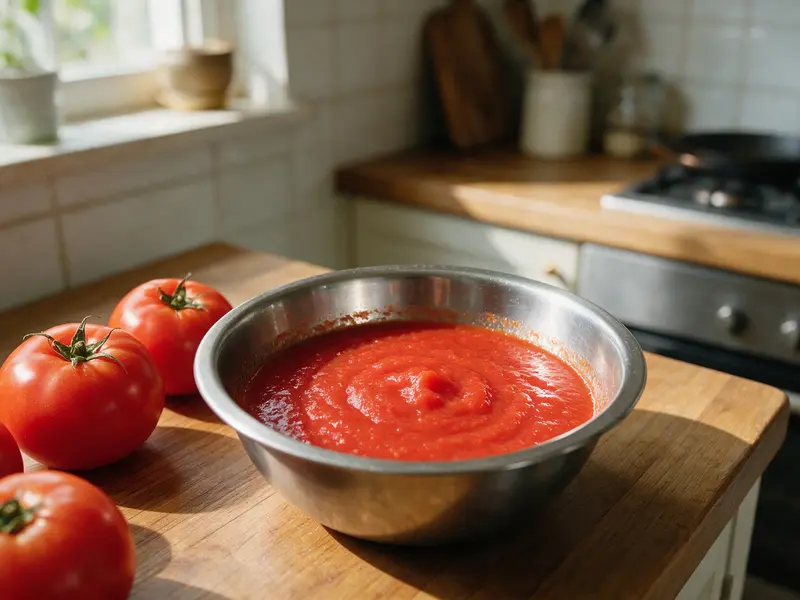
Tomato puree
Velvety, brick-red tomato puree, concentrated and tangy, simmered into rich, glossy gravies for a deep, rounded tomato warmth.
Taste: Intensifies tomato flavour when used alongside fresh tomato. Few sources say this.
Getting it ready
Add a little alongside fresh tomato, as in dal tadka, to deepen the flavour, and cook it about 8 to 10 minutes in an open pot. Canned tomato sauce can replace fresh tomatoes for a quicker makhani gravy.
Cooking with it
- Cook time: 8–10 minutes (open_pot) Few sources say this.
Keeping
- In the fridge: 5–9½ days Few sources say this.
Another view: Some keep homemade puree at least a month in the fridge in an airtight box.
- Frozen: 60–120 days
Used in
Pumpkin dal, Dal makhani, Choliya sabzi, Methi dal, Mix veg, Bhindi do pyaza, Shahi paneer, Navratan korma, Sev tamatar, Korma base, Bagara baingan, Dum aloo, Mushroom matar, Paneer butter masala
How it is made
Processed with heat, solvents or chemicals.
Ripe tomatoes are washed, steamed, crushed and softened in a steam-jacketed kettle, sieved free of skin and seeds, and concentrated under vacuum to 9–12% total solids.
Seasonal food wheel
- On the tongue: Rich
- After the meal: Rich
- Warmth: warming
- Texture: smooth
- Best seasons: late winter, early winter, rains
Questions answered
Useful tips
- Store-bought tomato puree. Store-bought tomato puree is more concentrated than fresh, giving richer colour and flavour; about 3 tablespoons can replace tomato paste.
- Making smooth homemade tomato puree. Blanch and peel tomatoes before blending, since the skins spoil the smoothness and may taste bitter; puree from raw, unpeeled tomatoes needs sieving.
- Homemade versus shop tomato puree. Homemade puree has no preservatives and tastes fresh; shop-bought puree contains stabilisers and can taste cooked or slightly metallic, while tomato sauce is cooked down and often sweetened.
- Tomato puree in place of curd in a batter. In some batters, pureed tomato can stand in for curd. Few sources say this.
- How bottled tomato puree is made. Ripe tomatoes are washed, steamed, crushed and softened in a steam-jacketed kettle, sieved free of skin and seeds, and concentrated under vacuum to 9–12% total solids.
- A very smooth paneer butter masala. You can strain the blended tomato puree for the gravy.
- Tomato paste or ketchup boosts tomato flavour. Adding a little tomato paste or ketchup alongside fresh tomato intensifies the tomato flavour, for example in dal tadka. Few sources say this.
- Canned tomato sauce for a quick makhani gravy. Two cans of tomato sauce can replace the fresh tomatoes for a quicker makhani gravy. Few sources say this.
- Minimum liquid and layering in an electric pressure cooker. Keep at least 1 cup thin liquid at the bottom of a 3 qt pot (1.5 for 6 qt, 2 for 8, 2.5 for 10), with tomato paste on top.
- Body for a no-onion Jain makhani gravy. Jain paneer makhani gets its body from tomato purée simmered about 10 minutes with soaked cashew paste and cream, with about a tablespoon of sugar to soften the tomato's edge. Few sources say this.
- Ketchup in curry gravies. Ketchup is not advised in a tomato gravy; a better shortcut is tomato paste plus a spoonful of tomato sauce. Few sources say this.
- Cooking out tomato and using tins. Tomato-based gravies need their tomatoes cooked down well; tinned plum tomatoes, blanched tomatoes or puree all work and shorten the cooking.
- Using concentrated tomato paste in curry. Tomato paste is about four times as strong as puree, so dilute it four to one; a curry serving 4-8 needs just two spoons or a tin.
- Taming very tangy tomatoes. If the tomatoes are very sour, blend 1-2 teaspoons of sugar into the puree. Few sources say this.
- Tomato form shapes the gravy. Crushed tomatoes or tomato pulp give a thicker, curry-like base, while diced tomatoes give a chunkier one.
- Canned tomatoes for fresh. Canned crushed tomatoes or puree can replace fresh tomatoes; use less puree since it is concentrated.
- Simmer chole for flavour. Simmer the chickpeas in the masala for a full 30 minutes so the flavours come together. Few sources say this.