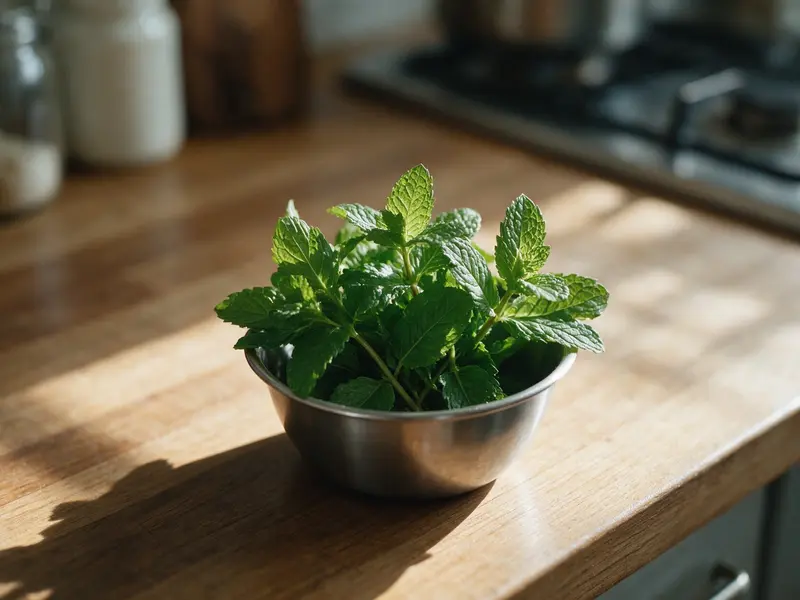
Mint
Cool, vivid mint leaves crushed into a bright green chutney, releasing a sharp, refreshing perfume and lively sweetness on the palate.
Also called: pudina (Hindi), pudhina
Taste: Fresh mint is pungent and strong; dried mint is mellower. Few sources say this.
Getting it ready
Mint leaves are tough, so a blender purées chutney better than a food processor. For tea, steep the leaves just off the simmer for about 4 minutes.
Keeping
Wash in cold water, drain, wrap in damp muslin and chill, or keep it in a box lined with paper.
Goes well with
Used to finish
aam panna, whole leaves, bel sharbat, whole sprig, chaas, sprigs, kanji, whole leaves, kokum sharbat, whole leaves, lassi, fresh leaves, sattu drink, fresh leaves, boondi raita, fresh leaves, raayi ka raita, chopped, tomato juice, leaves, qubooli, finely chopped, mishti doi, leaves, kamal kakdi kofta curry, fresh leaves, walnut chutney, whole fresh leaves, balushahi, fresh leaves, cucumber raita, whole leaves, mint raita, whole sprig, pineapple raita, a sprinkle, fruit chaat, fresh leaves
Used in
Green chutney, Kokum sharbat, Dhansak, Aam panna, Qubooli, Mint cinnamon tea, Chaat masala, Green masala paste, Kothamalli thogayal, Raw mango chutney, Walnut chutney, Kokum chutney, Balushahi, Cucumber raita, Mint raita, Pineapple raita, Kachumber salad, Fruit chaat, Samosa, Papdi chaat, Aloo paratha, Mooli paratha, Torani, Chaas, Sattu drink, Dal makhani, Jaljeera Few sources say this., Masala chai, Moong sprouts salad, Raab
Seasons
Summer (Mar–Jun), eaten; Monsoon (Aug–Aug), harvest Few sources say this.
Regions
- Uttar Pradesh
Festivals
Bohag Bihu (Assam)
Seasonal food wheel
- On the tongue: Spiced
- After the meal: Light
- Warmth: cooling
- Texture: coarse
- Best seasons: summer, autumn
Questions answered
- Can you freeze mint raita?
- Should mint leaves be blended into chaas or just added as garnish?
- Why might mint chutney become watery, discoloured, bitter or spoil quickly?
- Should ingredients for mint chutney be raw, roasted, cooked or ground, and why?
- How should mint chutney be stored, and what practices help maintain its quality?
- What can I add to vary coconut chutney: coriander, mint, ginger, garlic or shallots?
Useful tips
- Prepare coriander and mint for salads. Wash coriander and mint in a big basin of cold water, drain in a colander, wrap in damp muslin and chill until you use them. Few sources say this.
- Fresh versus dried mint. Fresh mint is pungent and strong; dried mint is mellower but still full of minty flavour, which is why many spice blends use it. Few sources say this.
- Blender for mint chutney. Mint leaves are tough, so a blender purées mint chutney better than a food processor; when anardana provides the tartness, add very little lemon juice. Few sources say this.
- Mint infusion from tea or fresh leaves. A mint infusion can be made either from dried mint tea or from fresh mint leaves. Few sources say this.
- Companion planting for fennel, garlic and mint. Fennel is usually grown on its own; garlic is often planted near tomatoes and roses but not beans or peas, and mint near cabbage and tomatoes but not parsley. Few sources say this.
- Mint-cinnamon tea. For mint-cinnamon tea, steep the herbs in a strainer in a mug of water just off the simmer for about 4 minutes, then sweeten to taste. Few sources say this.
- Growing mint in a pot. Mint grows in part shade to full sun with regular moisture and is a hardy perennial; plant it in a pot so its running roots cannot take over. Few sources say this.
- Mint through the winter. Mint survives frost, and under a cold frame or tunnel it can still be picked through winter. Few sources say this.
- Multiply mint by division or cuttings, not seed. Mint seldom comes true from saved seed, so multiply a good mint by dividing the clump in spring or rooting cuttings.
- Layering mint. Pin a few mint stems onto loosened, watered soil with a stone; they root in three to four weeks and can be moved by midsummer or autumn. Few sources say this.
- Rooting mint in water. Mint cuttings root in a glass of water on a windowsill; grow them a few weeks in a pot before planting out, as water roots differ from soil roots. Few sources say this.
- Mint varieties and their uses. Peppermint is high in menthol; spearmint and apple mint are milder and earthier, with apple mint suiting drinks, fruit and Indian dishes, and spearmint lime and tea blends. Few sources say this.
- Mint or coriander in aam panna. Mint or coriander can be ground into the mango pulp of aam panna or kept back as a garnish on top.
- Making mint paste for raita. Grind mint with a spoonful of the curd, a little sugar and salt for a smooth, stronger-tasting purée; finely chopping it is quicker but milder.
- Lemon juice keeps mint chutney green. A little lemon juice keeps mint chutney green.
- Mint in chaas: blended fresh or dried in the masala. Some cooks blend fresh mint into chaas with curd, ginger and spices; others whisk instead of blending and put dried mint into the roasted chaas masala.
- Pudina chaas from masala chaas. Blend about a quarter cup of mint into a cup of masala chaas to make pudina chaas, and serve it straight away. Few sources say this.
- Raw mango and mint chutney keeps 4–5 days. Raw mango and mint chutney keeps 4–5 days in an airtight container in the fridge. Few sources say this.
- Keep mint chutney refrigerated. Keep mint chutney, especially the curd-based version, in the fridge and do not leave it sitting at room temperature. Few sources say this.
- Mint and roasted cumin in summer food. Indian households traditionally add mint and roasted cumin to summer drinks and dishes.
- Punjabi mint chutney. Punjabi chutney can be made with pudina.
- Shikanji. For this lime drink, sugar is dissolved in water, then lime juice, mint, roasted cumin, black salt and pepper go in; soda water can replace part of the water. Few sources say this.
- Blending order for green chutney. For green chutney, blend chillies and scallion greens first, then mint and coriander, adding lime juice with the motor running and seasoning at the end.
- Late additions to slow-cooked black urad. In long-simmered black urad dal, add the tomato either with the masala before a long simmer or late, for the last 15 minutes to an hour; add butter late, and dried mint if used.
- Bulk up a green herb sauce with greens. Blend one to two cups of spinach or other leafy greens into a mint and coriander paste, with water as needed, for a fuller green curry sauce. Few sources say this.
- Herb-infused water or soda. Stuff lemongrass, mint, fennel, rose or a few dried hibiscus flowers into a bottle of soda or plain water, chill at least 30 minutes and drink it the same day. Few sources say this.
- Judge dried herbs by colour, smell and strength. Good dried herbs still look, smell and taste almost as they did fresh: mint stays bright green, and peppermint should smell sharp enough to sting the nose. Few sources say this.
- Fresh and dried herbs can share one brew. You can mix fresh and dried herbs in one tea, for example fresh mint with dried ginger and cinnamon bark. Few sources say this.
- Tomato chutney variations. For a quick tomato chutney, blend raw tomatoes with green chillies and finish with a tempering, like a salsa; adding fresh coriander or mint when grinding freshens it. Few sources say this.
- Use fresh herbs for green chutney. Use fresh, perky mint and firm deep-green coriander without yellow or brown leaves; wilted or old leaves give weak aroma and can taste bitter.
- Rose sharbat variations. Pomegranate juice can go into gulab sharbat, and the mint, tulsi or coriander are optional. Few sources say this.
- Savoury and sweet mukhwas mixes. Season a savoury mukhwas with dried mint, black or rock salt and a tiny pinch of citric acid; for a sweet one, add mint and chopped dates. Few sources say this.
- Flavour variations for ginger syrup. Ginger syrup can carry citrus peel, rosemary or thyme, mint leaves, or a cup or two of fruit such as pineapple or blueberries.
- Serving raabdi. Serve raabdi cold, optionally topped with mint and roasted cumin.
- Hemp seed chutney. For bhang ki chutney, roast hemp seeds first, then grind them with green chilli, coriander and mint.
- Keeping jaljeera and jaljeera powder. Fresh-paste jaljeera lasts only a day chilled and its mint may turn bitter, so make it fresh; dry powder keeps about six months sealed somewhere cool and dark. Few sources say this.
- Rajasthani chutneys. Rajasthanis are fond of chutneys built on herbs and spices such as coriander, turmeric, garlic and mint.
- Chulu ki chutney. Chulu ki chutney is ground from half-ripe apricots with garlic, mint, chillies and salt.
- Jaljeera. Jaljeera is water flavoured with cumin and mint and soured with tamarind.
- Freeze chopped coriander in zip bags. Chopped coriander can be frozen in zip-lock freezer bags.
- Lemongrass and spearmint tea. Lemongrass brewed with spearmint makes a particularly fresh tea; in much of Mexico chamomile, spearmint and lemongrass teas are daily drinks instead of coffee. Few sources say this.
- Kitchen uses of spearmint. Spearmint can be stirred into honey and other foods, added to refreshing tea blends, or brewed fresh. Few sources say this.
- Pani puri pani: season strongly and chill. Season pani puri water a little stronger than you want, since added water dilutes it, and chill it from a few hours up to a day before serving.
- Green dishes for Teej. Green dishes such as mint ladoos, sprouted moong salad and mint drinks echo the green theme of the rainy season at Teej. Few sources say this.