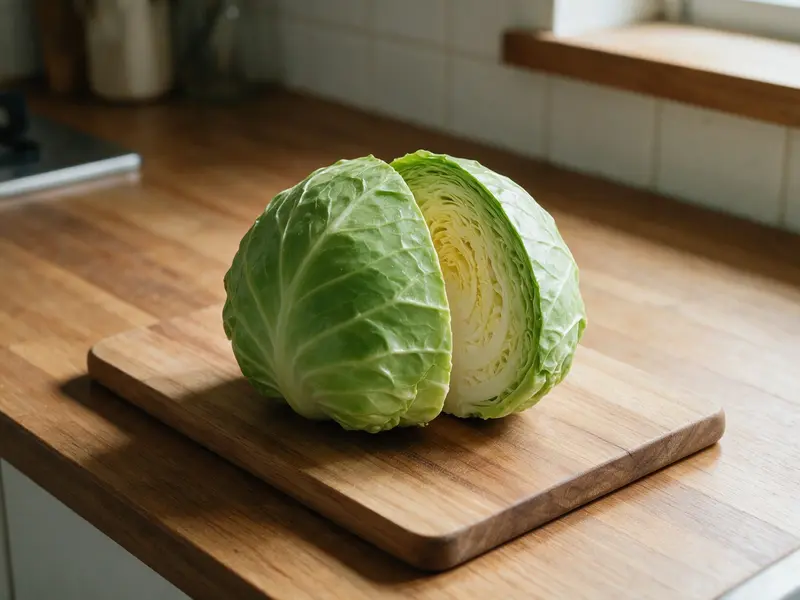
Cabbage
Crisp, pale-green leaves, finely shredded and tossed with coconut, turning sweet, glossy and tender-crunchy in a warm, fragrant pan.
Also called: patta gobhi (Hindi), muttaikose (Tamil)
Texture: Crunchy when freshly stir-fried, going limp if left in the hot pan or reheated.
Getting it ready
Cook it briefly in a little fast-boiling water, uncovered at first; long cooking brings out sulphur smells. Stir-fried cabbage loses its crunch if reheated, so cook it shortly before serving.
Cooking with it
- Cook time: 7.59–7.63 minutes Few sources say this.
- Cook time: 3–18 minutes (open_pot)
If something goes wrong
Cabbage or cauliflower smells strongly of sulphur
- Long cooking forms hydrogen sulphide
- Slice thinly and cook briefly, about five minutes or less, in a little boiling water, uncovered at first. to prevent
Cooked cabbage goes limp
- Cabbage left too long in the hot pan Few sources say this.
- Toss cabbage salad in the tadka only 10–15 seconds and move it to a bowl as soon as it starts to wilt. to prevent Few sources say this.
- Left standing and reheated Few sources say this.
- Cook stir-fried cabbage close to serving time. to prevent Few sources say this.
- Cabbage releases juices as it cooks Few sources say this.
- Cook it with moong dal, which soaks up the juices and adds body. to prevent Few sources say this.
Keeping
Chopped cabbage can be frozen without noticeable taste change.
Goes well with
Used to finish
- uttapam, shredded
Used in
Chapati upma, Cabbage with moong dal, Moong sprouts salad, Gundruk, Labra, Thoran, Palya, Besan chilla, Mixed vegetable soup, Besan chilla batter, Dhuska, Ragi momos, Oying, Chhum han, Galho, Jowar vegetable roti, Jowar cabbage muthia, Adai, Akki roti, Carrot poriyal, Idli, Roti, Sarson da saag, Sweet corn soup, Thalipeeth, Veg cutlet, Vegetable kurma
Seasons
Winter (Nov–Feb), availability; Winter (Nov–Mar), harvest
Festivals
Onam (Kerala)
Take care
Rinse it well and discard the outer leaves to cut pesticide residues.
Seasonal food wheel
- On the tongue: Cool
- After the meal: Light
- Warmth: cooling
- Texture: coarse
- Best seasons: summer, autumn
Questions answered
- How do I keep cabbage poriyal from turning mushy?
- Can red cabbage be used instead of green cabbage?
- Which cooking methods best preserve the texture and flavour of cabbage?
- Should cabbage be peeled, salted, soaked or cut in a particular way before cooking?
- Why does cabbage sometimes become watery, discoloured, bitter or mushy during cooking?
- Which spices, souring agents and other ingredients pair well with cabbage, and when should they be added?
Useful tips
- Cook cabbage and cauliflower briefly to avoid sulphur smell. Long cooking makes cabbage, cauliflower and mustard greens smell of sulphur; cook them briefly in a little fast-boiling water, uncovered at first. Few sources say this.
- Do not overcook cabbage and cauliflower. Cabbage-family vegetables get worse with long cooking: going from five to seven minutes roughly doubles the rotten-egg sulphur gas cabbage gives off. Few sources say this.
- Cabbage with moong dal. Cook shredded cabbage with raw, rinsed moong dal and salt, covered, 2 to 3 minutes on medium-high and then medium-low until the dal is tender; no soaking needed. Few sources say this.
- Cook stir-fried cabbage close to serving. Stir-fried cabbage loses its crunch if it waits and is reheated, so cook it shortly before serving. Few sources say this.
- Palakkad-style cabbage thoran. In a Palakkad method, raw cabbage is mixed with salt, turmeric, coconut, curry leaves, shallots, ginger and chilli, then left 10 minutes before it is cooked. Few sources say this.
- Shredding cabbage for thoran. Cabbage for thoran can be sliced into fine, long shreds on a slicer rather than chopped. Few sources say this.
- Add the coconut mix to cabbage thoran last. Stir the ground coconut mixture into cabbage thoran only once the cabbage is fully cooked.
- Pre-boil cabbage for palya. For cabbage palya, boil the shreds 5-7 minutes until they just turn translucent, then drain thoroughly before frying, so it does not go soggy. Few sources say this.
- Minimal cabbage palya. Cabbage palya needs only cabbage, salt and a few chillies; onion, turmeric and coconut are optional, and curry leaves can be picked out before serving. Few sources say this.
- Sorghum cabbage muthia rolls. Steam sorghum cabbage rolls 10-12 minutes until firm, cool, slice and lightly brown the slices over low heat.
- Cabbage and cauliflower grow strong-smelling when overcooked. Cabbage, cauliflower and turnip taste mild raw but release sulphur compounds and hydrogen sulphide with long cooking, so cook them only until just done. Few sources say this.
- Chop and freeze sturdy vegetables. Beans, cabbage, cauliflower and okra can be chopped and frozen without noticeable taste change, which stops them rotting before use. Few sources say this.
- Sauerkraut timing depends on room temperature. Cabbage lacto-ferments in about 3-4 weeks at 21-24 °C and 5-6 weeks at 16-18 °C; keep it at or below 24 °C.
- Kerala cabbage salad uses coconut oil. Kerala cabbage salad is flavoured with coconut oil; if you use peanut oil, add a spoon or two of grated coconut for that flavour. Few sources say this.
- Cabbage leaves stand in for lettuce in India. Because lettuce has long been hard to find in India, cabbage leaves are often used in its place. Few sources say this.
- Vegetables for thoran. Thoran works with cabbage, beans, beetroot, carrot, ash gourd, spinach, drumstick, bitter gourd, long beans, breadfruit, young jackfruit, banana stem or flower, raw papaya or green moong.
- Vegetables in chilla batter. Grated or chopped vegetables such as cabbage, beetroot or greens can be mixed into besan chilla batter.
- Mixed vegetable soup basics. Cut the vegetables into small pieces for quick cooking; most vegetables suit the soup, including cabbage, mushrooms and capsicum sautéed with the onion.
- Building flavour in veg cutlets. Sauté onion and tomato before mixing them into cutlets for more flavour; cauliflower or cabbage can join the other vegetables.
- Use enough salt in vegetable ferments. Use about 3 tablespoons of canning or pickling salt for each 5 lb of shredded cabbage.
- Remove pesticide residues from produce. Rinse and scrub fruit and vegetables well, peel where suitable and discard the outer leaves of cabbage to cut pesticide residues.
- Cutting creates onion, garlic and mustard pungency. Cutting or crushing onion, garlic, cabbage or mustard sets off enzymes that turn odourless precursors into the pungent, eye-stinging compounds. Few sources say this.
- Regional South Indian cabbage stir-fries. Tamil cabbage poriyal adds urad dal to the tempering, Kerala thoran adds dry-ground coconut with cumin, and an Andhra style adds chana dal soaked an hour.
- Udupi-style cabbage palya. Udupi cabbage palya simmers in a dry-ground paste of a little coconut, a byadgi chilli and powdered jaggery. Few sources say this.
- Hinkeju. Hinkeju is cabbage leaves, colocasia, mustard leaves and French beans boiled together with salt and chilli.