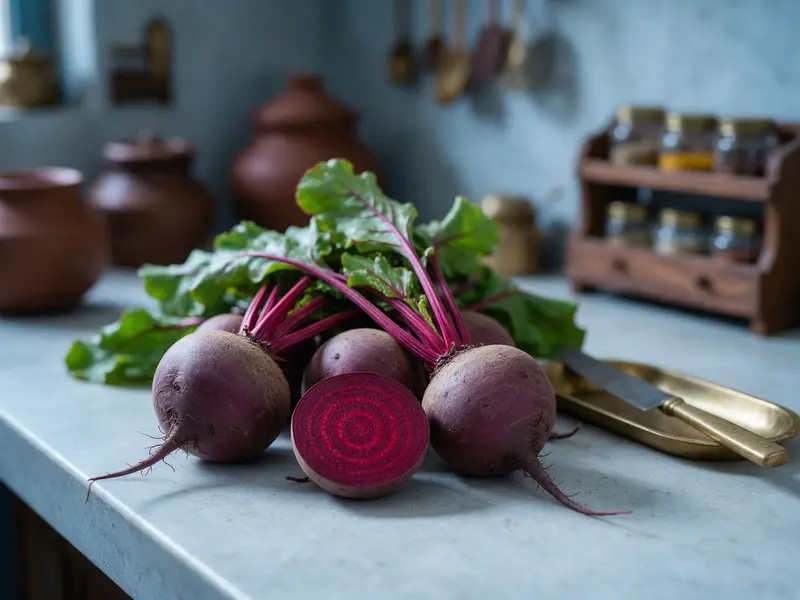
Beetroot
Deep garnet roots with an earthy sweetness, boiled whole until velvety, bleeding jewel-bright crimson into salads, chillas and cooling raitas.
Also called: chukandar (Hindi)
Taste: Earthy and sweet.
Texture: Smooth when cooked and blended.
Getting it ready
Boil it whole in its skin, since its red pigment bleeds out of cut pieces. A little lemon juice or vinegar intensifies the red, while soda turns it blue-green.
Cooking with it
- Cook time: 8–10 minutes (open_pot) Few sources say this.
Keeping
A raw beetroot salad with peanuts keeps about two days in the fridge.
Goes well with
Used to finish
- set dosa, grated
Used in
Kanji, Moong dal chilla, Beetroot raita, Gulab sharbat, Beetroot poriyal, Khatkhate, Vegetable sandwich, Veg cutlet, Tomato soup, Pav bhaji, Mixed vegetable pickle, Rail palaram, Sev puri, Thoran
Seasons
Winter (Dec–Feb), availability; Winter (Nov–Feb), availability; Winter (Nov–Feb), eaten
Tradition
Beetroot is often served in homes to add colour and earthiness to meals, and its juice is a common home drink.
Nutrition
Contains folate and fibre. Can turn urine pink or red, which is harmless. Demo note.
Questions answered
Useful tips
- Cook beetroot whole to keep its red. Boil beetroot whole, because its red anthocyanin pigment dissolves in water and bleeds out of cut pieces. Few sources say this.
- Prevent beetroot stains. Beetroot stains, so use an old chopping board and knife and wear an apron when grating it. Few sources say this.
- Preparing beetroot for raita. Beetroot for raita can be grated raw, sautéed grated for about 5 minutes then simmered covered 10–12 minutes, or pressure-cooked whole (3–4 whistles) or boiled in pieces (7–8 minutes).
- Grate beetroot for faster cooking. Grated beetroot cooks more quickly than chopped pieces.
- Water in beetroot poriyal. A splash of water helps the beetroot give up its own juices; once it is soft, cook off any leftover liquid with the lid off.
- Pressure cooking beetroot for poriyal. Beetroot for poriyal can be pressure cooked: one source gives one whistle on medium, another three whistles before adding it after the tempering.
- Beetroot for colour. A little beetroot gives veg cutlets or tomato soup a brighter colour and mild sweetness.
- Quick ways to cook potato and beetroot for sandwiches. Pressure cook potatoes and beetroot for 2-3 whistles on medium, or prick the potatoes and microwave them 4-5 minutes. Few sources say this.
- Colouring tomato soup with carrot or beetroot. Carrot or beetroot is often cooked with tomato soup for colour; remove it before blending, or leave it out to keep pure tomato colour and taste. Few sources say this.
- Beetroot colour depends on acidity. Beetroot pigment is red between about pH 4 and 7, turns violet when more acidic and yellow when strongly alkaline.
- How long beetroot poriyal keeps. Beetroot poriyal keeps for two days in the fridge. Few sources say this.
Another view: Some keep it 4–5 days refrigerated in an airtight box.
- Beetroot as a natural colour. Beet colour (betanin) is stable between about pH 3.5 and 7 and holds up to light, but fades with heat and oxidation, so it does not suit high-heat baking.
- Chillah: hot pan and swaps. Heat the pan well before the chillah batter goes in or it sticks; cast iron needs a long preheat. Grated carrot can replace beetroot. Few sources say this.
- Skip turmeric to show another colour. Leave turmeric out when you want another colour, such as beetroot red, to show, because it tints the whole dish yellow. Few sources say this.
- Kosambari and sundal methods adapt to other ingredients. The kosambari method works for carrot, radish or beetroot, and the sundal method for chickpeas, black chana, horse gram and cashews.
- Vegetables for mustard kanji. Carrot and beetroot go into mustard kanji, as in kanji ki gajar; one source also uses turnip or potato.
- Natural colours for tutti frutti. Tutti frutti's artificial colours add no taste, so leave them out for white tutti frutti or use saffron, turmeric or beetroot juice instead.
- Adjusting sol kadhi's colour. Extra kokum juice makes kadhi pinker and thinner, and adding two or so tablespoons of beetroot juice gives a deeper pink without extra sourness. Few sources say this.
- Vegetables for thoran. Thoran works with cabbage, beans, beetroot, carrot, ash gourd, spinach, drumstick, bitter gourd, long beans, breadfruit, young jackfruit, banana stem or flower, raw papaya or green moong.
- Vegetables in chilla batter. Grated or chopped vegetables such as cabbage, beetroot or greens can be mixed into besan chilla batter.
- Colour in tandoori masala. Kashmiri red chillies give tandoori masala a better colour; dry beetroot powder or red food colour deepens it further.
- Coloured rail palaram. For colourful rail palaram, knead spinach or beetroot into the flour. Few sources say this.
- How acid and alkali change vegetable colours. Green chlorophyll dulls to olive with long cooking or acid; red beetroot pigments leach into water but stay bright in acid; carrot and tomato orange barely changes. Few sources say this.
- Acid brightens red pigments; alkali turns them blue-green. Lemon juice or vinegar intensifies the red of beetroot and similar foods, while an alkaline medium such as soda turns their anthocyanins blue-green.
- Raw salads keep a couple of days in the fridge. Raw salads such as soaked moong dal with mango, or raw beetroot with peanuts, keep about two days in the fridge. Few sources say this.
- What goes into a Bombay vegetable sandwich. The Bombay vegetable sandwich is built on white bread, as Mumbai vendors use, with boiled potato regarded as essential and beetroot for sweetness.
- Boil roots and tubers whole in their skins. Boil potatoes and other tubers such as colocasia whole in their skins, peeling them only after cooking.
- Why synthetic colours are more stable than natural. Synthetic colours such as tartrazine and Ponceau 4R hold up to heat and pH, while natural colours fade sooner with heat, light, oxygen, metals or pH changes.