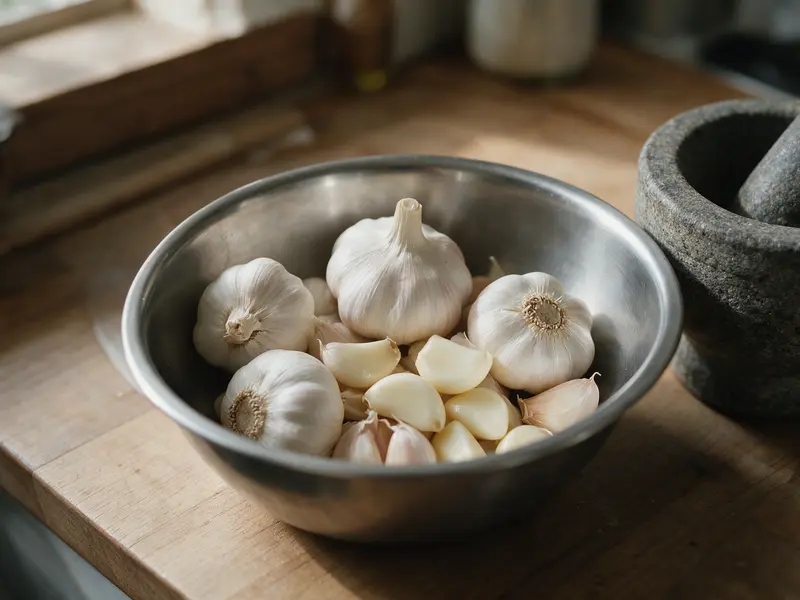
Garlic
Plump ivory cloves that sizzle to pale gold in hot ghee, releasing a deep, warm, sweetly pungent aroma through every dish.
Also called: belluli (Kannada), lahsun (Hindi), poondu (Tamil), rosun (Bengali), vellulli (Telugu)
Taste: Sharp and pungent when raw, turning mild as it cooks. Few sources say this.
Texture: Whole cloves boiled until soft turn mellow and sweet; cooked gently in hot oil they soften without colouring.
Getting it ready
Soak cloves in cold water for half an hour so the skins slip off. In a tempering, fry garlic 20 to 30 seconds until light golden, and ginger-garlic paste one to three minutes until pale blonde; burnt garlic turns bitter.
Cooking with it
- Cook time: 20 minutes (open_pot) Few sources say this.
Swaps
- roasted cumin powder: Forum advice Few sources say this.
- asafoetida
- dried fenugreek leaves Few sources say this.
- ginger: Ginger can be used in a tempering when garlic is left out to fill the aromatic gap, though it will not reproduce garlic's flavour.
Keeping
Keep whole bulbs in an open mesh basket in a dry, airy, dark spot, not in plastic bags. Refrigerated, it keeps about 15 days.
- In the fridge: 15 days Few sources say this.
Goes well with
Ginger, Cumin seeds, Black pepper, Ghee, Green chilli, Mustard oil
Used to finish
- butter naan, sliced, pressed on
Used in
Varan, Dal tadka, Moong dal soup, Tomato pappu, Arhar dal, Dal and rice, Methi thepla, Pesarattu, Panta bhat, Ginger garlic paste, Onion tomato masala, Green chutney, White gravy (mughlai), Makhani gravy, Kadhi pakora, Avakaya, Aam kasundi, Sarson da saag, Onion curry paste, Shalgam gobhi achaar, Mulligatawny, Dahi ka soop, Saag paneer, Kadai paneer, Sabut urad dal, Aloo tamatar, Amrood ki chutney, Batata vada, Bengali khichuri, Bhakarwadi, Bread pakora, Carrot poriyal, Chana palak, Dalma, Kadala curry, Kaddu ki sabzi, Khichdi, Lauki chana dal, Lobia masala, Mango pickle Few sources say this., Matki usal, Methi dal, Mix veg, Mushroom matar, Palya, Panchmel dal, Pav bhaji, Rajma masala, Shahi paneer, Tomato chutney, Undhiyu, Vegetable kurma
Seasons
Monsoon (Sep–Sep), harvest; Winter (Nov–Feb), availability
Regions
South India, Rajasthan, Kashmir, Assam, Gujarat, Tamil Nadu, Madhya Pradesh, Manipur
Tradition
Garlic fried in ghee or oil is a familiar finish for dal in many North Indian homes.
Nutrition
Used in small amounts, so its nutritional contribution is minor. Demo note.
Questions answered
Useful tips
- Fry garlic in the tadka until light golden. Fry garlic in the tempering for 20 to 30 seconds, until it is light golden or lightly browned, before adding onion or pouring.
- In Tamil kootu talippu, fry garlic without browning. For kootu, fry the garlic in the talippu but do not let it brown before the turmeric goes in. Few sources say this.
- Sai bhaji gets a final garlic-ginger tadka. For sai bhaji's second tadka after pressure cooking, fry chopped garlic (some add ginger) in hot oil until it turns golden.
- Saute ginger-garlic paste until the raw smell goes. Fry ginger-garlic paste for one to three minutes, until its raw smell has gone and it turns pale blonde.
- Pour garlic fried in ghee over saaru at the end. For hesaru bele saaru, fry chopped garlic in ghee for about a minute and pour it over at the very end. Few sources say this.
- Crush garlic for more flavour in tadka. In a tadka, crushed garlic usually gives a stronger flavour than finely chopped garlic. Few sources say this.
- Substitute ginger-garlic paste in the base. Half a cup of ginger-garlic paste can replace the fresh ginger and garlic in a batch of base sauce. Few sources say this.
- Prepare ginger and garlic for paste. Wash and fully dry ginger before grinding (tender thin-skinned ginger need not be peeled); soak garlic in cold water for half an hour so the skins slip off.
- Black chickpeas can replace garlic in avakaya. Garlic-free avakaya sometimes swaps the garlic for black chickpeas (kala chana). Few sources say this.
- Use fresh spices and garlic for pickles. Use fresh spices for pickling; mouldy garlic or old spices can make pickles soft. Few sources say this.
- Garlic pickle: even pieces cooked soft in mustard oil. For garlic pickle cut very large cloves lengthways to match the rest, then cook with green chillies in smoking-hot mustard oil on low 5–7 minutes until soft but not coloured. Few sources say this.
- Dry-roasting fresh garlic, ginger and chilli for dry blends. Fresh garlic, ginger and green chilli for a dry blend are dry-roasted over low heat until most moisture has gone and they turn golden, 7 to 10 minutes. Few sources say this.
- Substitute for green garlic. If green garlic is unavailable, use 3 to 5 cloves of ordinary garlic with the greens of about 4 scallions. Few sources say this.
- Garlic can turn vinegar blue. Garlic steeped in vinegar sometimes turns the vinegar teal blue. Few sources say this.
- Companion planting for fennel, garlic and mint. Fennel is usually grown on its own; garlic is often planted near tomatoes and roses but not beans or peas, and mint near cabbage and tomatoes but not parsley. Few sources say this.
- Plant garlic in autumn, lift it in summer. Plant single garlic cloves point up in autumn and harvest the next summer once the leaves yellow.
- Snap off garlic scapes. Snap off curling garlic scapes before they flower to get bigger bulbs, and chop the scapes into stews or salads. Few sources say this.
- Let chopped garlic stand before cooking. Chop garlic and let it stand 10–15 minutes before eating it or adding it to a dish, to get the most from it. Few sources say this.
- Pounded garlic emulsion. For a garlic emulsion, crush 3–4 garlic cloves in a mortar, then pound while trickling in oil in a thin stream with salt and lemon juice; longer pounding usually emulsifies better. Few sources say this.
- Ginger-garlic herbal vinegar. Cover grated ginger, garlic and other pungent roots with cider vinegar in a sealed jar, steep 3 to 4 weeks, then strain and sweeten with honey. Few sources say this.
- Pickled garlic and garlic oil. Garlic can be pickled in tamari and vinegar or used to flavour an oil. Few sources say this.
- Garlic for a finishing tadka on low heat. For some finishing tadkas, sliced garlic is cooked on low heat so it softens without browning. Few sources say this.
- Raw versus cooked garlic in chutney. Raw garlic gives chutney a sharp pungency; cooking it with tomatoes, roasting or charring it gives a mellower or smoky taste, and lemon softens raw garlic's bite.
- Use fresh garlic for garlic chutney. Use fresh garlic for lehsun ki chutney; old garlic can make the chutney bitter.
- Lemon and chilli powder in garlic chutney. Red chilli powder gives garlic chutney its bright red colour and zing, and a squeeze of lemon at the end adds tang and balances the heat.
- Roasting for tomato-garlic chutney. Roast tomatoes, garlic and chillies on medium heat so they soften inside, not just char; a lightly oiled tawa works, and peel burnt skins once cool.
- Kartik (habisa) dalma: no onion or garlic, ghee instead of oil. During Kartik, Odia dalma is made with ghee rather than oil and without onion or garlic, often seasoned just with cumin and ginger.
- Hing in place of garlic. Fried in fat, hing tastes garlicky and oniony; roughly half a teaspoon replaces 2 tbsp of crushed garlic, added early, just after the other spices.
Another view: Some say hing is not a stand-in for onion or garlic and is used only in pinches, about a pinch for two servings. Some say hing is not a stand-in for onion or garlic and only a pinch should be used; others give quantities for using it in place of garlic.
- Keeping garlic from burning. Turn the heat down before garlic goes in, pour in some liquid within a minute, or cut bigger pieces; garlic smells sweet just before burning and turns harsh after. Few sources say this.
- Resting garlic pickle before storing. Leave the mixed garlic pickle covered in a dry spot, well away from kitchen steam, for 24-28 hours until it releases its juices. Few sources say this.
- Making garlic pickle with less oil. For a less oily garlic pickle, use half the oil and scale the chilli, mustard and methi powders down by the same proportion. Few sources say this.
- Ginger is not a garlic substitute. Because ginger and garlic taste quite different, ginger is not usually a straight swap for garlic. Few sources say this.
- Dark-roasted onion paste in place of garlic. When garlic is left out, onions cooked until deeply browned and reduced to a thick paste can help fill the gap. Few sources say this.
- Hing in place of onion and garlic. Asafoetida is often used instead of onion and garlic, giving a savoury, allium-like note where they are avoided.
- Garlic in the cabbage palya tempering. Fry the garlic along with hing, chillies and curry leaves and stop as soon as it starts turning golden. Few sources say this.
- Garlic readiness in the second tadka. In the finishing tadka, the garlic is ready when it just begins to change colour.
- Ginger-garlic paste for chopped. Ginger-garlic paste can replace chopped ginger and garlic, about a teaspoon; for better flavour, pound fresh ginger, garlic and chilli instead of using bottled paste.
- Garlic is optional in methi dal. Garlic can be left out of methi dal. Few sources say this.
- Ginger and garlic for dalma tempering. Pound the ginger and garlic coarsely, not to a paste, for the dalma tempering.
- Traditional rasam may skip garlic. Some households make traditional rasam without garlic.
- Green garlic paste is safe. Garlic paste that turns green but still smells of garlic is safe to eat.
- Raw garlic in oil carries a botulism concern. Raw garlic held in oil carries a risk of botulism.
- Refrigerate homemade garlic or herb oils. Refrigerate all homemade garlic, chilli or herb oils; only commercially acidified products or tested acidification recipes followed exactly can stay at room temperature.
Another view: A curry powder that starts by frying chillies and fresh garlic in oil keeps only about a week at room temperature, or about a year in the fridge. Once opened, garlic pickle keeps up to 3 months in the fridge.
- Onions and garlic turn mild when cooked. Onion and garlic owe their sharp bite to sulphur compounds; cooking breaks these down, so pungent raw onions become mild. Few sources say this.
- Cutting creates onion, garlic and mustard pungency. Cutting or crushing onion, garlic, cabbage or mustard sets off enzymes that turn odourless precursors into the pungent, eye-stinging compounds. Few sources say this.
- Rajasthani cooking without onion and garlic. Much Rajasthani home cooking leaves out onion and garlic and relies on generous ginger and green chilli instead. Few sources say this.
- 'Lussan' and 'lahsoon' are garlic. Garlic is lussan or lahsoon. Few sources say this.
- Curing garlic for storage. To cure garlic, spread or hang it out of direct sun with good airflow until the tops turn brown; hard-neck types generally keep longer. Few sources say this.
- Fry garlic gently for chutney. Fry garlic for chutney gently on low heat, about 5–6 minutes, until it smells roasted but before it colours deeply.
- No onion, garlic or green chilli in the naivedyam. Varalakshmi naivedyam is usually made without onion, garlic or green chilli, with peppercorns providing the heat. Few sources say this.
- Pepper, ginger, ajwain, hing and garlic are used more freely in winter. North Indian households traditionally use black pepper, ginger, ajwain, hing and plenty of garlic more freely in their winter cooking. Few sources say this.
- Why garlic burns faster than onion. Garlic carries less water and more natural sugar (long fructose chains) than onion, so it dries out and browns almost instantly, and minced garlic heats in seconds.
- Chill garlic pickle early if you skip sun-curing. If garlic pickle is not set out in the sun, move it to the fridge once it has stood for its first day. Few sources say this.
- Why some homes and temples cook without onion and garlic. Many Hindu households, and Vaishnava homes and temple kitchens in particular, avoid onion, garlic and related plants, holding that such foods are unfit to offer to the deity.
- Garlic colour in a tadka. Garlic in a tadka should turn pale gold; if it browns the moment it hits the oil, the oil is too hot. Few sources say this.
- Yogurt gravy without onion or garlic. A yogurt gravy can be made without onion or garlic.
- Storing red chilli garlic chutney. Red chilli garlic chutney keeps about a week in the fridge. Few sources say this.
- Braj cooking without onion or garlic. In the Braj region around Mathura, food is traditionally cooked without onion or garlic.
- Sources of bitterness. Bitterness can come from bitter vegetables or spices, burnt garlic or spices, over-browning, some oils or concentrated plant compounds; mild cases can be balanced.
- Season lightly before freezing. Season dishes lightly before freezing and adjust at serving, since curry spices can turn musty and garlic or cloves can grow harsh.