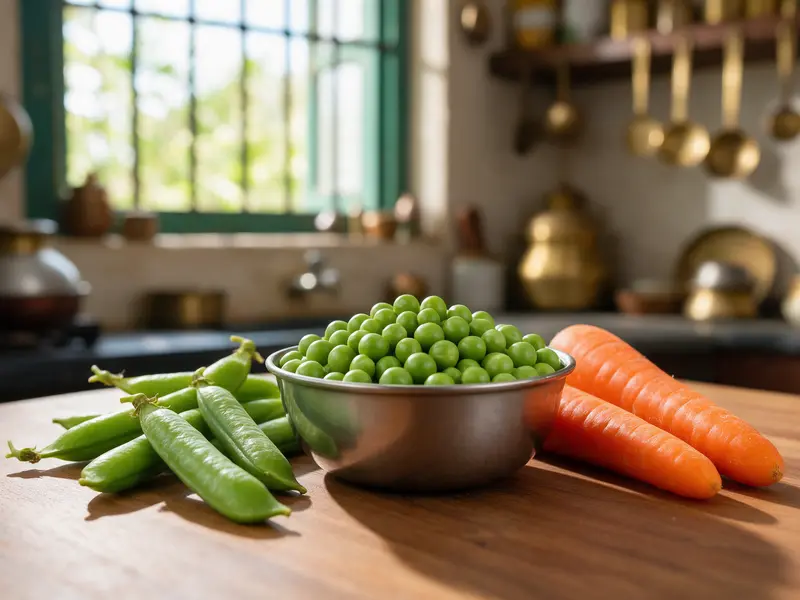
Green peas
Plump, emerald green peas, tender and sweet, bursting softly in rich, spiced gravies alongside potatoes and creamy paneer.
Also called: matar (Hindi), pattani (Tamil)
Taste: Sweet; fresh peas taste brighter, while frozen ones make curries noticeably sweeter. Few sources say this.
Texture: Freshly shelled peas are firmer than frozen ones.
Getting it ready
Peas cook in about 1 to 1.5 minutes; cook frozen ones straight from frozen. Soak dried peas about 3 hours before cooking, or pressure-cook them.
- Few sources say this.
Cooking with it
- Cook time: 1–1½ minutes
- Cook time: 1 minutes (electric_pressure_cooker) Few sources say this.
- Cook time: 33½ minutes (open_pot) Few sources say this.
- Pressure cook whistles: 2–3 whistles (pressure_cooker) Few sources say this.
Swaps
- sweet corn: pulao add-ins Few sources say this.
Keeping
Peas keep better in the pod than shelled, and they lose sweetness as their sugar turns to starch, so buy only what you will use soon.
- Frozen: 30 days Few sources say this.
Another view: Some storage charts give 8–12 months frozen for peas. Some keep home-frozen peas 6–8 months. Some keep home-frozen vegetables, peas included, 10 months.
Goes well with
Used in
Matar paneer, Shukto, Samosa dough, Khichdi base (rice-moong), Samosa, Kothimbir vadi, Aloo tikki, Lau ghonto, Shalgam ki sabzi, Gajar matar, Santula, Khatkhate, Vegetable biryani, Vegetable pulao, Undhiyu, Vegetable kurma, Semiya upma, Masala dosa, Idiyappam, Veg cutlet, Hara bhara kabab, Aloo matar, Dum aloo, Aloo tamatar, Mix veg, Ghugni, Pani puri
Seasons
Winter (Dec–Feb), availability; Winter (Oct–Feb), availability; Winter (Nov–Feb), availability
Tradition
Peas are usually left out of Navratri fasting food.
Nutrition
Vegetables that add fibre and colour. Demo note.
Useful tips
- Substitutes for fresh pigeon peas in undhiyu. If there are no fresh pigeon peas for undhiyu, swap in green peas, edamame or fresh green chickpeas, or simply skip them. Few sources say this.
- Black cardamom and mace are optional in pulao. Black cardamom and mace can be left out of matar pulao; it loses some smoky depth but still works. Few sources say this.
- Pani puri fillings. Pani puri can be filled with potato, ragda, whole moong, kala chana or green peas.
- Peas for ghugni. Ghugni is classically cooked from dried white peas, as in Bengal; kala chana, lobia or green peas make workable swaps.
- Natural glutamate in tomato, peas and mushroom. Glutamate, the savoury compound sold as MSG, occurs naturally at about 250 mg per 100 g in ripe tomatoes, 200 mg in green peas and 180 mg in mushrooms.
- Cooking times for baby vegetable mashes. For baby mash, sweet potato with spinach takes about 3 pressure-cooker whistles; potato and peas need around 15 minutes steamed or pressure cooked. Few sources say this.
- Foods suited to the pressure cooker. Rice, dal, potatoes and other roots and tubers, beans, peas and some gourds are well suited to pressure cooking. Few sources say this.
- Cook frozen vegetables straight from frozen. Frozen vegetables are best cooked straight from frozen, without thawing. Few sources say this.
- Fresh versus frozen peas. Freshly shelled peas have a firmer texture and brighter flavour than frozen ones. Few sources say this.
- Simmering paneer in gravy until soft. Stir paneer gently into the gravy and simmer covered on low, about 10 minutes, until soft and the sauce thickens, without breaking the pieces. Few sources say this.
- Stretch a finished dish for extra guests. To feed unexpected guests, quickly cook frozen peas, chopped vegetables, potatoes or rice, even in a microwave, and fold them into the dish already made. Few sources say this.
- Whole dried peas: soak and cook. One cookbook soaks whole dried peas overnight; soaked dried yellow peas then need about 1 minute at full pressure plus natural release, or about 30 minutes more boiling if still hard. Few sources say this.
- Fresh peas for pea and potato curry. Frozen peas make a pea and potato curry noticeably sweet, so shell fresh peas for an authentic taste; about 1.5 lb of pods gives 1.5 cups. Few sources say this.
- Curried pea soup can double as kofta sauce. A curried pea soup works as a kofta curry sauce: use less water or cook it longer uncovered so it reduces. Few sources say this.
- Raw crushed peas keep tikki stuffing green. Use raw, coarsely crushed peas in aloo tikki stuffing; cooking them first dulls the colour. Few sources say this.
- Variations for shalgam gobhi achaar. Seasonal sem, string beans or peas can join the turnip and cauliflower, and freshly ground garam masala gives better flavour. Few sources say this.
- Vegetables to add to tinda sabzi. Tinda sabzi can be bulked out with carrot, tomato, potato or peas. Few sources say this.
- Peas in shalgam ki sabzi. Cooked peas can be combined with the mashed turnip.
- Using frozen peas. Frozen peas can stand in for fresh; soak them in warm water for about 10 minutes before cooking.
- Vegetables to add to pulao beyond peas and carrots. Besides peas and carrots, a pulao can take vegetables such as broccoli, mushrooms or baby corn.
- Vegetables for kurma. Kurma takes any mix of vegetables, such as potato, carrot, beans, peas and cauliflower.
- Stuffed baati. Baati balls can be filled with a green pea or dry-fruit stuffing before cooking.
- Fresh or frozen peas. Fresh peas give the best flavour and bite, but frozen peas work well, and soaked and boiled dried peas are another option.
- When to add peas. Frozen or tender peas go in towards the end so they stay sweet with some bite; firm fresh peas need to go in early or be boiled separately first.
- Preparing frozen peas. Frozen peas need no thawing: rinse and add them, or soak them about 10 minutes in warm water and drain first.
- Keep boiled peas green. If fresh peas are not tender, boil them 4-5 minutes with a little salt and sugar before adding them, which keeps their colour. Few sources say this.
- Vegetables for tahari. Potato is essential in tahari; cauliflower and peas are common, and carrot, beans or tomatoes for tang also work.
- Sauté mushrooms before simmering. Sauté the mushrooms (and peas) with the spices for a few minutes before adding liquid for fuller flavour.
- Peas in pulao. For peas pulao, the rice and peas can be cooked separately and then combined.
- Adding vegetables to upma. Carrot, beans, peas or potato add colour to upma; boil harder vegetables first and add them when the rava is half cooked.
- A hara bhara kabab mixture that holds its shape. Squeeze the spinach well, cook the greens until dry, cool them and the potatoes before mixing, and mash coarsely rather than to a paste.
- Variations on aloo tamatar. Boiled peas can go in with the potatoes, and for an everyday version add ginger-garlic paste after the cumin and chopped onion, before the tomatoes.
- Vangi bath variations. Capsicum, potatoes or peas can join the brinjal in vangi bath, capsicum can even replace it, and ghee can stand in for oil.
- Bread pakora filling variations. Leftover batata vada filling suits bread pakora, the peas in its potato stuffing are optional, and a plain version just sandwiches spicy and garlic chutneys. Few sources say this.
- Vegetables in green-pea dhuska. Green-pea dhuska can take extra carrot, capsicum or onion. Few sources say this.
- Keep bajra grains separate in ghooghri. Cook the bajra for ghooghri so the grains stay separate; if it goes mushy, it is better used for khichdi. Few sources say this.
- Peas and corn lose sweetness in storage. Peas keep better in the pod than shelled, and both peas and corn lose sweetness as their sugar turns to starch, so buy only what you will use soon. Few sources say this.
- Why green vegetables turn olive. Heat and acid knock magnesium out of chlorophyll, turning greens olive or grey-green for good; tamarind, lemon or tomato cooked with them speeds it. Few sources say this.
- Mumbai vegetable pulao from cooked rice. A quick vegetable pulao from cooked rice is a Mumbai street dish, often served with potato curry, green chutney and raita. Few sources say this.
- Winter greens and vegetables shape North Indian home cooking. Traditionally, North Indian winter kitchens cook mustard greens, bathua, spinach, fresh methi, coloured carrots, peas, green chickpeas, cauliflower and potatoes while the season lasts.
- Tehri. Tehri is yellow rice cooked with mixed vegetables such as cauliflower, carrot, peas and potato; the Allahabad version is a vegetable khichadi.
- Vegetables in millet pongal. You can add carrot, peas, beans or spinach to millet pongal. Few sources say this.
- Peas in Navratri food. Peas are usually left out of Navratri fasting food; carrot can be used instead. Few sources say this.