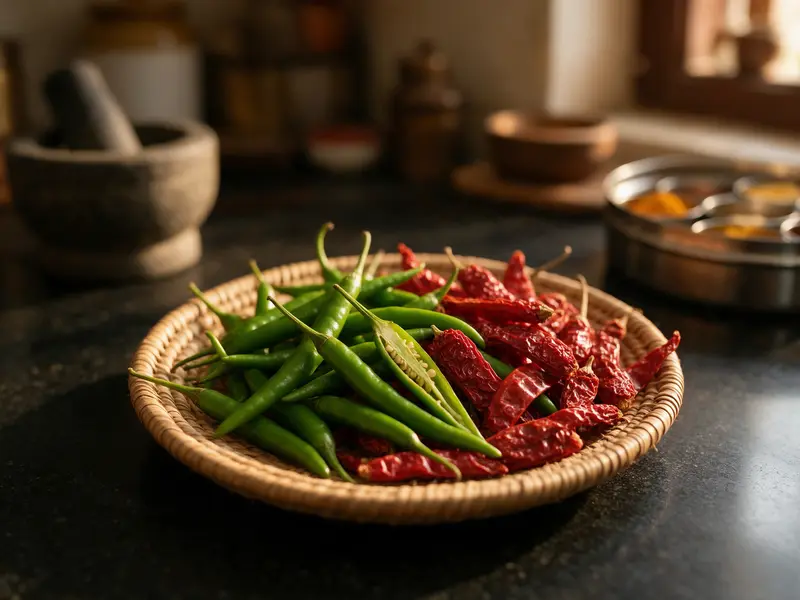
Green chilli
Glossy, slender green chillies, slit and sizzled in hot oil, bringing a fresh, grassy fire and bright snap to every bite.
Also called: hari mirch (Hindi), kancha lonka (Bengali), pachai milagai (Tamil), pachi mirchi (Telugu)
Taste: Fresh and hot; as a rule, the smaller the chilli, the hotter. Few sources say this.
Getting it ready
Scraping out the pale ribs and seeds lowers the heat but keeps the flavour. Add chilli to individual portions so a milder version can be served to children; dairy and fat calm the burn better than water.
Swaps
- dried red chilli: pottukadalai chutney Few sources say this.
- capsicum: milder version Few sources say this.
If something goes wrong
Whole green chillies awkward to eat in dal
- Chillies left whole
- Chop them before cooking or remove at the table; use fewer if heat-sensitive. to prevent Few sources say this.
Green chillies rot in the fridge
- Water left on the chillies
- Dry them completely before putting them in a jar. to prevent
- Stalks removed before washing Few sources say this.
Another view: Some remove the stems before washing.
- Wash first and remove the stalks only afterwards. to prevent Few sources say this.
Another view: Cooks differ on whether stems are removed before or after washing.
- Wash first and remove the stalks only afterwards. to prevent Few sources say this.
Goes well with
Ginger, Garlic, Nigella seeds, Mustard oil, Coriander leaves, Carom seeds
Used to finish
cholar dal, slit, dhansak, slit lengthways, panta bhat, finely chopped, pazhaya sadam, chopped, qubooli, slit and deep-fried, dal and rice, chopped, chotpoti, chopped, pesarattu, chopped, fried with onions, uttapam, finely chopped, set dosa, chopped, aloo posto, whole or slit, fresh, bharwan baingan, broken into small bits, jeera aloo, slit, lemon onion rings, finely chopped, coconut chutney, whole, moong sprouts salad, chopped, ambali, chopped, kambu koozh, finely chopped, torani, whole or slit, turai chana dal
Used in
Mati mahor dali, Bhaja muger dal, Dal makhani, Panchmel dal, Varan, Khatti meethi dal, Dal tadka, Parippu curry, Tomato pappu, Arhar dal, Dal and rice, Uttapam, Pesarattu, Handvo, Khaman, Ven pongal, Curd rice, Kanda poha, Lemon rice, Pazhaya sadam, Panta bhat, Dal paratha, Green chutney, Onion tomato masala, White gravy (mughlai), Akki roti, Bhutte ka kees, Cucumber pachadi, Methi malai matar, Missi roti, Moong dal chilla Few sources say this., Mor kuzhambu, Paneer butter masala, Raita, Rajma masala, Sundal
Regions
South India, Uttar Pradesh, Gujarat, Goa, Kerala
Festivals
Onam (Kerala)
Tradition
Green chillies are traditionally left out of saaru for new mothers. Many Rajasthani families who skip onion and garlic season generously with ginger and green chilli instead.
Seasons
Fresh chillies tend to be milder in the monsoon.
Take care
Wash your hands after chopping chillies and keep them away from your eyes and face. Prick whole chillies before they go into hot oil so they do not burst.
Seasonal food wheel
- On the tongue: Spiced
- After the meal: Spiced
- Warmth: warming
- Texture: medium
- Best seasons: spring
Questions answered
- Can I use jalapeños instead of Indian green chillies?
- How do I preserve or use up surplus fresh green chillies?
- Why do some cooks add a green chilli or chilli stalk to milk when setting curd?
- Can I chop or grind ginger, garlic and green chillies in bulk, and how long will they keep in the fridge?
- Which chilli powder or green chilli do Indian recipes mean, and can cayenne or Mexican chilli powder substitute?
Useful tips
- Starting curd with a green chilli when you have no starter. With no starter, some cooks drop a whole fresh green chilli with its stem into warm milk to start curd, then use that batch as the next starter.
- Mild green chilli with peanut-sesame-coconut paste. With a peanut-sesame-coconut paste, use a less hot variety of long green chilli.
- No onion, garlic or green chilli in the naivedyam. Varalakshmi naivedyam is usually made without onion, garlic or green chilli, with peppercorns providing the heat. Few sources say this.
- What is in a packaged green chilli sauce. One Indian packaged green chilli sauce lists water and potato first, about 25 % green chilli, then cornflour, acetic acid, xanthan gum and sodium benzoate. Few sources say this.
- No green chilli in saaru for new mothers. Green chillies are left out of saaru meant for new mothers.
- Vinegar green chilli pickle. Salt sliced green chillies about 2 hours, add vinegar and refrigerate at least a day before use; the pickle keeps about a year in the fridge. Few sources say this.
- Savoury vadapappu variation. For a savoury vadapappu, mix grated raw mango, green chilli, coconut, coriander and salt into the soaked dal. Few sources say this.
- Seasoning makki di roti. Ajwain, ginger, green chilli and coriander are used to season makki di roti dough. Few sources say this.
- Dry-roasting fresh garlic, ginger and chilli for dry blends. Fresh garlic, ginger and green chilli for a dry blend are dry-roasted over low heat until most moisture has gone and they turn golden, 7 to 10 minutes. Few sources say this.
- Urad dal makes chilli pickle purée silky. Urad dal boiled into a green chilli pickle purée releases starch that makes it silky smooth, so it should not be left out. Few sources say this.
- Use raw, pounded mustard for raayi ka raita. For raayi ka raita, pound the mustard seed raw with green chilli and a little salt to a coarse paste; do not roast or fry it. Few sources say this.
- Grinding the coconut paste for pachadi and kichadi. Grind the coconut, ginger and green chilli for pachadi with a little of the curd rather than water; the chillies can be ground in instead of cooked whole.
- Preparing and cooking dhekia. Only the very tender stems of dhekia are eaten: trim off hard parts, wash and chop, fry in mustard oil with green chilli and crushed garlic, and cook covered. Few sources say this.
- For a paler getti chutney keep the grind simple. To keep getti chutney white, grind it with a single green chilli as the only addition, then pour the tempering over afterwards. Few sources say this.
- Andhra moong dal through the seasons. In Andhra homes moong dal is the usual summer choice for pappu charu; in winter some households swap chilli powder for green chilli and crushed ginger. Few sources say this.
- Keeping hotel-style coconut chutney white. The chutney's white colour comes from coconut, so keep green chilli to one or two, or skip it and get heat from red chillies in the tempering.
- Quick paneer butter masala gravy without onion. For a fast onion-free gravy, grind raw tomato, green chilli and ginger to a paste and cook it down. Few sources say this.
- Making rajma hotter. For a hotter rajma, fry a chopped green chilli along with the onions or switch to a stronger chilli powder. Few sources say this.
- Balancing methi malai matar. Keep methi malai matar mild, with little green chilli, and balance its sweet, bitter and salty notes; onion gives most of the sweet side.
- Tamatar ka chokha. For tamatar ka chokha, roast and crush tomatoes, then stir in chopped onion, green chilli and a little mustard oil.
- Moong dal chilla batter. For moong dal chilla, grind soaked dal coarse and mix in salt, onion, green chilli and coriander.
- Everyday Bengali dal uses a nigella tempering. Bengali masoor dal is commonly tempered with nigella and green chilli; onion and panch phoron versions are also made.
- Pazhaya sadam is eaten with small onions and chillies. Pazhaya sadam is eaten with onions and green chilli.
- Chilli in the milk to help curd set. Some cooks drop green chilli stalks or a broken dried red chilli into the milk, saying it helps curd set thicker; this rests on anecdote.
- Rajasthani cooking without onion and garlic. Much Rajasthani home cooking leaves out onion and garlic and relies on generous ginger and green chilli instead. Few sources say this.
- Ginger-chilli paste for no-onion, no-garlic cooking. For cooks who avoid onion and garlic, a ginger and green chilli paste is the everyday flavour base; it keeps about 10 days in the fridge or 4 months frozen. Few sources say this.
- Letting diners adjust heat and salt. Placing a green chilli on a thali lets heat be added at the table, and salted vadis add occasional bursts of extra salt. Few sources say this.
- What Bihari sattu is. Bihari sattu is flour ground from roasted chickpeas; it is also kneaded into a dough with salt, green chilli and onion.
- Chooda ka bhunja. Chooda ka bhunja is fried flattened rice with chopped onion and green chilli.
- Keep chilli heat adjustable for children. Adding chilli to individual portions instead of the whole pot allows a mild yet still aromatic version to be served. Few sources say this.
- Remove chilli stalks after washing. Remove the stems from green chillies before storing them.
- Freeze ground herbs, chillies and paste as cubes. Blend coriander, green chillies or ginger-garlic paste coarsely and freeze in ice-cube trays, then drop a cube into dishes as needed.
- Freeze whole chillies without clumping. Freeze green chillies in a single layer in a towel-lined zip bag with the air pressed out, or pre-freeze them on a tray, so they don't clump. Few sources say this.
- Frozen chillies need no thawing. Frozen green chillies can go straight into curries and dals without thawing. Few sources say this.
- Speed up panta bhat fermentation. Drop a piece of tamarind or a few green chillies into the soaking water to hurry the panta bhat fermentation. Few sources say this.
- Fry chillies first, then reuse the oil. For mirchi ka salan, fry the green chillies first.
- Remove chilli ribs and seeds to cut heat. Most capsaicin sits in the pale ribs and where seeds attach, so scraping these out lowers a chilli's heat while keeping its flavour.
- Prick whole green chillies. Prick the skins of whole green chillies before cooking them in a dish so they do not burst. Few sources say this.
- Monsoon chillies are milder, so add ginger to green chutney. Fresh chillies tend to be milder in the monsoon, so in Bengal ginger is often added to green chutney then to bring back its sharpness. Few sources say this.
- Smaller chillies are hotter. As a rough rule, the smaller the chilli, fresh or dried, the hotter it tends to be; bird's eye chillies are best avoided in green chutney. Few sources say this.
- Smaller chillies tend to be hotter. As a rule of thumb, smaller chillies are hotter than larger ones. Few sources say this.
- Salt chillies before frying them for saalan. Toss cut chillies with salt for about 30 minutes, then rinse, drain and dry them well before frying. Few sources say this.
- Slit chillies and crack cardamom for tadka. Slit whole green chillies and crack cardamom pods before adding them to hot fat, so they do not burst and splutter. Few sources say this.
- Adjust chutney heat to taste. To tame a fiery chutney such as thecha, use fewer or seeded chillies, pale green rather than dark green ones, or add more lemon, nuts or fresh herbs.
- Gongura sourness varies by leaf. Red-stemmed gongura is sharper and tangier than the green-stemmed kind, and very bright green leaves are sourer; balance with more green chillies, or add tamarind if not tart.
- Making thecha. Blister green chillies in a wide heavy pan on high heat, then pound in a mortar or pulse briefly in a chopper; a blender makes it too smooth.
- Keep kosambari mild. Kosambari is traditionally mild: use few green chillies, swap them for a broken red chilli in the tempering, or use slit chillies and lift them out for children.
- Dry curry leaves and chillies fully for chivda. Dry washed curry leaves and chillies completely and fry them until fully crisp; leftover moisture makes chivda soggy as it sits.
- Roasting for axone chutney. Roast tomatoes and chillies in the hot ash of a fire or on a tawa, piercing green chillies first and turning the tomato so it cooks evenly before peeling.
- Paniyaram variations. Add carrot, beans or potato for masala paniyaram, or make a sweet version from wheat flour, maida and jaggery with cashews.
- Green chillies keep lauki theplas green. Use green chillies for heat in dudhi thepla to keep the colour green; red chilli powder works instead but tints the bread. Few sources say this.
- Substitutes for Indian green chillies. Serrano, Thai or bird's-eye chillies come closest to Indian green chillies (about half a serrano each); jalapeños work but are far milder, so use more.
- Green or red kurma. Green chillies and ground coriander leaves give the traditional green South Indian kurma; red chillies give a red one. Few sources say this.
- Avoid bitter mustard paste. Mustard paste is best ground firmly with green chillies in one pass, since grinding repeatedly can make it bitter. Few sources say this.
- Adjusting the heat of a mixed pickle. Taste bought achar masala before using and adjust the chilli powder; slit green chillies can be added for extra heat.
- Milder khichdi. Use fewer green chillies for a milder khichdi. Few sources say this.
- Chillies for mirchi bajji. Mirchi bajji is usually made with large, thick, mild chillies such as Bhavnagri or bullhorn types; hotter ones can be chosen for more heat. Few sources say this.
- Adjusting the heat of dum aloo. For more heat in dum aloo, add green chillies or swap some of the Kashmiri chilli, which mainly gives colour, for a hotter chilli.
- Seeding chillies for mirchi bajji. Scrape out chilli seeds for mirchi bajji, all of them if you want it mild, since seeds can burst in hot oil.
- Jhol and its green chillies. Jhol is a light, thin stew spiced with ginger, cumin, coriander, chilli and turmeric, with whole green chillies added last.