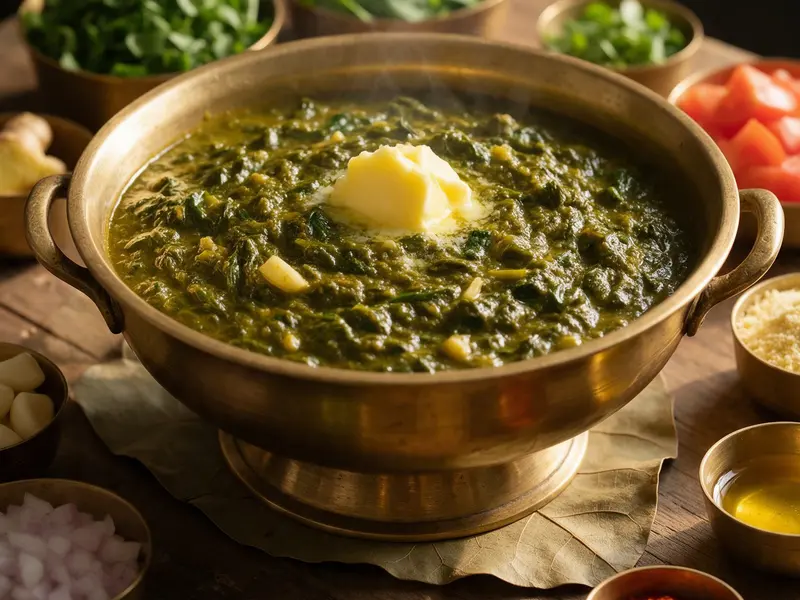
Sarson da saag
Velvety dark-green mustard greens and spinach slow-cooked with ginger and garlic, thickened with cornmeal and crowned with a melting knob of butter.
Taste: Tangy with tomato and spiced with green chilli. Seasoned with ginger and garlic. Smooth and creamy. Made mostly from tomato, onion and spinach.
In every version: coriander powder, garlic, ghee, ginger, green chilli, onion, red chilli powder, tomato.
Sarson da Saag (finished with butter)
Ingredients
Greens
Aromatics
Thickener
- 2 tbsp cornmeal
Tempering
- 2 tbsp ghee
- 2 onions, finely chopped
- 4 green chillies, chopped
Spice
- 1 tsp red chilli powder
- 1 tbsp coriander powder
- 1 tsp garam masala
Finish
- for garnishing unsalted butter optional
Method
- Pressure cook greens with ginger, garlic, tomato, salt and 2 cups water to one whistle, then simmer.
- Cool, lift out the greens and grind them with cornmeal to a paste.
- Brown onions in ghee, then add green chillies.
- Add the paste and dry spices and cook until thick.
- Top with butter, ginger and chillies; serve hot with makki di roti.
Served with: makki ki roti
To finish: butter (a dollop)
Tips for this version
- Thicken sarson da saag by stirring about 2–3 tablespoons of cornmeal (makki atta) into the puréed greens and simmering.
- Blend the cooked greens only to a coarse purée, not a smooth one.
- Pressure cook the greens from one whistle up to 5–6 whistles, then cook them down until thick: about 10 minutes plus 5–10 with the onion tempering, or 20–25 minutes after adding makki atta.
- Use a generous share of spinach with mustard greens in saag to tone down their bitterness.
- To tame the bitterness of sarson saag, mix in milder greens: about two parts mustard leaves to one part bathua, plus some spinach.
- Long cooking makes cabbage, cauliflower and mustard greens smell of sulphur; cook them briefly in a little fast-boiling water, uncovered at first.
- Mash the cooked greens lightly with a potato masher for sarson da saag.
- Saag that looks dry can be thinned with a splash of water.
Sarson da Saag (with white radish)
Ingredients
To thicken
- 2 tbsp maize flour, makki ka atta
Tadka
- 2-3 tbsp ghee
- ¼ tsp hing
- 3-4 garlic cloves, large, chopped
- 1 onion, medium, chopped
- 2 dried red chilies
- ½ tsp coriander powder
- ½ tsp garam masala
Method
- Put the washed, chopped greens in a pressure cooker with onion, garlic, ginger, chillies, tomatoes, radish, chilli powder, salt and 1.5 cups water; cook 5-6 whistles on high (or about 20-25 min in an open pot).
- Blend to a coarse puree with an immersion blender.
- Return to medium-low heat, stir in the maize flour and simmer on low 20-25 minutes, stirring, until thick.
- Heat ghee, fry hing and garlic briefly, add onion and red chillies until lightly golden, stir in coriander powder and garam masala and pour over the saag.
Served with: makki ki roti
To finish: butter (a dollop)
Tips for this version
- Thicken sarson da saag by stirring about 2–3 tablespoons of cornmeal (makki atta) into the puréed greens and simmering.
- Blend the cooked greens only to a coarse purée, not a smooth one.
- Pressure cook the greens from one whistle up to 5–6 whistles, then cook them down until thick: about 10 minutes plus 5–10 with the onion tempering, or 20–25 minutes after adding makki atta.
- Use a generous share of spinach with mustard greens in saag to tone down their bitterness.
- To tame the bitterness of sarson saag, mix in milder greens: about two parts mustard leaves to one part bathua, plus some spinach.
- Long cooking makes cabbage, cauliflower and mustard greens smell of sulphur; cook them briefly in a little fast-boiling water, uncovered at first.
- Mash the cooked greens lightly with a potato masher for sarson da saag.
- Saag that looks dry can be thinned with a splash of water.
Sarson da Saag (blanched greens, no maize flour)
Ingredients
- 500 g mustard greens (sarson)
- 250 g spinach (palak)
- 250 g bathua leaves
- 1 onion, finely chopped
- 2 tomatoes, finely chopped
- 4-5 garlic cloves, minced
- 1 inch ginger, grated
- 2-3 green chillies, finely chopped, adjust to taste
- ½ tsp turmeric powder
- 1 tsp red chilli powder, adjust to taste
- 1 tsp coriander powder
- ½ tsp salt
- 1 tbsp oil
- as needed ghee, for garnish optional
- as needed water, for blanching
Method
- Clean all three greens thoroughly and chop them fine.
- Blanch the greens in a large pot of boiling water for 5–7 minutes until tender; drain.
- Heat the oil in a kadai on medium and soften the onions.
- Add garlic, ginger and green chillies and cook a couple of minutes.
- Add tomatoes and cook until soft and the oil separates.
- Stir in turmeric, chilli powder, coriander powder and salt and cook a few minutes.
- Add the blanched greens and cook 10–15 minutes on low, stirring now and then; mash lightly with a potato masher if you like.
- Loosen with a little water if dry, top with ghee if using and serve hot with makki di roti.
Served with: makki ki roti
To finish: butter (a dollop)
Tips for this version
- Thicken sarson da saag by stirring about 2–3 tablespoons of cornmeal (makki atta) into the puréed greens and simmering.
- Blend the cooked greens only to a coarse purée, not a smooth one.
- Pressure cook the greens from one whistle up to 5–6 whistles, then cook them down until thick: about 10 minutes plus 5–10 with the onion tempering, or 20–25 minutes after adding makki atta.
- Use a generous share of spinach with mustard greens in saag to tone down their bitterness.
- To tame the bitterness of sarson saag, mix in milder greens: about two parts mustard leaves to one part bathua, plus some spinach.
- Long cooking makes cabbage, cauliflower and mustard greens smell of sulphur; cook them briefly in a little fast-boiling water, uncovered at first.
- Mash the cooked greens lightly with a potato masher for sarson da saag.
- Saag that looks dry can be thinned with a splash of water.
If something goes wrong
Sarson ka saag turns watery
- Too much liquid in the saag Few sources say this.
- Stir in some maize flour and simmer. to rescue Few sources say this.
Where it comes from
Punjab (characteristic), Punjab
Seasons
Sharad, Hemant, Shishir, Monsoon, Winter
Festivals
Baisakhi, Holi, Lohri, Maha Shivratri, Basant Panchami, Chaitra Navratri
Useful tips
- Mashing sarson da saag. Mash the cooked greens lightly with a potato masher for sarson da saag.
- Sarson da saag is a Punjabi winter dish. Sarson da saag is a Punjabi winter dish built on mustard greens.
- Cooking times for sarson da saag. Pressure cook the greens from one whistle up to 5–6 whistles, then cook them down until thick: about 10 minutes plus 5–10 with the onion tempering, or 20–25 minutes after adding makki atta.
- Loosening sarson da saag. Saag that looks dry can be thinned with a splash of water.
- Thicken saag with cornmeal. Thicken sarson da saag by stirring about 2–3 tablespoons of cornmeal (makki atta) into the puréed greens and simmering. Few sources say this.
- Punjabi saag is tempered in ghee and finished with butter. Punjabi sarson da saag is tempered in pure ghee and finished with butter.
- Sarson da saag and makki di roti at Lohri. Sarson da saag with makki di roti is the main Lohri dinner in many accounts, since mustard greens are a winter crop of Punjab. Few sources say this.
Another view: Served at room temperature with green chutney. Sources disagree on when saag is eaten: some call it the main Lohri dinner; others follow a saying that it is cooked in Poh and eaten the day after Lohri, in Magh.
- Cook cabbage and cauliflower briefly to avoid sulphur smell. Long cooking makes cabbage, cauliflower and mustard greens smell of sulphur; cook them briefly in a little fast-boiling water, uncovered at first. Few sources say this.
- Sarson ka saag: slow simmer and a coarse purée. Blend the cooked greens only to a coarse purée, not a smooth one.
- Taming bitterness in sarson saag. To tame the bitterness of sarson saag, mix in milder greens: about two parts mustard leaves to one part bathua, plus some spinach.
- Boil and drain the greens for sarson saag. Boil chopped mustard greens without a lid so they stay bright, then drain them once soft, let them cool and grind them coarsely.
Another view: Do not drain the saag cooking water; keep it and simmer it down. Some keep the mustard-green cooking water and reduce it; others boil the greens and drain them before grinding.
- Keep the saag cooking water and reduce it. Some cooks keep the water the mustard greens cooked in and simmer it down with the saag rather than pouring it away. Few sources say this.
Another view: Boil chopped greens in salted water until soft, then drain and cool before blending. Boil the greens uncovered to keep the colour bright, then drain and grind coarse.
- Under-salted saag tastes bitter. Saag with too little salt tastes more bitter, so check and adjust its salt at the end. Few sources say this.
- Spinach softens bitter mustard greens. Use a generous share of spinach with mustard greens in saag to tone down their bitterness.
- A spoon of ghee on khichdi and saag. A little ghee can be spooned over bajra khichdi or sarson ka saag at serving time; on the saag it is optional.
- Winter saag is served with dahi and lassi. In North Indian homes, winter saag meals are traditionally served with dahi and tall glasses of homemade lassi.
- Why mustard greens taste sharp. Cutting or crushing mustard leaves turns their sinigrin into allyl isothiocyanate, the source of their bite; bitterness depends on the variety, so taste a raw leaf first. Few sources say this.
- Sarson da saag in Punjab. Sarson ka saag is a favourite home dish across Punjab.
- Sarson saag and makki roti at Baisakhi. Saag with makki roti is a classic dish for Baisakhi.
- The saag season and slow-cooked mustard greens. In Punjab, Haryana, Rajasthan and western Uttar Pradesh, the saag season runs roughly October to February, and mustard greens are traditionally slow-cooked for hours, often in earthen pots. Few sources say this.
- A Punjabi winter table. In Punjab's cold months, makki roti and sarson ka saag come with ghee or white butter, alongside new-season jaggery and panjiri made from roasted atta, ghee and dry fruit.