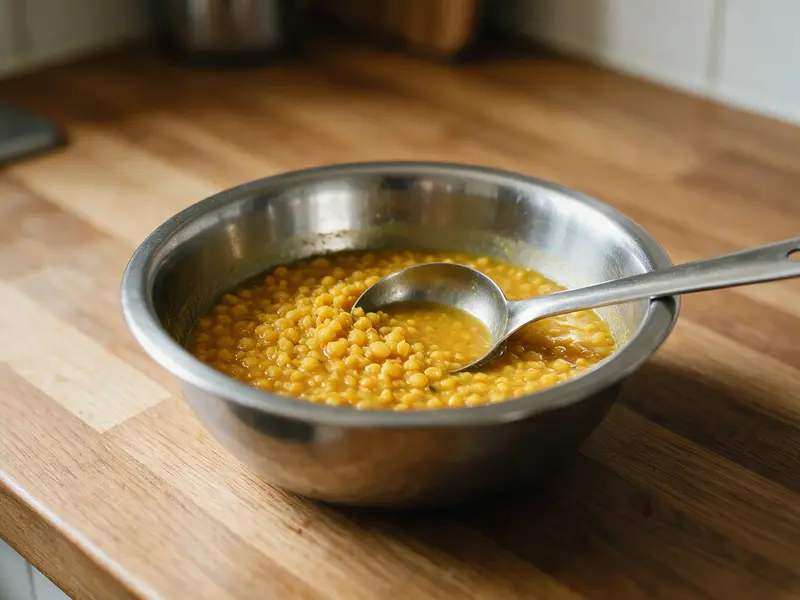
Cooked dal
Velvety, golden dal, gently thickened overnight, revived with warm water and a sizzling fresh tadka of ghee, cumin and fragrant spice.
Texture: Thickens as it cools and loosens again when reheated with warm water, though not always to its original texture.
Getting it ready
After the dal joins the tempering, simmer only a few minutes so the flavours combine. Pour hot tadka over and leave it covered briefly to infuse; mash the dal smooth first for a creamy result.
If something goes wrong
Dal turns mushy from overcooking
- Too much pressure cooking (too many whistles) for a quick-cooking or soaked dal
- Simmer in an open saucepan on low and keep checking the texture. to prevent
- Limit whistles, e.g. a single whistle for soaked split urad. to prevent
- Urad dal overcooked or stirred vigorously Few sources say this.
- Stop cooking when each grain is soft but whole, and swirl the pan or press lightly with the back of a ladle instead of stirring. to prevent Few sources say this.
Dal, sambar or dal gravy too thick
- Dal thickens as it simmers, is mashed, or cools
- Stir in warm or hot water a little at a time until it reaches the consistency you want. to rescue
- Re-season with salt and spices after thinning. to rescue
- Simmer a few minutes on low heat after adding the water. to rescue
- Stir in a little hot water or unsalted cooking liquid, adding it gradually while reheating. to rescue
- Mix while reheating and re-taste salt and seasoning after diluting. to rescue
- Keep the dal thinner when cooking ahead. to prevent
- When cooking ahead, leave the dal thinner than you want it. to prevent Few sources say this.
- Loosen a long-simmered dal with a little boiling water, about 100–200 ml at a time. to rescue Few sources say this.
- Too little water used
- Add water and simmer briefly. to rescue
Dal too thin, watery or runny
- Too much cooking water, or not reduced enough
- Measure water to the recipe's ratio next time (e.g. about 1:2 or 1:2.5 dal to water; don't scale water up blindly when doubling). to prevent
- Pour off some liquid and/or simmer uncovered or partly covered to reduce, avoiding high heat. to rescue
- Simmer gently to evaporate the excess water, without over-reducing an already concentrated dal. to rescue
- Skip the extra cooker water when a juicy vegetable such as chayote will release its own liquid. to prevent Few sources say this.
- Pressure released by force Few sources say this.
- Let the pressure drop naturally. to prevent
- Dal not mashed after cooking, so the pulses did not thicken the liquid Few sources say this.
- Mash part of the cooked pulses. to rescue
Dal sticks or burns on the bottom of the pot or pressure cooker
- Not stirred during simmering or before sealing
- Stir at regular intervals during the final simmer. to prevent
- Mix dal, water and spices before sealing so solids don't settle on the base. to prevent
Another view: Some layer starchy or dense ingredients rather than stirring them in, which can scorch.
- Stir everything together before closing the lid to prevent
- Too little water
- Use about 2½–4 cups water per cup of dal; add more if it sticks to prevent
- Keep enough liquid for the food and the cooking method. to prevent
- Check whether the liquid is being absorbed or lost as steam. to prevent Few sources say this.
- High flame for the whole cook
- Start on medium and reduce the flame after the first whistle. to prevent
- Use a heavy-bottomed pot, or lower the heat to a steady simmer to prevent Few sources say this.
- Pressure cook khichdi on medium heat. to prevent Few sources say this.
- Mixture too thick or starchy going in
- Keep it thinner going in. to prevent
- Reduce afterwards by simmering uncovered. to rescue
- Tadka added before pressure cooking
- Temper separately and add it at the end. to prevent
- Old burnt residue in the cooker
- Clean the cooker fully before each use. to prevent
- Small batch size Few sources say this.
- Adjust water and time, or use a vessel you can watch. to prevent Few sources say this.
- Early warning signs ignored
- Turn off the heat at once on a faint burnt smell or odd steam; fully scorched dal cannot be saved. to rescue Few sources say this.
- Base already scorched Few sources say this.
- Move the unburnt food to another vessel without scraping the burnt base into it. to rescue
Dal or sambar tastes bitter
- Foam not skimmed during open-pot cooking
- Skim off the scum as it rises. to prevent
- Too much of a bitter seasoning in the tempering (methi, mint, turmeric, spinach)
- Use these sparingly, e.g. cap methi at about two teaspoons scaled to the batch. to prevent
Dal dish lacks tang or heat
- Under-seasoning
- Add more dry mango powder for sourness, or extra chilli powder with the garam masala. to rescue Few sources say this.
Leftover dal tastes off
- Kept too long in the fridge
- Use leftover dal within about a day. to prevent
Another view: Some keep cooked dal 2–3 days in the fridge.
- Cool boiled dal or legumes fully, refrigerate them airtight and use within two days. to prevent Few sources say this.
- Use leftover dal within about a day. to prevent
- Dal frozen while still warm Few sources say this.
- Cool dal completely before freezing it. to prevent
- Freezer burn from air left in the bag
- Lay freezer bags flat and squeeze out the air, leaving a little headspace. to prevent Few sources say this.
- Dal gravy not boiled thoroughly after the dal was added, so it spoils quickly in humid weather Few sources say this.
- Bring the dal to a full rolling boil after combining it with the gravy. to prevent Few sources say this.
Keeping
Refrigerate within two hours in shallow, sealed containers; it keeps about 3–4 days chilled. It freezes well for about three to four months: freeze plain, thaw in the fridge and add a fresh tadka.
- In the fridge: 1–6½ days
- Frozen: 23–157 days
Goes well with
Rice, Spinach
Used in
Dal paratha, Tadka (tempering), Dal dhokli, Dal tadka, Dhansak, Mamidikaya pappu Few sources say this., Methi dal, Panchmel dal, Parippu curry Few sources say this., Varan Few sources say this.
Tradition
In Gujarati homes, dal dhokli is traditionally a Sunday dish made from the previous day's extra dal.
Take care
Cold storage only slows bacteria. Reheat to a rolling boil, about 165 F, and discard dal left out over two hours, or one hour above 90 F; reheating cannot rescue badly stored food.
Seasonal food wheel
- On the tongue: Cool
- After the meal: Cool
- Warmth: neutral
- Texture: medium
- Best seasons: summer, autumn
Questions answered
- What can I make with leftover dal?
- How long does cooked dal last in fridge
- How long can cooked dal, curry or soup be kept in the refrigerator?
- What is the safest way to cool and store cooked dal after preparation?
- How can cross-contamination be avoided when handling cooked dal safety?
- How can batch-cooked dal be planned or prepared ahead for a busy weekday?
Useful tips
- Fold dry-cooked dal gently. Fold seasonings into dry-cooked dal very gently so the soft grains stay whole and separate. Few sources say this.
- Whip the cooked dal smooth for rasam. Whip the cooked dal with an immersion blender or hand beater, or stir it hard, so the rasam is as smooth as possible. Few sources say this.
- How long cooked dal keeps in the fridge. Cooked dal keeps about three to four days refrigerated in a sealed container; cooked rajma about two to three days.
- Freezing cooked dal. Cooked dal freezes well for about three to four months; freeze in portions, thaw overnight in the fridge and reheat with water.
- Refrigerate cooked dal within two hours. Refrigerate cooked dal within two hours, or within one hour if the room is above 90 F; otherwise discard it.
- How long cooked dal and boiled beans keep in the fridge. Food-safety bodies give 3-4 days in the fridge for cooked leftovers; one household source keeps mashed dal 2-3 days and boiled chickpeas or rajma 4-5 days.
- Freezing plain cooked dal for sambar. Cook toor or moong dal until soft with turmeric and no salt, cool it, and freeze in portions sized for one use; drop them into sambar or rasam still frozen. Few sources say this.
- Simmer briefly after combining dal with the tempering. After the cooked dal joins the tempering or masala, simmer it about 3–10 minutes so the flavours combine.
- Mash or whisk dal smooth. Mash or whisk the cooked dal until completely smooth before adding it to the tempering, because Indian dals are meant to be creamy.
- Refrigeration slows but does not stop spoilage. Cooked dal, curry and soup are perishable, and cold storage only slows microbial growth rather than stopping it.
- Dal thickens as it cools. Dal thickens as it cools, so loosen it with warm water when reheating.
- Let the tadka sit on the dal before stirring. Pour the hot tadka over the dal straight away and leave it unstirred, or covered, for a short while so the aromas infuse.
- Adjust dal consistency with water. Dal thickens as it cools, so check it before serving and loosen it with warm water to the consistency you want.
- Only bring dal to a boil after adding it to the tempering. Once the dal is combined with the tempering, cook it only briefly, bringing it to a boil or simmering a few minutes, then serve.
- Skim the foam off dal. Skim off the foam as it forms while boiling dal. Some cooks say it can make the dal bitter if left in.
- Mash some dal to thicken it. To thicken a watery dal, mash or crush part of the cooked pulses into it.
- Add delicate vegetables later. Add delicate vegetables and leafy greens later than dense ones, including in dal or khichdi, so they do not overcook.
- Leftover dal as a thickener. Leftover dal can add body to soups, grain dishes or vegetables, because its dispersed starch and pulse solids thicken and bind. Few sources say this.
- Turning plain dal into new meals. Plain dal works as a flexible base that can lean tangy, aromatic, vegetable-rich or thicker, bearing in mind what each addition brings. Few sources say this.
- Giving everyday dal a new flavour. A dal is usually refreshed best by taking it in a single matching direction (aromatic, sour, fresh or vegetable) instead of piling on unrelated seasonings. Few sources say this.
- Keep hot dal or khichdi hot in a flask. Preheat a flask with boiling water for a few minutes, empty it, fill it with piping hot food such as dal or khichdi and keep it closed until lunch.
- Freeze plain dal and add tadka later. Freeze dal plain and add a fresh tadka after thawing and reheating.
- Knead leftover dal into paratha dough. Use leftover dal or bhaji in place of some kneading water for parathas, adding a little extra salt and spice.
- Spinach goes into dal near the end. Spinach or kale can be added to dal toward the end of cooking. Few sources say this.
- Make-ahead dal: keep it thin. Dal usually sets thicker on cooling, so make-ahead dal can be left on the thin side, or water added and the dal brought back to the boil. Few sources say this.
- Roast fresh methi before folding into dal. Roast chopped fresh methi in a little oil, first on medium-high then lower, for 10–15 minutes until completely dry and deep green, before folding it into dal. Few sources say this.
- Quick rasam from cooked toor dal. For a shortcut rasam, stir about 2 tablespoons of rasam powder and some tamarind paste into already cooked toor dal, then simmer. Few sources say this.
- Leftover dal paratha: about 1 cup dal to 1.5 cups atta. Knead leftover dal into the paratha dough, roughly 1 cup toor dal to 1.5 cups atta, adding flour if sticky, and rest it about 15 minutes.
- More uses for leftover dal: chilla, thalipeeth, tikki. Leftover dal can be mixed with wheat flour, onion and chilli for chilla, kneaded into jowar dough for thalipeeth, or bound with sooji into tikki.
- Water or stock for cooking dal. Most dal recipes use plain water; half a stock cube is occasionally crumbled in for a savoury note, though water may keep the spices tasting fresher. Few sources say this.
- Rasam should be thin, not thick like sambar. Keep rasam runny, like a thin soup; a spoon of mashed dal adds a little body, but piling on extra water dilutes its flavour and heat.
- Using a slow cooker for dal and kadhi. Kadhi and dals like dal palak cook well in a slow cooker, but many hover near 100 °C and can dry food out, so keep braising liquid only part-way up. Few sources say this.
- Add lemon juice off the heat. Stir lemon juice into dals and curries at the very end, off the heat or just before serving, for brightness.
- Koldil bhaji. Koldil is sometimes combined with dal that is already cooked, plus spices, and fried until cooked.
- Baking soda in spinach khar. Baking soda is optional in spinach khar; the curry still tastes good without it. Few sources say this.
- Cool big batches of dal in shallow containers. Divide large batches of dal into shallow containers so they cool quickly; hot food can go straight into the fridge.
- Bring leftover dal to a rolling boil. Reheat leftovers to 165 F; soups and sauces like dal should be brought to a rolling boil.
- Dal with grain makes a complete protein. Eating dal with a grain such as rice or roti is said to make a complete protein.
- Starchy dishes thicken as they cool. Dishes with rice, dal or flour are thinner when very hot and thicken as they stand; reheating loosens them, though not always to the original texture.
- Reheating cannot rescue badly stored food. Reheating improves texture but cannot make improperly stored food safe.
- Why food sticks to the pan. Food sticks when its surface dries, starches or proteins bond to hot metal, or solids settle where heat is strongest; thick dal, rice and milk dishes are prone.
- Check leftovers before reusing. Before reusing leftover vegetables or dal, check they were cooled and stored safely and show no spoilage.
- The temperature danger zone. Bacteria multiply fastest between about 40 F and 140 F (4-60 C), so cooked food should spend as little time as possible in that range.
- Boil soups and stews when you have no thermometer. Without a thermometer, bring soups, stews, dal and gravies to a full boil and keep them boiling for at least a minute.
- Cool fast and pack airtight before freezing. Cool cooked food completely and quickly, then pack it airtight with the air pressed out before it goes into the freezer.
- Boil dal gravy well in humid weather. In humid weather, a last boil will not stop dal spoiling; cool it quickly and refrigerate it, or keep it hot until serving. Few sources say this.
- Dal dhokli as a way to use leftover dal. Dal dhokli is traditionally a way to use up extra dal left from an earlier meal.
- Cool a large pot quickly in an ice-water bath. To cool a big pot of dal or curry fast, stand it in a bowl or sink of ice water and stir.
- Chutneys, pickles and raita lift plain food. A spoonful of chutney or pickle turns plain flatbread into a snack and lifts a simple dal; raita does the same for a curry. Few sources say this.
- Reheat leftovers piping hot all the way through. Reheat leftovers until the inside reaches 74 °C, stirring so the heat spreads; bring dal, gravies and soups to a rolling boil, and never reheat in a slow cooker.
- Dal thickness differs from region to region. How thick a dal is varies by state, and the very thick dal served in Indian restaurants in the US is not the norm everywhere. Few sources say this.
- Family dals differ in small additions and tempering. Home dals differ in small touches: one Gujarati family adds pumpkin, yam, kokum and dried dates, another cooks a sweet dal, and tadkas vary from family to family.
- Keeping dal tadka. Dal tadka keeps 3 to 4 days airtight in the fridge; add water when reheating. Few sources say this.
- Gurdwara langar at Baisakhi. At Baisakhi, gurdwaras serve langar of dal, seasonal vegetables and roti to everyone. Few sources say this.