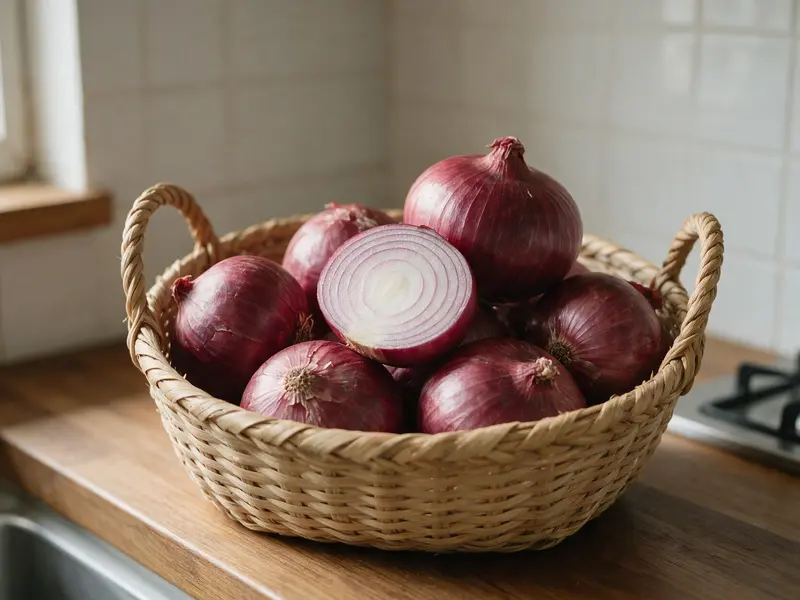
Onion
Translucent slices slowly coaxed to deep amber in ghee, turning sweet, jammy and fragrant, the rich, savoury heart of countless curries.
Also called: eerulli (Kannada), kanda (Marathi), peyaj (Bengali), pyaaz (Hindi), ullipaya (Telugu), vengayam (Tamil)
Taste: Sharp and pungent raw; sweet and savoury once browned.
Texture: Sliced root to tip, onions hold their shape through long browning; covered with a little water they turn soft, sweet and concentrated.
Getting it ready
Fry on medium heat, stirring often, until golden, judging by colour rather than time: too fast turns them bitter, too slow leaves them pale. A pinch of salt helps them soften and brown faster.
Cooking with it
- Cook time: 10 minutes Few sources say this.
- Cook time: 5–14 minutes (open_pot)
Swaps
- shallots: onion chutney
- cabbage: Jain swaps; Forum advice
If something goes wrong
Rice tastes bitter (dhansak brown rice)
- Onion fried past dark brown to black
- Keep the water ready and pour it in the moment the onion is dark brown. to prevent Few sources say this.
Onions turn mouldy
- Humidity in the refrigerator
- Store whole onions in a dry, ventilated, dark spot outside the fridge. to prevent
Onions burn or turn bitter before browning evenly
- Pan too hot, pushing past browning into scorching
- Lower the heat and add a splash of water to deglaze. to rescue Few sources say this.
- Give onion paste a couple of minutes on medium-high, then brown it slowly on medium or low for 12–15 minutes. to prevent Few sources say this.
- Onions not softened first, so the surfaces brown while the insides stay raw Few sources say this.
- Soften the onions under a lid with a little water before browning. to prevent
Onions brown but the sauce stays thin and raw
- Onions fried too fast on high heat Few sources say this.
- Fry onions more gently so they cook through before browning. to prevent
Onions turn mushy and wet
- Too much baking soda used to speed browning
- Use only a pinch of soda, or skip it. to prevent Few sources say this.
- Onions sliced across the grain Few sources say this.
- Slice from root to tip, along the fibres. to prevent
Onion paste turns watery
- Over-processed in a food processor Few sources say this.
- Pulse the onions only until minced. to prevent Few sources say this.
Keeping
Keep whole onions in an open basket in a dry, airy, dark spot, away from potatoes. Cut onion keeps overnight sealed in the fridge; wrap it well so its smell does not spread.
- In the fridge: 1–24½ days
Goes well with
Used to finish
- kala chana, raw, sliced into rings
- sattu drink, finely chopped
- chaats, chopped
- dals, rings tossed with spices and lime
- rice dishes, rings tossed with spices and lime
- dry vegetables, sliced
- panta bhat, sliced
- pazhaya sadam, chopped
- qubooli, julienned and fried
- ragi porridge, finely chopped
- papdi chaat, finely chopped
- chotpoti, sliced
- pesarattu, chopped, sauteed until translucent but crunchy
- uttapam, finely chopped
- set dosa, chopped
- bharwan bhindi, thinly sliced, sauteed
- saag paneer, sauteed, reserved
- samosa, finely chopped
- aloo tikki, finely chopped
- ambali, finely chopped
- ragi koozh, finely chopped
- kambu koozh, chopped
Used in
Mosur dal, Dhansak, Dal tadka, Arhar dal, Uttapam, Pesarattu, Kanda poha, Panta bhat, Dal paratha, Chapati upma, Onion tomato masala, White gravy (mughlai), Kadhi pakora, Mirchi ka salan, Sarson da saag, Boiled onion paste, Onion curry paste, Mulligatawny, Lemon onion rings, Raayi ka raita, Dry bhindi, Bharwan bhindi, Baingan bharta, Lauki sabzi, Paneer bhurji, Akki roti, Aloo matar, Aloo pitika Few sources say this., Aloo tamatar, Ambali, Bagara baingan, Bengali khichuri, Bhindi do pyaza, Bread upma, Carrot poriyal, Chana dal fry, Chana palak, Chole, Dalma, Dhokar dalna Few sources say this., Dhuska, Dum aloo, Gajar matar, Gujarati kadhi, Idli, Jalebi, Kaddu ki sabzi, Khichdi, Kuzhi paniyaram, Lassi, Lauki chana dal, Lauki kofta, Lobia masala, Malai kofta, Mango pickle Few sources say this., Masala dosa, Masala vada, Matki usal, Medu vada, Methi malai matar, Missi roti, Mixed vegetable soup, Moong dal chilla Few sources say this., Mushroom matar, Navratan korma, Pakhala, Palya, Panchmel dal, Paneer butter masala, Paneer tikka, Papdi chaat, Pappu charu Few sources say this., Pav bhaji, Poita bhat, Pulao, Rajma masala, Rava dosa, Roti, Sev puri, Sev tamatar, Shahi paneer, Thalipeeth, Tomato chutney, Varan Few sources say this., Veg cutlet, Veg kolhapuri, Vegetable biryani, Vegetable kurma, Vermicelli upma
Seasons
Summer (Mar–May), harvest; Monsoon (Oct–Dec), harvest; Winter (Nov–Feb), availability; Winter (Jan–Mar), harvest
Regions
Kashmir, Gujarat, Maharashtra, Madhya Pradesh, Manipur
Festivals
Onam (Kerala)
Seasonal food wheel
- On the tongue: Spiced
- After the meal: Spiced
- Warmth: warming
- Texture: medium
- Best seasons: spring
Questions answered
Useful tips
- Onion chutney bitterness and colour. Onion chutney can turn slightly bitter if you use too many onions or roast the chillies dark brown; the longer the chillies roast, the darker the chutney. Few sources say this.
- Raw onion paste can taste harsh or bitter. Blending raw onion breaks many more cells than chopping, releasing harsh sulphur compounds; cook such paste slowly in enough oil until well browned, or soften onions before blending.
- Cook onion until translucent. Sources differ for varan: some cook the onion until translucent before adding chillies and tomato; others add chillies first and saute the onion only a minute or two.
- Wipe with an onion before each dosa. Wipe the greased tawa with a cut onion before each dosa to clean it and prevent sticking.
- Keep onion paratha dough stiffer. Make onion-paratha dough stiffer than ordinary roti dough, because chopped onion releases water as the dough rests. Few sources say this.
- Mincing onion in a processor. Pulse onion in a food processor in short bursts so it does not turn into a watery pulp.
- Cook a blended onion-tomato paste fully before spicing. Soften onion, tomato, chilli, garlic and ginger about 10 minutes, blend, then cook the paste covered on low 10–15 minutes before adding spices. Few sources say this.
- Cooking and storing raw onion paste. Brown raw onion-ginger-garlic-chilli paste in ghee or oil on medium heat before adding tomatoes; it keeps 10 days chilled or 3 months frozen. Few sources say this.
- Fried onion paste for Mughlai dishes. For rich Mughlai dishes, deep-fry ginger and garlic until golden, then sliced onion until well browned, drain and grind with yogurt; it keeps 5 days in the fridge. Few sources say this.
- Keep onion wedges joined at the root. When cutting onion wedges for a curry, leave each one attached at the root end so the layers open but stay together as they cook. Few sources say this.
- Salt raw onion rings to soften them. For lemon onion rings, toss the rings with salt in a non-reactive bowl, leave about 2 hours, then drain or rinse off the juices before dressing. Few sources say this.
- Nimboo pyaz: lemon onion rings with grills. Dress salted onion rings with lemon, coriander, ginger paste and chilli flakes, marinate about 2 hours in the fridge and serve chilled with tandoori food. Few sources say this.
- Dry onion slices before frying birista. Get onion slices dry before frying: pat them dry, or salt them, rest 15–20 minutes and squeeze out the water; a light dusting of cornflour adds extra crispness.
- Preparing onion rings as a garnish. For an onion-ring garnish, slice onions about 5 mm thick, separate the rings, then add spices and lemon last and toss lightly so the rings stay whole.
- Soak raw onion rings in iced water. Soak raw onion rings in ice or very cold water for a few minutes to soften their pungency and make them crunchier.
- Raw or fried onion topping. An onion topping can be raw, restaurant-style, or fried if your household prefers; either way, add it just before serving. Few sources say this.
- Onion chutney variations. Saute a ripe tomato with the onions for a variation; the tempering is optional, some cooks keep onion chutney thick and untempered.
- Soften raw onion with salt, sugar and lemon. Rubbing chopped onion with salt, sugar and lemon juice for a couple of minutes softens its raw bite before it goes into raita. Few sources say this.
- Add onion to vada batter just before frying. Mix onion and spices into vada batter only just before frying, because onion releases water as it sits and thins the batter. Few sources say this.
- Kartik (habisa) dalma: no onion or garlic, ghee instead of oil. During Kartik, Odia dalma is made with ghee rather than oil and without onion or garlic, often seasoned just with cumin and ginger.
- Rest the sattu filling so onion binds it. Let the mixed sattu filling sit about half an hour, then press it with your hands; the onion lets out moisture that, with a little oil, binds the mix.
- Onion and tomato order in gajar matar. You can skip onion and tomato; when including them, soften onion first, follow with tomato and spices, and add the vegetables last. Few sources say this.
- Cook onion or tomato paste until the raw smell goes. If you use onion or tomato paste to thicken a gravy, keep cooking it until it no longer smells raw. Few sources say this.
- Finely cut onion and tomato thicken dal. Cut the onion and tomato small so they dissolve into the dal as it cooks and give it body. Few sources say this.
- How much birista one onion makes. A large onion yields just over half a cup of birista, since frying can take away up to half of the onion's weight.
- Nigella for an onion note without onion. Nigella seeds can add a hint of onion flavour to dishes cooked without onion. Few sources say this.
- Hing in place of onion and garlic. Asafoetida is often used instead of onion and garlic, giving a savoury, allium-like note where they are avoided.
- Long-simmered onion paste for korma-style gravies. For restaurant-style korma and masala gravies, onion is puréed and simmered covered with water, ginger and garlic for about an hour to make a mild base.
- Soaking chopped onion. Soaking chopped onion in warm water before making the onion-tomato masala cuts the raw smell and the tears; it is optional. Few sources say this.
- Onion in the Punjabi tadka. For a Punjabi-style tadka, add the onion after the cumin and saute it until soft or translucent.
- Boiled onion paste. Boiled onion paste, from red or white onion and sometimes boiled with whole spices, usually forms the base of creamy white gravies in North Indian cooking. Few sources say this.
- Boiled onion-tomato masala for a milder taste. A boiled rather than fried onion-tomato masala gives a milder onion and garlic flavour. Few sources say this.
- Ghee optional in onion curry paste. Ghee in an onion curry paste is optional; oil alone works. Few sources say this.
- Fried onion yield. Onions lose up to about half their weight when fried; one large onion gives roughly half a cup of birista. Few sources say this.
- Onion in carrot poriyal is optional. Classic carrot poriyal skips ginger, garlic and onion so the carrot leads, but chopped onion can be sauteed with the curry leaves if you like.
- Onion is optional in aloo tamatar. Onion can be left out of aloo tamatar sabzi.
- Build the onion-tomato base slowly. Chop the onion fine and sauté the onion-tomato base slowly until oil separates; this thick masala carries the curry's flavour and gives a smoother gravy.
- Tomato and onion in bread upma. Tomatoes can make bread upma soggy, so some cooks skip them, and if used, drop the lemon; leave out the onion for a Jain version.
- Onion in the tempering. A small chopped onion can be fried in the tempering until light pink.
- Cutting creates onion, garlic and mustard pungency. Cutting or crushing onion, garlic, cabbage or mustard sets off enzymes that turn odourless precursors into the pungent, eye-stinging compounds. Few sources say this.
- Rajasthani cooking without onion and garlic. Much Rajasthani home cooking leaves out onion and garlic and relies on generous ginger and green chilli instead. Few sources say this.
- Onion pakoras in kadhi. Onion pakoras are simmered in kadhi.
- Quick vinegar carrot-onion pickle. Keep a jarred vinegar carrot-onion pickle somewhere dark for a day, then refrigerate; it keeps 7–10 days in the fridge. Few sources say this.
- Boiled onion paste for smooth curries. Curries built on boiled onion paste are very smooth and delicate, and many restaurants rely on it because it is easy, keeps well and suits almost any curry.
- Sindhi cooks use tomato and onion raw and cooked. Sindhi cooking often adds plenty of tomato and onion, both cooked and raw, to dishes such as dry-cooked moong dal. Few sources say this.
- Rajma with or without onion. Rajma is made either with onion or without; the two versions look alike but taste quite different. Few sources say this.
- Onion-tomato raita does not keep well. Make onion-tomato raita close to serving: left to stand, the vegetables release water and make it runny; one source adds that the raw onion turns strong-smelling.
- No onion, garlic or green chilli in the naivedyam. Varalakshmi naivedyam is usually made without onion, garlic or green chilli, with peppercorns providing the heat. Few sources say this.
- Why garlic burns faster than onion. Garlic carries less water and more natural sugar (long fructose chains) than onion, so it dries out and browns almost instantly, and minced garlic heats in seconds.
- Why some homes and temples cook without onion and garlic. Many Hindu households, and Vaishnava homes and temple kitchens in particular, avoid onion, garlic and related plants, holding that such foods are unfit to offer to the deity.
- Blue or green onion is harmless. Red onion that turns blue or green from its pigment reacting is safe to eat and tastes the same.
- Yogurt gravy without onion or garlic. A yogurt gravy can be made without onion or garlic.
- Onion-free curry base for satvik cooking. A curry base made without onion and garlic fits satvik, fasting-day and temple-style cooking. Few sources say this.
- Storing onion curry paste. Onion curry paste keeps up to 5 days in the fridge or up to 3 months frozen; cool it fully and freeze in half-cup portions.
- Braj cooking without onion or garlic. In the Braj region around Mathura, food is traditionally cooked without onion or garlic.
- Sprouting aromatics and blended raw onion can make a base bitter. Onions cooked too fast over high heat burn or turn bitter, spoiling a curry base.
- Lift out every scrap of fried onion. After frying onions for a gravy, it helps to lift out every scrap, since bits left in the oil burn and can turn the gravy bitter. Few sources say this.
- Deeply browned onion colours dhansak rice. Dhansak brown rice gets its colour from caramelised sugar, deeply browned onions or both, with the onions also adding flavour.
- How to tell an onion-tomato masala is done. The masala is ready when oil seeps out and pools at the edges, spluttering stops, and the paste turns deep-coloured, glossy and jammy.
- How cooking method changes onion flavour. Onions fried in oil taste most intense; covered in little water they turn sweet and concentrated; boiled long uncovered in plenty of water they are mildest. Few sources say this.