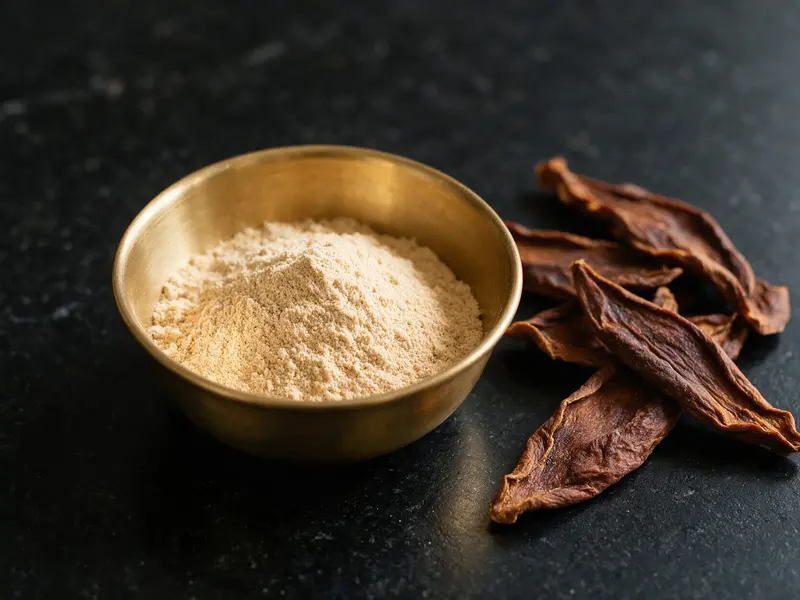
Dry mango powder
Fine, pale-gold powder of sun-dried green mango, sharply sour and faintly fruity, sparkling over crisp potatoes, chaat and summer salads.
Also called: amchur (Hindi)
Taste: Very sour and acidic, with a little fruity sweetness.
Getting it ready
Add it at the end of cooking or just before serving so the tang stays bright; it does not stand long simmering as anardana does. Do not roast it. Lemon or tamarind can replace it.
Swaps
- tamarind
- lemon: sour element in Gujarati dal
- anardana: aloo paratha filling
- kachri Few sources say this.
Goes well with
Used to finish
- aloo gobi, a sprinkle
Used in
Dal makhani, Dal paratha, Onion tomato masala, Jeera aloo, Dry bhindi, Bharwan bhindi, Bharwan baingan, Bharwan karela, Chaat masala, Chole masala, Pav bhaji masala, Kitchen king style blend, Tomato khejur chutney, Chana chaat, Samosa, Khasta kachori, Aloo paratha, Mooli paratha, Paneer paratha, Missi roti, Sun dried vegetables, Choliya sabzi, Kamal kakdi sabzi, Phool makhana namkeen, Shakarkandi chaat, Aloo capsicum, Aloo chaat, Bhindi do pyaza, Boiled peanut chaat, Chana palak, Kaddu ki sabzi, Ker sangri Few sources say this., Moong sprouts usal, Parwal sabzi, Patra, Pav bhaji, Rajma masala
Regions
North India, North India (where it comes from), Rajasthan
Seasonal food wheel
- On the tongue: Rich
- After the meal: Spiced
- Warmth: cooling
- Texture: medium
- Best seasons: spring
Useful tips
- Add lemon juice or amchur at the end. Squeeze in lemon juice or add amchur just before serving or as the heat goes off, so the tang stays bright.
- Anardana handles long cooking better than amchur. Anardana withstands long cooking better than amchur, so it suits slow-simmered dishes while amchur is best added late. Few sources say this.
- Add amchur and ground spices at the end of a dry sabji. In a dry potato sabji, salt, ground spices and amchur can go in at the end with a final minute on high heat. Few sources say this.
- Amchur is sun-dried raw mango. Amchur is made by chopping raw mangoes, sun-drying them and grinding them to a fine powder. Few sources say this.
- Lemon in place of amchur in parwal sabzi. If you have no amchur, finish parwal sabzi with lemon juice instead. Few sources say this.
- Garam masala as a stand-in for amchur. In boiled peanut chaat, garam masala can be used if there is no amchur. Few sources say this.
- Amchur in chaat and its substitute. Amchur gives chaat its sour note and can taste slightly salty, so salt with care; chaat masala can stand in for it. Few sources say this.
- Add amchur at the end. Add amchur with garam masala once vegetables are tender, or stir it in with kasuri methi after switching off the heat.
- Amchur is a North Indian souring agent. Amchur (dry mango powder) is a common souring agent in North Indian cooking.
- What amchur is. Amchur is ground sun-dried unripe mango: very sour and acidic with a little fruity sweetness; it is also sold as thin dried slices.
- Add powdered ingredients at the grinding stage, unroasted. Powdered ingredients such as turmeric, salt, amchur and anardana go into the grinder unroasted, after or with the roasted whole spices; hing is added raw or dry-roasted for a few seconds.
- Chaat masala: a quick flavour rescue. Chaat masala, based on amchur, roasted cumin and black salt, can be sprinkled into a dish that tastes not quite right, and over fruit, salads and juices. Few sources say this.
- Shortcuts and souring swaps for sprout usal. Replace amchur with lemon juice or tamarind for tang, and pressure-cook the sprouts first if you are short of time. Few sources say this.
- Sour ingredients help limit okra slime. Cooking bhindi with something sour, such as tomato, dry mango powder or a squeeze of lemon, helps keep the stickiness down. Few sources say this.
- Tomato in yogurt gravy. Use only a little tomato in a yogurt gravy, as more makes it too sour; it can be left out with amchur added to the koftas instead. Few sources say this.
- Rajma without onion and garlic. Rajma can be made without onion or garlic, leaning on tomato, amchur and whole spices for depth. Few sources say this.
- Finishing bhindi do pyaza. Add garam masala and amchur at the very end, with lime juice or kasuri methi in the last minutes for extra sourness or a restaurant-style finish.
- Do not leave tamarind out where it defines the dish. Where tamarind gives a dish its defining sourness, lemon or amchur will not match its taste, so diluted tamarind paste or sauce is the better substitute. Few sources say this.
- Seasoning options for aloo capsicum. For tang, add 1/4 to 1/2 teaspoon amchur or a squeeze of lemon.
- Richer and tangier chana palak. Coconut milk or cashew cream makes chana palak creamier, paneer can be added, and anardana or amchur gives tang; lemon juice after cooking works too.
- Substitute for pav bhaji masala. In pav bhaji, 2 teaspoons garam masala with 1 teaspoon amchur can stand in for pav bhaji masala. Few sources say this.
- Cooking ker sangri. Ker sangri is cooked with spices and dry mango powder into a sweet-salty dish, sometimes in buttermilk or with yogurt.
- Origin of fruit chaat. Fruit chaat is often linked to chopped fruit that train vendors dusted with amchur, chilli and salt. Few sources say this.
- Sour ingredients and colocasia's itch. Colocasia roots and leaves can prickle the mouth because of calcium oxalate crystals, so cooks always pair them with a sour ingredient such as lemon, amchur, curd, buttermilk or tamarind.
- Himachali khatta dishes. Himachali khatta are sour dishes, such as kala chana cooked in mustard oil in a sweet-sour amchur-jaggery sauce thickened with besan, served at dham feasts, or pumpkin with whole spices.
- Sour ingredients cut okra slime. Sour additions such as amchur, tomato or tamarind help cut the sliminess of okra.
- Add sweet and sour to pumpkin late. Add amchur, sugar or jaggery and garam masala only once the pumpkin breaks easily, since sweet and sour added early slow its cooking.
- Besan masala roti. Besan masala roti dough is seasoned with cumin, red chilli, coriander powder and amchur.
- Kashmiri chillies in pav bhaji masala. Kashmiri chillies give pav bhaji masala a brighter red; roast them until they swell up.
- Sweetener in pumpkin sabzi. In kaddu ki sabzi, add the jaggery (or white or brown sugar) and mango powder only after the pumpkin is soft, using less if the pumpkin is sweet.
- Raw mango in place of amchoor. When raw mango replaces amchoor in kaddu ki sabzi, add it once the pumpkin is roughly 75 percent done. Few sources say this.
- What sonth chutney is. Sonth can be made as a sweet-sour chutney of tamarind balanced with jaggery.