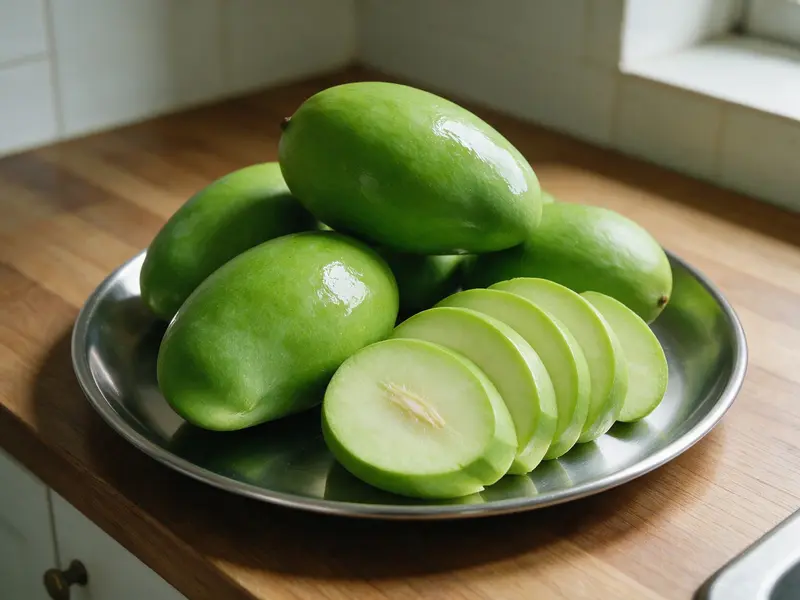
Raw mango
Hard, glossy green mango with crisp, pale flesh and a bracing, mouth-puckering sourness, perfumed and bright in pickles and panna.
Also called: kairi (Hindi), kachcha aam (Hindi), mangai (Tamil)
Taste: Sharp and sour; a little sugar softens an over-tart chutney.
Getting it ready
For aam panna, roast or grill the hardest green mangoes until very soft, then scoop out the pulp. For pickles, choose firm, dark green, unbruised fruit, dry it thoroughly and start within a day of harvest.
- Few sources say this.
Swaps
- tamarind Few sources say this.
- lemon: or tamarind pulp; add near the end Few sources say this.
If something goes wrong
Mango chutney preserve turns mushy
- Mangoes too ripe Few sources say this.
- Use the hardest green mangoes; any that yield to pressure are too ripe. to prevent
Keeping
Raw mango and mint chutney keeps 4–5 days airtight in the fridge; sweetened panna concentrate keeps about a week chilled or a month frozen.
Goes well with
Mint, Jaggery, Green chilli, Grated coconut, Turmeric powder
Used to finish
aam panna, slices, sattu drink, finely chopped, curd rice, pieces, pazhaya sadam, cut in pieces
Used in
Avakaya, Methia keri, Aam kasundi, Mango chutney preserve, Mango pickle, Aam panna, Kasundi (fermented mustard), Raw mango chutney, Kancha aamer chutney, Aloo bukhara chutney, Sonth chutney, Bhel puri, Boiled peanut chaat, Mamidikaya pappu, Amlechi uddamethi, Thinai thayir sadam, Avial, Pani puri, Foxtail millet mango rice, Kaddu ki sabzi, Methi thepla, Pakhala, Puri, Sev puri, Torani
Seasons
Summer (Mar–Jun), eaten; Spring (Mar–Apr), availability; Spring (Feb–Mar), eaten
Regions
- Udupi
Festivals
Ugadi (Andhra Pradesh), Onam (Kerala), Akshaya Tritiya, Puthandu (Tamil Nadu)
Tradition
Raw mango also goes into avakaya, magaya and murabba.
Seasonal food wheel
- On the tongue: Rich
- After the meal: Tangy
- Warmth: neutral
- Texture: medium
- Best seasons: spring
Questions answered
Useful tips
- Peeling raw mango is optional. Raw mango for chutney can go in unpeeled; peeled mango cooks 5–7 minutes faster, but the skin gives more flavour.
- Mango ginger: ginger looks, raw mango aroma. Mango ginger looks like beige-skinned ginger but smells and tastes of raw mango, so cooks use it in pickles and chutneys when green mangoes are unavailable.
- Adding raw mango to dal. For mango dal, soften raw mango first, boiled with chillies about 10 minutes or in the tempering with a little water, then add the cooked dal and simmer.
- Raw mango in avial. Add strips of raw mango to avial near the end, together with the coconut paste. Few sources say this.
- Raw mango in kasundi. Raw mango softens the pungency of kasundi and adds tang, though kasundi can also be made without it. Few sources say this.
- Raw mango in place of amchoor. When raw mango replaces amchoor in kaddu ki sabzi, add it once the pumpkin is roughly 75 percent done. Few sources say this.
- Kairi panha. Panha is the pulp of cooked raw mango stirred with sugar, salt and roasted cumin powder.
- Saute grated raw mango briefly for millet mango rice. Give grated raw mango about one minute in the seasoning before adding the cooked foxtail millet.
- 'Ammbi' and 'kairi' are raw mangoes. Small unripe green mangoes are called ammbi or kairi in Hindi. Few sources say this.
- Raw mango and mint chutney keeps 4–5 days. Raw mango and mint chutney keeps 4–5 days in an airtight container in the fridge. Few sources say this.
- Uddamethi, a Konkani raw mango curry. Uddamethi is named after urad (udda) and methi: raw mango simmered in jaggery is combined with ground coconut, chilli and tamarind, then topped with fried urad and methi.
- Roast raw mango for aam panna. For aam panna, roast raw mangoes until the skin darkens a little, let them cool, then scoop out the pulp.
- Balancing a too-tart raw mango chutney. If a raw green mango chutney is too tart, balance it with a little sugar. Few sources say this.
- Amchur is sun-dried raw mango. Amchur is made by chopping raw mangoes, sun-drying them and grinding them to a fine powder. Few sources say this.
- Savoury vadapappu variation. For a savoury vadapappu, mix grated raw mango, green chilli, coconut, coriander and salt into the soaked dal. Few sources say this.
- Drain salted mango before cooking. Salt grated or sliced raw mango, rest it, then pour off or hang in muslin to discard the liquid it releases before cooking.
- What torani is and how it is seasoned. Torani is pakhala's sour liquid, seasoned with salt, roasted cumin, ginger and herbs such as coriander, curry or lemon leaves, often with raw mango.
- Balancing sourness in bhel. If the raw mango in your bhel is very tart, use less tomato or lemon. Few sources say this.
- Salt cut mango for two days before pickling. In one Bihari method, cut raw mango is salted for two full days so it releases its water before it goes into the pickle. Few sources say this.
- Sev puri toppings and variations. Onion and tomato are optional on sev puri, and grated carrot, beetroot, raw mango, curd or steamed sprouts can be added.
- Panha drinks from sour fruits. Traditional panha drinks are made from sour fruits such as raw mango or kokum with water and sugar or jaggery; some regions add salt. Few sources say this.
- Murabba. Murabba is made by steeping amla, raw mango or pineapple in strong sugar syrup until the fruit softens. Few sources say this.
- Jackfruit and raw mango at Bohag Bihu. Jackfruit and raw mango go into curries, pickles and chutneys at Bohag Bihu, since they are in season then. Few sources say this.
- Kairi panha at Gudi Padwa. Kairi panha of boiled raw mango and jaggery is often made at Gudi Padwa as summer approaches. Few sources say this.
- Seasonal chorchori and chutney in Bengal. Bengali chorchori and chutney usually follow the season: gourds, banana flower and raw mango chutney in summer; cauliflower, cabbage, carrot and tomato or date chutney in winter. Few sources say this.
- Mamidikaya pappu, Andhra mango dal. Mamidikaya pappu is an Andhra dal of raw mango cooked with toor or moong dal. Few sources say this.
- Mavinakai chutney. Mavinakai chutney is ground from raw mango, coconut, urad dal and chillies.
- Pachadi. Pachadi is the southern raita: thick curd mixed with raw mango, grated carrot, fried okra or mashed brinjal.
- Do not dry magaya mango bone-hard. Sun-dry the salted mango for magaya only until it loses moisture but is still pliable; bone-dry pieces make a chewy pickle.
- Avakaya spice proportions. For avakaya, use equal weights of red chilli powder, mustard powder and powdered salt, and about one cup of this mix per cup of mango pieces. Few sources say this.
- Dry washed fruit before cutting and pickling. After washing mangoes or lemons, dry them thoroughly, and let cut mango pieces air-dry briefly so no surface water goes into the pickle.
- Choose hard, sour, unbruised raw mangoes. Pick firm, dark green, sour raw mangoes without bruises for pickling; softer fruit spoils faster and gives less tang.
- Pickle produce soon after it is picked. Start pickling within about a day of harvest; produce that waits too long can give hollow or shrivelled pickles.
- Magaya: salt, squeeze and sun-dry the mango. For magaya, salt mango strips with turmeric for three to four days, then sun-dry the squeezed pieces about three days and sun the drained juice one to two days. Few sources say this.
- Soak dried magaya pieces in the concentrated juice. Soak the dried mango pieces in their sun-concentrated juice early, adding just enough to soften them without leaving loose liquid. Few sources say this.
- Salt and shade-dry mango for long-keeping methia keri. For longer-keeping methia keri, salt and turmeric the mango for a day, drain, and dry it in one layer 12–15 hours, out of direct sun, with no fan. Few sources say this.
- Add a little vinegar if pickle mangoes are not sour. A couple of tablespoons of vinegar can optionally be added to kadumanga achar.
- Salt and drain mango for aam kasundi. For aam kasundi, salt the cut mango for 15 minutes in a perforated bowl and throw away the liquid it releases. Few sources say this.
- Aam panna is a popular traditional summer drink.. Aam panna is a popular traditional summer drink.
- Sugar early keeps fruit pieces whole. Add plenty of sugar at the start when cooking fruit pieces you want to keep their shape, as in murabba; sugar firms the tissue. Few sources say this.
- Mangoes for aam panna. Choose the hardest green mangoes for panna, then grill them about 30 minutes or bake wrapped in foil at about 220 °C for 35–40 minutes until very soft. Few sources say this.
- Hard unripe mango can replace Indian green mango. If Indian green mangoes are unavailable, use a large, very hard unripe mango instead. Few sources say this.
- Mango chutney preserve is done at honey colour. After adding the vinegar, cook mango chutney preserve until the syrup caramelises to the colour and texture of honey, about 20 minutes. Few sources say this.
- Quick peeled-mango pickle. Peeling the mango makes a cooked mango pickle cure much faster: leave it unrefrigerated 2 days or more, then keep it in the fridge about a month. Few sources say this.
- Cutting raw mango for Kerala curry. In Kerala, small raw mangoes for curry are often cut through the seed, peel on, though many now cut around it; the sour mango is cooked in a non-reactive pan. Few sources say this.
- Keep fruit pieces whole in chutney. Cook mango pieces only until tender, mix pineapple gently and grate mango coarsely, so the fruit keeps its shape instead of turning to pulp.
- Use firm raw mangoes for pickle. Choose firm, raw green mangoes for pickling; ripe ones turn mushy and spoil quickly.
- When split peas can replace chana dal. In soupy or mashed dishes, yellow split peas work in place of chana dal, but not in dry ones where the dal must stay whole.
- Add the curd to avial last, on low heat. Stir beaten curd into avial at the very end, after the coconut paste, on a low flame for about a minute so it does not split.
- Sun-dry mango pieces before pickling. Wash the mangoes thoroughly, then leave the cut pieces out in the sun for two to three days to drive off moisture before pickling. Few sources say this.
- Fruit ripeness decides how well a preserve sets. Slightly underripe to just-ripe fruit gels best; overripe fruit has broken-down pectin and its murabba, jam or fruit cheese may not set. Few sources say this.
- Aam panna concentrate: sweetening and storage. Sweeten roasted raw-mango pulp with an equal volume of jaggery or sugar; the strained concentrate keeps about a week in the fridge or a month frozen. Few sources say this.
Another view: Some keep a roasted concentrate about a week in the fridge, with double the sweetener, and advise against freezing it.
- What amchur is. Amchur is ground sun-dried unripe mango: very sour and acidic with a little fruity sweetness; it is also sold as thin dried slices.
- Sugar-vinegar fruit chutney preserves at room temperature. Mango or apricot chutney preserve cooked with sugar and vinegar, cooled and put into sterile jars, keeps about 6 months at room temperature and darkens without losing flavour. Few sources say this.
- Homemade summer drinks replace bought ones. In summer, households traditionally make chaas, aam panna, jaljeera, sattu drinks and barley water from pantry staples instead of buying cold drinks. Few sources say this.
- Summer welcome drinks on Jamai Sasthi. Jamai Sasthi welcome drinks include aam pora shorbot of roasted raw mango, tender coconut water and Gondhoraj lime ghol, chosen for the heat.
- Seasonal fruit on Puthandu. The Puthandu feast uses seasonal produce such as raw mango, raw banana and jackfruit, and includes mukkani: mango, jackfruit and banana. Few sources say this.
- Ugadi ingredients open the spring season. At Ugadi in Karnataka, Andhra Pradesh and Telangana, households traditionally bring in tender neem leaves and flowers, raw mango, jaggery and coconut to set the season's tastes. Few sources say this.
- Raw-mango dal and aamras on Akshaya Tritiya. Raw-mango dal and aamras are often made on Akshaya Tritiya because the day falls in the summer mango season. Few sources say this.
- Aamer chutney for Jamai Sasthi. Jamai Sasthi aamer chutney usually uses green or half-ripe mango, since the day falls in mango season. Few sources say this.