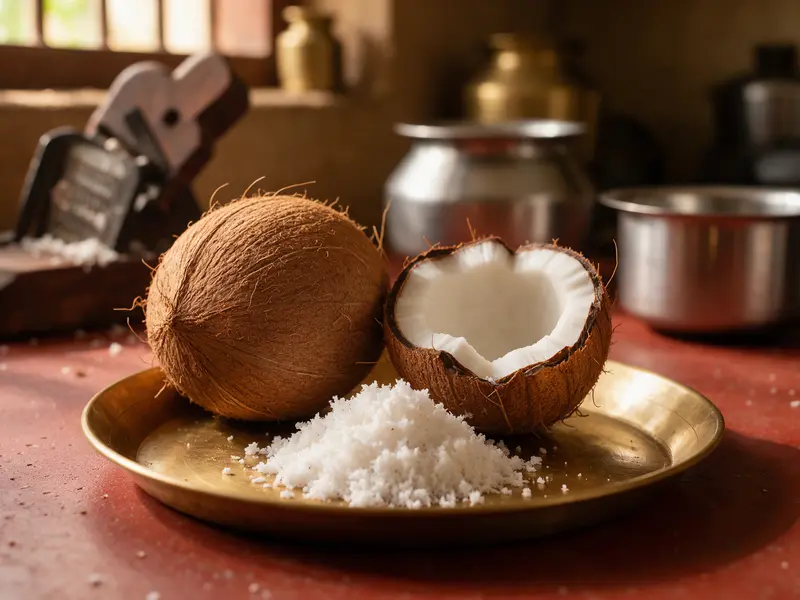
Grated coconut
Snowy fresh coconut, moist and milky-sweet, ground into lush golden masalas or roasted until fragrant, toasty and deeply aromatic.
Also called: kobbari (Telugu), nariyal (Hindi), narkel (Bengali), thengai (Tamil)
Taste: Naturally sweet, with a delicate flavour. Few sources say this.
Getting it ready
Grind it raw or roasted with spices into a paste for kootu, sambar or parippu curry; roasting until golden gives Kerala varutharacha sambar its flavour. Peel off the brown skin before grinding it for chutney.
Cooking with it
- Cook time: 10 minutes Few sources say this.
- Cook time: 2–3 minutes (open_pot)
Swaps
- chana dal: carrot chutney; taste changes Few sources say this.
- onion: kothamalli thogayal Few sources say this.
- coconut milk: subject grated coconut replaced by coconut milk; veg kurma; subject fresh coconut replaced by coconut milk; veg kurma
- poppy seeds Few sources say this.
- gram flour (besan): coconut-free version, 2 tbsp Few sources say this.
- curd (dahi): subject fresh coconut replaced by yogurt; veg kurma Few sources say this.
- khoya: lobia masala Few sources say this.
- desiccated coconut
- roasted chana dal Few sources say this.
If something goes wrong
No coconut available for kootu
- Ingredient unavailable
- Skip the ground coconut powder and add cumin to the tempering (talippu). to rescue
Keeping
Grate coconuts in bulk, freeze most and refrigerate a little; thaw briefly or grind with warm water. Batters made with coconut, such as appam, keep only briefly.
- Frozen: 21 days Few sources say this.
Another view: Some say frozen grated coconut keeps for many months. Some use frozen grated coconut for up to six months.
- In the fridge: 2–3 days Few sources say this.
Goes well with
Sprouted moong, Bitter gourd, Green chilli, Cumin seeds, Urad dal
Used to finish
- cholar dal, chopped or grated, fried light brown in ghee
- dalma, slices
- cabbage with moong dal, grated
- kheer and puddings, freshly grated
- rice dishes, freshly grated
- kanda poha, grated
- panta bhat, sliced
- millet porridge, sprinkled
- khaman, freshly grated
- set dosa, grated
- olive chutney, a pinch, scattered
- cham cham, sprinkled
- ada pradhaman, small pieces fried golden
- khandvi, grated
- patra, grated
- murungai keerai poriyal, grated
- kanda paat bhaji, grated
- lauki muthia
- moong dal dhokla
Used in
Dalma, Varan, Parippu curry, Appam, Khaman, Bisi bele bath, Mirchi ka salan, Gond ladoo, Coconut milk homemade, Mysore rasam, Shukto, Cholar dal, Kheer, Appam batter, Dhokla batter, Neer dosa batter, Akki roti dough, Coconut chutney, Coconut masala paste, Peanut-sesame-coconut paste, Red coconut chutney, Pottukadalai chutney, Peanut chutney, Sesame chutney, Paruppu thogayal, Akki roti, Coconut rice, Karanji, Murungai keerai poriyal, Patra, Puttu, Rava dosa, Sundal, Vegetable kurma
Seasons
Summer (Mar–Jun), eaten
Regions
South India, East India, Maharashtra, Goa, Karnataka, Tamil Nadu, Kerala, Kerala, Telangana
Festivals
Onam (Kerala), Vishu (Kerala), Raksha Bandhan (Maharashtra)
Tradition
South Indian cooking uses a lot of coconut largely because coconut palms grow in abundance there. It thickens South Indian yogurt curries in place of besan.
Take care
Choose a coconut with no cracks and no mould round the eyes; rancid or overpowering-smelling water means it has spoiled.
Seasonal food wheel
- On the tongue: Hearty
- After the meal: Hearty
- Warmth: cooling
- Texture: coarse
- Best seasons: summer, autumn, rains
Questions answered
Useful tips
- Use fresh grated coconut for coconut chutney. Freshly grated coconut gives the best coconut chutney; frozen grated coconut is the fallback, but coconut milk does not work as a substitute.
- Using frozen grated coconut. Let frozen grated coconut come to room temperature, roughly an hour out or a brief microwave thaw, then break up lumps and warm it in the pan.
- Freeze grated coconut in small portions. Freeze grated coconut in thin, small packs or as ice-cube-tray blocks bagged after a night, so you take out only what you need; date the bags and never refreeze it.
- Pinch test for narkel naru. The naru mixture is ready when a slightly cooled pinch rolls easily into a small ball. Few sources say this.
- Dry the coconut before grinding thogayal. Saute grated coconut in the hot pan until it dries out before grinding it into thogayal; roasting it golden also helps the chutney keep longer.
- Fresh or desiccated coconut in barfi. Fresh grated coconut can replace desiccated if lightly dry-roasted without browning; desiccated has less moisture and flavour, so it needs more milk, condensed milk or mawa.
- Dry-roast coconut before adding jaggery. Dry-roast grated coconut a few minutes, without browning, to drive off moisture before adding jaggery; fillings then set well and stay crisp-shelled.
- Coconut milk for ragi halbai. For ragi halbai, fresh grated coconut is ground with the soaked ragi to extract the milk. Few sources say this.
- Ragi halbai: extracting millet milk. For ragi halbai, soak finger millet 3–4 hours, grind it with fresh grated coconut, strain, and regrind the residue twice to collect the millet milk. Few sources say this.
- When to add coconut to a poriyal. In many dry preparations, grated coconut goes in once the pan liquid has evaporated, since adding it earlier can dull its flavour. Few sources say this.
- Quick ways to thaw frozen coconut. Frozen grated coconut can thaw on the counter, sit 5-10 minutes in hot water, get a short microwave burst, or be warmed in a pan and cooled before grinding.
- Tinned coconut cream in appam batter. Tinned coconut cream has been used in appam batter in place of fresh grated coconut, and the edges came out only a little less crisp. Few sources say this.
- Roasting coconut for a dark curry masala. On low heat, roast grated coconut with shallots, garlic, fennel, chillies and curry leaves for about 25 minutes, stirring constantly, until it is golden brown and very fragrant.
- Fresh or frozen coconut for kurma. Freshly grated coconut tastes better in kurma, but frozen grated coconut is fine. Few sources say this.
- Coconut and oil for neer dosa. A quarter cup of thin coconut milk can replace grated coconut in neer dosa; oil can be skipped on non-stick, though coconut oil adds flavour.
- Roasting coconut for masala. Pulse grated coconut coarsely before roasting so it browns evenly, and roast on low to medium heat without letting it burn. Few sources say this.
- Grinding coconut for milk. Grind the coconut with lukewarm rather than hot water; pieces instead of grated coconut also work, though they take longer. Few sources say this.
- Coconut in ragi roti. Grated coconut in ragi rotti dough can help stop it becoming chewy and hard. Few sources say this.
- Layering the puttu tube. Fill the puttu tube loosely without pressing the flour down, alternating with grated coconut, which adds softness and flavour but can be skipped.
- Frying coconut for pastes and rice. Fry grated coconut only until it starts to turn light golden; browner coconut darkens the dish.
- Coconut in lobia masala. Grated coconut in the lobia masala paste adds flavour and body but is optional. Few sources say this.
- Rava dosa variations and fillings. For onion rava dosa, scatter chopped onion on the greased tawa before pouring; grated coconut, cashews or a potato filling can also be added.
- Filling a puttu mould. Spoon the ragi flour into the puttu tube loosely without pressing it down, layering it with grated coconut. Few sources say this.
- Tossing patra slices. Steamed patra rolls are sometimes sliced and tossed in a pan with mustard seeds and grated coconut.
- Cooked millet and coconut need two minutes in the seasoning. Stir the cooked millet and grated coconut into the seasoning and cook them together for two minutes.
- Karanji. Karanji is a fried dumpling with a filling of grated coconut, jaggery and cardamom.
- Singodi. Singodi is a cardamom-scented sweet of khoya, grated coconut and sugar.
- Garijalu. Garijalu are filled with grated coconut and sugar scented with cardamom.
- Puttu. Puttu is steamed powdered rice layered with grated coconut.
- Sundal. Sundal is boiled gram or kala chana tossed with grated coconut, ginger and green chilli.
- Vegetarian patoler dolma. A vegetarian patoler dolma stuffs patol with grated coconut and chickpeas before frying.
- Rescue a bitter or too-hot chutney. Fix a bitter or too-hot chutney by adding coconut (sesame chutney) or tamarind plus a little jaggery (ginger chutney); bitterness also eases after chilling.
- Barfi that will not set. Barfi that won't set is usually undercooked: if moisture seeps out when pressed, cook it a few minutes more and set it again.
- Overcooked jaggery fillings turn hard. Stop cooking coconut-jaggery mixtures as soon as they come together: overcooked jaggery crystallises as it cools and makes naru or modak filling hard and chewy.
- Toast coconut with spices for kootu. For kootu, roast urad dal and dry chillies (often with cumin) in a little oil, then grind with coconut, usually raw, into a paste; some cooks toast the coconut too.
- Roast coconut until golden and fragrant for varutharacha masala. For varutharacha sambar, roast the coconut with the spices until it is golden and fragrant.
- Hotel-style sambar adds tamarind and coconut before the second cook. Hotel-style tiffin sambar recipes vary: a little fresh coconut is often added, usually ground into the masala, and a second pressure cook after adding tamarind is optional.
- Dalma: jaggery, coconut and spices go in while the dal and vegetables cook. Badia dalma recipes differ: bay leaf and ginger often cook with the dal and vegetables, while coconut, hing and sweetener go in during simmering, in the tempering or as garnish.
- Mustard tempering may slow souring of coconut dishes. A mustard-seed tempering on coconut chutneys and curries may help them sour more slowly. Few sources say this.
- Fry nuts and coconut first, then temper in the same oil. For Bengali cholar dal, coconut pieces can be fried first and set aside with the fat reused for tempering, fried in separate ghee, sauteed in the tempering itself, or added near the end.
- Huli masala coconut is ground raw. In huli tovve masala, the coconut is ground raw with the fried spices, not fried.
- Grate coconut in bulk and freeze. Grate coconuts in bulk, freeze most and refrigerate a little; thaw briefly or grind with warm water.
- Making coconut milk at home. Blend grated mature coconut with warm water and squeeze for the thick first extract, then repeat for thinner second and third extracts.
- Savoury vadapappu variation. For a savoury vadapappu, mix grated raw mango, green chilli, coconut, coriander and salt into the soaked dal. Few sources say this.
- Desiccated coconut versus fresh. Dried coconut keeps far longer than fresh but lacks its delicate flavour; it is usually lightly roasted for chutney powders and dry masalas. Few sources say this.
- Frying poha and coconut for chivda. Keep the oil at medium for chivda; fry poha in a fine metal strainer lowered into the oil for about a minute until crisp and barely coloured. Few sources say this.
- Drying coconut strips in the oven. Dry fresh coconut strips for snacks in a very low oven, about 93 °C, until crisp but still white; browning means the oven is too hot. Few sources say this.
- Fried urad dal as a spice base. Fry a spoon of urad dal in ghee about 2 minutes until lightly golden, with cumin, coriander seed, pepper, chilli and coconut, as a spice base for spinach dal. Few sources say this.
- Choosing a good coconut. Pick a coconut with no cracks and no mould round the eyes that feels heavy and sloshes when shaken; rancid or overpowering-smelling water means it has spoiled. Few sources say this.
- Cracking a coconut in the oven. After draining the water, 10 to 15 minutes in a 200 °C oven cracks a coconut's shell and helps the flesh come free. Few sources say this.
- Fresh coconut chutney: peel the brown skin. Fresh coconut makes a naturally sweet coconut chutney; peel off the brown skin with a vegetable peeler before chopping and grinding. Few sources say this.
- Use leftover pan heat for delicate additions. Add coconut, coriander leaves or quick-burning spices after switching off the stove and let the pan's leftover heat toast or wilt them.
- Stir constantly as sweets dry out at the end. Stir continuously on low heat near the end of cooking atta halwa or coconut barfi; the drying mixture burns fast.
- Setting coconut barfi. Coconut barfi sets at room temperature as well as in the fridge; in hot weather it may need overnight, and the fridge can speed it up.
- Roast sesame and coconut pale. Don't let sesame or coconut darken while roasting for til ladoo, or the flavour suffers. Few sources say this.
- Coconut-jaggery filling for enduri. Cook the coconut and jaggery on medium for about 5-7 minutes until it browns, then stir in cardamom; one source cools it fully before filling. Few sources say this.
- Roast coconut slowly for pitlai paste. When toasting coconut with spices, low heat and close watching help, as coconut scorches quickly. Few sources say this.
- Guava chutney variations. Garlic can be blended into guava chutney.
- Coconut in beetroot poriyal for lunchboxes. For a lunchbox, saute the coconut well so it keeps better, adding it at the end and cooking only briefly. Few sources say this.
- Grind desiccated coconut with warm water for chutney. When fresh coconut is not at hand, blend desiccated coconut with warm water so it behaves more like fresh coconut in chutney.