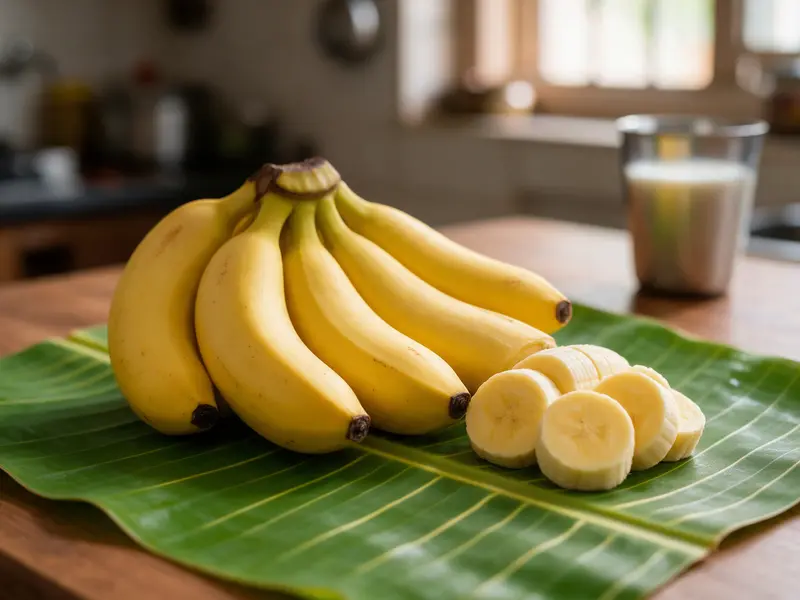
Banana
Soft, sun-ripened banana, creamy and golden, melting into a mellow, honeyed sweetness, or crisping in ghee into caramel-edged fritters.
Also called: kela (Hindi)
Taste: Grows sweeter as ripening turns its starch to sugar. Few sources say this.
Texture: Softens as it ripens; naturally soft fruits like banana are easy for elders to eat.
Getting it ready
Cut banana browns in air; coat it with lime juice and sugar, a light syrup or cream. South Indian cooks sauté ripe banana with spices before folding it into yogurt.
Keeping
Keep bananas on the counter, since cold blackens the skin, and away from greens, cucumbers and carrots, which their ethylene affects. An apple in a paper bag speeds ripening.
Used to finish
- millet porridge, chopped
Used in
Unniyappam, Fruit chaat, Mangalore buns, Khajur milkshake, Banana chips, Koat pitha, Curd rice, Kosambari, Malpua, Rava kesari, Thoran
Seasons
Spring (Mar–Apr), availability; Winter (Nov–Feb), eaten
Regions
Assam, Karnataka
Festivals
Ugadi (Andhra Pradesh), Onam (Kerala)
Goes well with
Nutrition
A fruit that brings natural sweetness, fibre and potassium. Demo note.
Questions answered
Useful tips
- Stop cut banana and apple browning. Cut banana and apple brown in air; coat them with lime juice and sugar, a light syrup or cream to slow it. Few sources say this.
- Turmeric for banana chips. Turmeric gives banana chips their golden colour; adjust the amount but do not leave it out.
- Why cut brinjal, potato and banana turn brown. Cut or bruised potato, apple and banana brown when enzymes act on their phenolic compounds in the presence of oxygen.
- Fried banana dumplings. Fried banana dumplings are a west-coast tea-time sweet, also made as temple prasaad for Ganesh; ripe plantains are traditional. Few sources say this.
- Banana halwa. Banana halwa is ripe banana cooked with ghee, sugar, cardamom and dry fruits until smooth and thick.
- Banana bonda. Banana bonda is a deep-fried snack made with banana.
- Ripen fruit in a paper bag. Put unripe fruit such as mango or banana in a closed paper bag to ripen it faster.
- Soft fruits for elders. Banana, chikoo, pear and other naturally soft fruits, or fruit milkshakes, are easy to eat with little chewing. Few sources say this.
- Banana pachadi is sautéed; northern fruit raitas are raw. In South India ripe banana is often sautéed with ground spices before folding into yogurt, while in North India fruit usually goes raw into raitas. Few sources say this.
- Ferment unniyappam rice batter. Soak the rice long enough and ferment only the ground rice; mix in jaggery, banana and the rest just before frying for soft unniyappam. Few sources say this.
- Fruit chaat: avoid watery fruit and add soft fruit last. Avoid watery fruit like watermelon, papaya and cantaloupe in fruit chaat, and add banana and mandarin just before serving so they do not go mushy. Few sources say this.
- Banana for Kerala chips. Kerala banana chips call for nendran bananas that are still fully green and unripe.
- Bananas for chips. For banana chips choose fully raw, green-skinned, fairly thick nendran bananas; their extra starch gives crisper chips with a distinct flavour.
- How kolakhar is made. Kolakhar comes from banana trunk, rhizome and peels sun-dried for weeks and burnt; water filtered through the ash in a bamboo sieve is the kolakhar.
- Making natural khar. Natural khar comes from the seeded Bhimkol banana: its pseudo-stem, corm and peel are sun-dried and burnt, and water is filtered through the ash.
- Frying koat pitha. Fry koat pitha on medium to low heat, as the fritters brown and burn quickly, and cool them before eating since the banana stays gooey when hot. Few sources say this.
- Which fruits ripen after picking. Mango, papaya, banana and tomato keep ripening after picking, while citrus, grapes, pineapple and melon do not ripen further. Few sources say this.
Another view: A pineapple still mostly green can be left in sunlight for a day or two to ripen.
- Laying a sadya leaf. For a sadya the banana leaf is laid with its narrow tip to the left, and serving starts on the lower half.
- Bananas stay out of the fridge. Bananas usually keep better on the counter, since cold turns their skins black. Few sources say this.
- Plantain halwa. Cook puréed very ripe plantain with ghee and sugar about 30 minutes until it thickens and leaves the pan, then spread 1 inch thick to cool and cut. Few sources say this.
- Fry unniyappam gently for softness. High heat or long frying gives crisp unniyappam; fry on moderate heat, turn when golden and stop when a toothpick comes out clean.
- Overripe small bananas for unniyappam. Use overripe small bananas for unniyappam flavour, not plantains or Cavendish. Few sources say this.
- Use ripe bananas for Mangalore buns. Use overripe bananas and mash them well.
- Making kolakhar at home. Kolakhar is made by burning sun-dried peels of ripe bhim kol bananas and steeping the ash in water overnight, then straining off the clear dark-brown liquid.
- Separate ethylene-producing fruit. Ripe bananas and apples give off ethylene, so store them away from leafy greens and other produce.
- Which fruits ripen after picking. Bananas, mangoes and papaya can be picked mature and ripened at home, but oranges do not ripen after picking; ripening turns starch to sugar and softens the fruit. Few sources say this.
- Monsoon food in Bengal: warming curries, fritters and chai. In Bengal, rainy monsoon days call for crisp fritters, usually with hot chai.
- Malpua uses late-winter surplus. Holi malpua batter can take spring wheat and overripe late-winter fruit such as banana, using up seasonal surplus. Few sources say this.
- Makara chaula in Odisha. In Odisha, makara chaula of new rice, banana, coconut, jaggery and milk is offered to the sun, new rice being regarded as especially full of life. Few sources say this.
- Seasonal fruit on Puthandu. The Puthandu feast uses seasonal produce such as raw mango, raw banana and jackfruit, and includes mukkani: mango, jackfruit and banana. Few sources say this.
- Telangana and Andhra pachadi differ. Telangana sweetens Ugadi pachadi with jaggery alone, while some Andhra homes also add banana. Few sources say this.
- Khar, Assam's alkaline cooking liquid. Khar is a dark, alkaline liquid strained through the ash of dried bhim kol banana peels, and dishes made with it, from bottle gourd to banana stem, share the name. Few sources say this.
- Pazham pori. Pazham pori, a Kerala teatime snack, is ripe banana dipped in a maida batter and deep fried.
- Malpua. Malpua are flour pancakes fried in ghee and soaked in sugar syrup; the Bihar version adds milk, mashed banana and sugar to the batter.