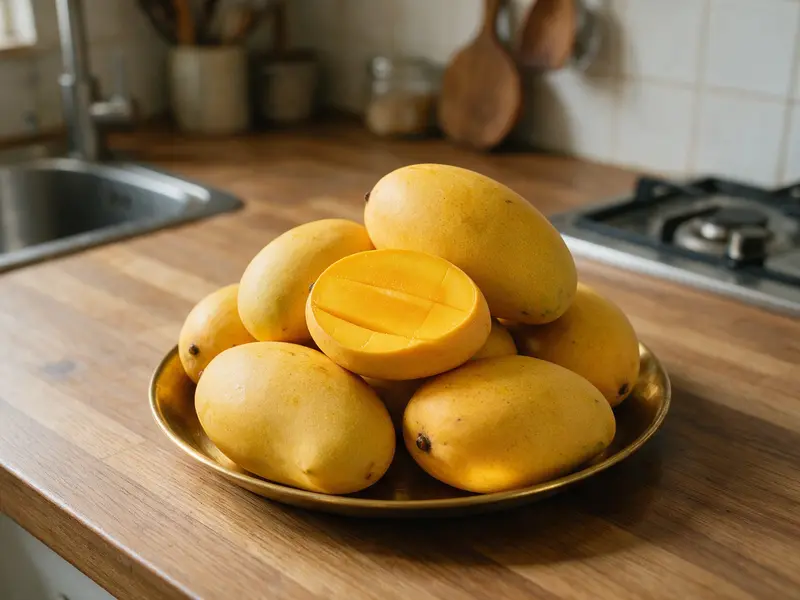
Mango
Luscious sun-gold mango, velvety and dripping with honeyed, perfumed juice, its tropical sweetness glowing through creamy shrikhand and silken chutneys.
Also called: aam (Hindi)
Taste: A ripe mango smells strongly sweet, with no sour note. Few sources say this.
Texture: A ripe mango yields slightly to gentle pressure; the heavier it feels for its size, the juicier.
Getting it ready
Stir mango pulp into shrikhand for amrakhand. Canned mango pulp, about 1 cup per large mango, can replace fresh in mango chutney.
Keeping
Ripe mangoes give off ethylene, so keep them away from greens, cucumbers and carrots. To ripen one faster, put it in a paper bag with an apple.
- Frozen: 365 days Few sources say this.
Goes well with
Used to finish
- balushahi, small cubes
Used in
Coconut chutney, Balushahi, Fruit chaat, Aamras, Pularisi koozh, Aam kasundi Few sources say this., Aam panna Few sources say this., Avakaya, Kaddu ki sabzi, Kancha aamer chutney, Lassi, Mamidikaya pappu Few sources say this., Mango chutney preserve, Mango lassi, Mango pickle Few sources say this., Methi thepla, Methia keri Few sources say this., Mor kuzhambu, Pulissery Few sources say this., Puri
Seasons
Summer (Mar–Jul), availability; Summer (Apr–Jun), availability; Summer (Mar–Jul), harvest; Summer (Apr–Jul), availability; Summer (Jun–Jul), availability; Summer (Apr–May), availability Few sources say this.
Regions
Punjab, Uttar Pradesh, West Bengal, Gujarat, Andhra Pradesh, Konkan
Festivals
Vishu (Kerala), Puthandu (Tamil Nadu), Jamai Sasthi
Seasonal food wheel
- On the tongue: Hearty
- After the meal: Hearty
- Warmth: warming
- Texture: medium
- Best seasons: late winter, early winter, rains
Questions answered
Useful tips
- Amrakhand is mango shrikhand. Stir mango pulp into shrikhand to make amrakhand.
- Home mango juice. For bottled mango juice, cut away bruised or worm-damaged parts and sweeten with about 5–10 percent sugar depending on the fruit. Few sources say this.
- Choosing a ripe mango. A good mango usually smells sweet with no sour note and yields slightly to gentle pressure. Few sources say this.
- Hard unripe mango can replace Indian green mango. If Indian green mangoes are unavailable, use a large, very hard unripe mango instead. Few sources say this.
- Cooking a mango chutney. Cook mango with sugar, spices and vinegar, covered, on low for 50–60 minutes, stirring now and then, until soft and thick; cool fully before jarring. Few sources say this.
- Choosing a ripe mango. A ripe mango usually smells strongly sweet with no sour note and yields slightly to gentle pressure, and the heavier it feels for its size the juicier it tends to be. Few sources say this.
- Canned mango pulp for mango chutney. Canned mango pulp, preferably Alphonso, can replace fresh ripe mango in mango chutney, about 1 cup pulp per large mango. Few sources say this.
- Ripe mango in summer mor kuzhambu. In ripe-mango season, mor kuzhambu can be made with ripe mango.
- Mango pulp for lassi out of season. Canned mango pulp can replace fresh mangoes so mango lassi can be made out of season.
- Keep mango lassi cold without thinning it. Use chilled mango, curd and milk, and blend in ice cubes to chill mango lassi without watering it down.
- Order of blending mango lassi. Blend the mango pulp with the sugar first, then the curd, then the crushed ice.
- Fruit choice for chire doi aam. Any other fruit can stand in for mango in chire doi aam.
- Mango kootu balances sweet and sour. Mango kootu is a South Indian summer dish in which yogurt and chillies balance the sweetness of ripe mango and coconut milk. Few sources say this.
- Sweetening aamras to the mango. Taste the pulp before adding any sugar; sweet mangoes may need none, while sour ones need more sugar when you blend.
- Mangoes for mango lassi. Use fully ripe, sweet Indian mangoes such as Alphonso, Kesar, Badami, Dusheri, Neelam or Raspuri for a creamy lassi, chilled first.
- Sweetening mango lassi. Start with 1 to 2 tablespoons of sugar, or none if the mangoes are very sweet, and adjust to the fruit and the sourness of the curd.
- Ripen fruit in a paper bag. Put unripe fruit such as mango or banana in a closed paper bag to ripen it faster.
- Carotene colours survive normal cooking. The orange-yellow carotenoids in carrot, pumpkin and mango hold their colour in acid, alkali and ordinary cooking; only very long cooking may darken them. Few sources say this.
- Which fruits ripen after picking. Mango, papaya, banana and tomato keep ripening after picking, while citrus, grapes, pineapple and melon do not ripen further. Few sources say this.
Another view: A pineapple still mostly green can be left in sunlight for a day or two to ripen.
- Raw-mango dal and aamras on Akshaya Tritiya. Raw-mango dal and aamras are often made on Akshaya Tritiya because the day falls in the summer mango season. Few sources say this.
- Mango lassi at Baisakhi. Lassi, including mango lassi, is a popular Baisakhi drink for the hot weather of that season.
- Neem flower and mango pachadi for Puthandu. For Puthandu, neem flower goes into mango pachadi, the one time it is used; its bitterness reminds families to take hard times with good.
- Mango and jackfruit in Vishu cooking. Mango and jackfruit feature heavily in Vishu cooking, and tender jackfruit is a favourite in Kerala summers. Few sources say this.
- Mango pulp with puris in mango season. In Maharashtra, Gujarat and Rajasthan, households traditionally eat aamras (Gujarati kairi no ras) with puris or thepla during mango season, April to June. Few sources say this.
- Punjabi chutney bases. Mango and dhania are both used as bases for Punjabi chutney.
- Gojju. Gojju is a sweet, sour and spicy dish of vegetables or fruit such as pineapple or mango cooked in tamarind juice.
- Loosening aamras that is too thick. If aamras turns out too thick, add a little milk or water at a time until it reaches the consistency you like.
- Serve aamras chilled. Aamras is at its best cold: chill it in the fridge for about an hour before serving and keep any left over refrigerated.
- Prepping whole mangoes for pulp. Before peeling, soak whole mangoes in water for around 30 minutes and roll each one between your palms so the flesh softens for pulping.
- Use firm raw mangoes for pickle. Choose firm, raw green mangoes for pickling; ripe ones turn mushy and spoil quickly.
- Separate ethylene-producing fruit. Ripe bananas and apples give off ethylene, so store them away from leafy greens and other produce.
- Which fruits ripen after picking. Bananas, mangoes and papaya can be picked mature and ripened at home, but oranges do not ripen after picking; ripening turns starch to sugar and softens the fruit. Few sources say this.
- Summer produce on the table. Traditionally, summer meals feature mangoes, melons, watermelon, cucumber, tender coconut, okra, jackfruit, pumpkin, litchi, jamun, palm fruit and foxtail millet. Few sources say this.
- Summer treats are set aside when the rains come. Once the rains arrive, households traditionally set aside summer treats such as panipuri, mangoes, popsicles and lemon sherbet. Few sources say this.
- Do not freeze overripe mangoes. Freeze only mangoes that are ripe but firm; overripe ones are not suited to freezing. Few sources say this.
- Summer fruit on the Jamai Sasthi table. Mango, litchi, jackfruit and jamun are often served on Jamai Sasthi because Bengal's summer orchards are full then. Few sources say this.
- Seasonal fruit on Puthandu. The Puthandu feast uses seasonal produce such as raw mango, raw banana and jackfruit, and includes mukkani: mango, jackfruit and banana. Few sources say this.
- The Vishu kani. A Vishu kani is usually arranged with mango, jackfruit, rice, lemon, golden cucumber, konna flowers and betel leaves to symbolise nature's abundance. Few sources say this.
- Puran poli with aamras in Khandesh. In Maharashtra, Akshaya Tritiya is often marked by eating puran poli with aamras. Few sources say this.