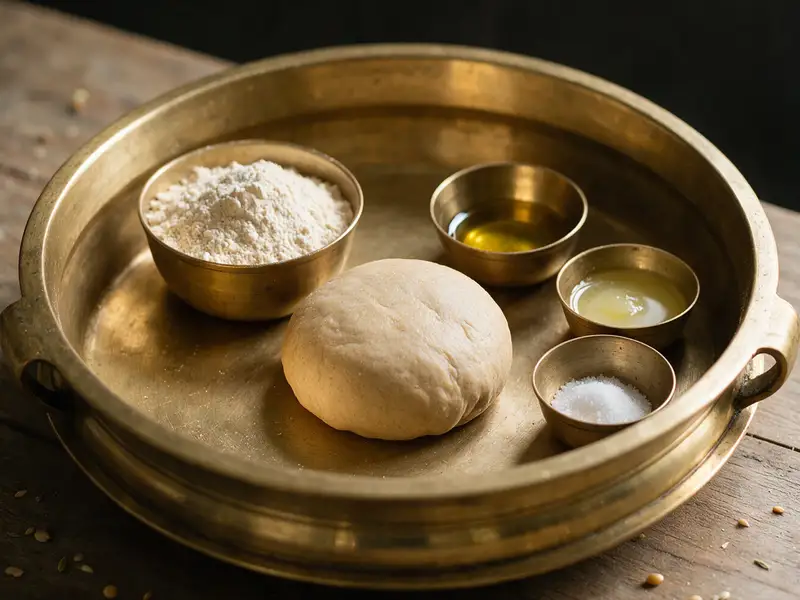
Paratha dough
Taste: Mild and savoury. Made mostly from whole wheat flour and ghee.
Paratha Dough (plain round, oil and ghee)
A soft, pliable whole-wheat dough enriched with ghee, ready to fold into flaky layers that blister golden and buttery on the tawa.
Ingredients
Dough
- 2 cup whole wheat flour (atta), 240 g
- 1 to 2 tsp vegetable oil, or ghee
- ½ tsp salt, or as needed
- ½ cup water, or as needed
Cooking
- as needed ghee, or oil, for layering and roasting
Method
- Combine the atta, the oil or ghee and the salt in a bowl.
- Pour in the water a little at a time, mixing and kneading between additions rather than adding it all at once. Splash in more water if the dough feels dry, or dust in flour if it sticks.
- Cover the dough with a towel and leave it for 30 minutes (room conditions not stated).
- Pinch off a medium ball, flatten, dust with flour and roll to a 4-inch round. Brush with ghee, fold in half, brush again and fold into a triangle; dust and roll out to about 6-7 inches. (Alternatively fold the greased round from four sides into a square and roll.)
- Heat a tawa on medium. Test it with a pinch of flour, which should brown within seconds; wipe it off.
- Lay the paratha on the tawa; flip once the underside is lightly browned and air pockets appear, then smear ghee on the top. Flip again when spotted brown and grease that side too. Keep turning, pressing the edges, until evenly spotted on both sides. Use medium heat for a thin pan, medium-high to high for a heavy one.
- Keep cooked parathas covered in a casserole while you roll and cook the rest; serve hot with dal, curry or pickle.
Tips for this version
- Use leftover dal or bhaji in place of some kneading water for parathas, adding a little extra salt and spice.
- Fat such as ghee coats protein strands and slows gluten formation: a little makes dough more extensible, a lot makes it tender.
- Pleat the dough over the filling, pinch off excess dough and seal with no air inside, then roll slowly with light pressure.
- Rub oil or ghee into the flour and salt before adding warm water, for a soft but firm paratha dough.
- Parathas stay raw inside when parts are thick, the filling is damp or clumped, or the heat browns the outside first; lower the heat rather than cooking longer.
- Rest wheat dough covered after kneading; relaxed gluten makes it supple and easy to roll.
- Add water to a dough gradually and only as much as it needs; pouring it all in makes a sticky dough that is hard to roll.
- Smearing fat and dusting dry flour between the folds keeps layers from fusing, giving thin flaky parathas; use enough but not too much.
Paratha Dough (triangle-folded)
A soft, pliable whole-wheat dough enriched with ghee, ready to fold into flaky layers that blister golden and buttery on the tawa.
Ingredients
Dough
- 2 cups whole wheat flour (chapati atta), plus extra for dusting
- 2 tsp oil, in the dough
- ½ tsp salt
- 0.75 cup + 2 tbsp water, room temperature or warm, as needed
- 1 tsp oil, to coat the dough
Cooking
Method
- Mix flour and salt, rub in the oil, then add water bit by bit and knead with the heel of the hand (or a stand mixer on low) to a smooth, medium-soft dough, neither sticky nor stiff.
- Coat with a teaspoon of oil, cover and rest 10-15 minutes (at least 15 advised); conditions not stated.
- Knead briefly, cut into 8, shape balls, flatten and dust with flour; roll each to about 6 inches.
- Oil the round, fold the thirds over each other, oil again and fold the sides into a square (or fold in half twice to a triangle); dust and roll out evenly, turning as you go.
- Cook on a tawa at medium-high: flip when bubbles show (about 30 seconds), oil 1-2 tsp per side, press gently, until both sides have golden-brown spots and crisp edges.
Tips for this version
- Use leftover dal or bhaji in place of some kneading water for parathas, adding a little extra salt and spice.
- Fat such as ghee coats protein strands and slows gluten formation: a little makes dough more extensible, a lot makes it tender.
- Pleat the dough over the filling, pinch off excess dough and seal with no air inside, then roll slowly with light pressure.
- Rub oil or ghee into the flour and salt before adding warm water, for a soft but firm paratha dough.
- Parathas stay raw inside when parts are thick, the filling is damp or clumped, or the heat browns the outside first; lower the heat rather than cooking longer.
- Rest wheat dough covered after kneading; relaxed gluten makes it supple and easy to roll.
- Add water to a dough gradually and only as much as it needs; pouring it all in makes a sticky dough that is hard to roll.
- Smearing fat and dusting dry flour between the folds keeps layers from fusing, giving thin flaky parathas; use enough but not too much.
Paratha Dough (square-folded)
A soft, pliable whole-wheat dough enriched with ghee, ready to fold into flaky layers that blister golden and buttery on the tawa.
Ingredients
Dough
- 2 cups whole wheat flour
- 0.75-1 cup water, added gradually
- ½ tsp salt
- 2 tsp oil
Cooking
- 2-3 tbsp ghee, or oil, for layering and cooking
Method
- Combine flour, salt and oil, add water gradually and knead smooth.
- Smear with oil, cover and rest 15-20 minutes (conditions not stated).
- Roll a ball into a small disc, spread ghee or oil, and fold into a square (four folds, oiling each) or a triangle (half, then half again); dust and roll to about 6 inches.
- Cook on a medium-hot tawa 1-2 minutes until small bubbles appear, flip, drizzle ghee or oil on each side in turn until golden spots show on both.
Tips for this version
- Use leftover dal or bhaji in place of some kneading water for parathas, adding a little extra salt and spice.
- Fat such as ghee coats protein strands and slows gluten formation: a little makes dough more extensible, a lot makes it tender.
- Pleat the dough over the filling, pinch off excess dough and seal with no air inside, then roll slowly with light pressure.
- Rub oil or ghee into the flour and salt before adding warm water, for a soft but firm paratha dough.
- Parathas stay raw inside when parts are thick, the filling is damp or clumped, or the heat browns the outside first; lower the heat rather than cooking longer.
- Rest wheat dough covered after kneading; relaxed gluten makes it supple and easy to roll.
- Add water to a dough gradually and only as much as it needs; pouring it all in makes a sticky dough that is hard to roll.
- Smearing fat and dusting dry flour between the folds keeps layers from fusing, giving thin flaky parathas; use enough but not too much.
Questions answered
- Should paratha dough be firmer than chapati dough?
- How do rolling thickness and tawa temperature affect paratha dough?
- Why does paratha dough become hard, dry, chewy, uneven or fail to puff?
- How long should dough for paratha dough rest, and what does resting change?
- How can paratha dough be kept soft and reheated without losing its texture?
- What flour, water ratio and kneading method give good results with paratha dough?