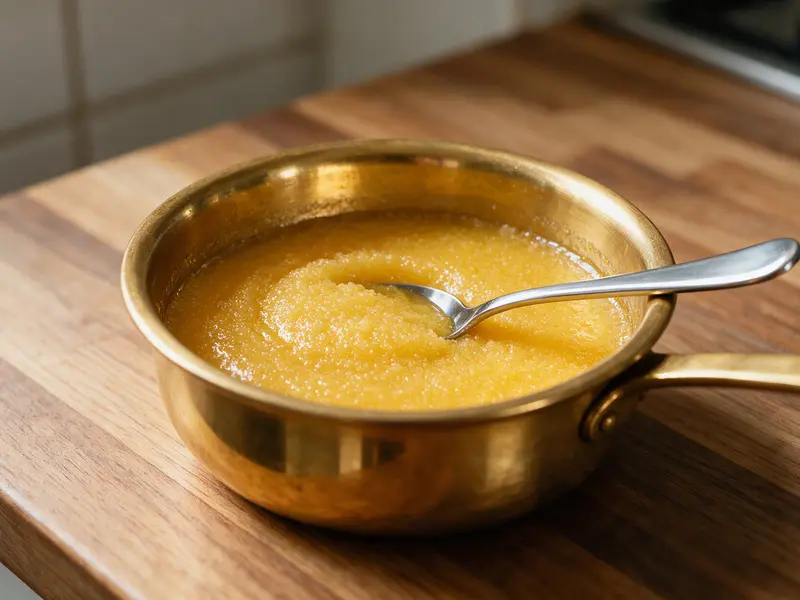
Ghee
Golden, gently nutty ghee, glossy and warm, blooming spices in a fragrant sizzle and pooling in rich, aromatic ribbons over steaming dal.
Also called: desi ghee (Hindi), nei (Tamil), neyyi (Telugu), tuppa (Kannada)
Taste: Rich and aromatic; properly clarified ghee has a fuller flavour.
Texture: Cow ghee is deep yellow and buffalo ghee white with a yellowish tint. Its graininess depends on its fatty-acid make-up.
Getting it ready
Temper spices in hot ghee, lowering the heat once seeds pop so they do not scorch; a cumin seed that sizzles at once shows it is ready. A spoon stirred in at the end finishes dal with aroma.
Cooking with it
- Cook time: 15–20 minutes (open_pot) Few sources say this.
Swaps
- mustard oil: tahari Few sources say this.
- coconut oil
Another view: Some say ghee should not be replaced in panjiri.
- vegetable oil: subject ghee replaced by oil; bele saaru
If something goes wrong
Dal feels heavy
- Large amount of ghee (e.g. 4 tbsp) Few sources say this.
- Use less ghee or swap in oil for everyday meals. to prevent Few sources say this.
Ghee too hard to scoop in cold weather
- Cold temperatures crystallise the fat; this is not a fault
- Set the jar in a bowl of warm water, or warm the amount needed in a small pan. to rescue Few sources say this.
- Leave it out to soften, kept somewhere cool and away from light. to rescue Few sources say this.
Keeping
At room temperature ghee keeps about four and a half months, with sources ranging from one to nine; refrigerated, about a year. Keep it in a clean, dry, airtight glass or steel jar away from sunlight, and use a dry spoon.
- At room temperature: 30–239 days
- In the fridge: 364–365 days
Goes well with
Cumin seeds, Whole wheat flour (atta), Gond, Black pepper, Garlic
Used to finish
baati, dipped, makki ki roti, smeared, missi roti, brushed, ragi roti, smeared lightly, arhar dal, 1-2 tsp, a spoonful, bhaja muger dal, a drizzle on top, cholar dal, a drizzle, dalma, 1 tbsp, stirred in off the heat, gujarati dal, a drizzle, mudda pappu, a dollop, panchmel dal, 1-2 tsp, a drizzle, mosur dal, a dollop, parippu curry, a drizzle, plain dal, a dollop, tomato pappu, a dollop on top, varan, a drizzle, mulligatawny, a little, stirred in, bengali khichuri, stirred in, bisi bele bath, hot, poured over, millet porridge, poured over with the nuts, qubooli, a drizzle, ven pongal, a drizzle, moong dal khichdi, a drizzle, dal and rice, a dollop, pesarattu, a drizzle, idli, a drizzle, dosa idli and uttapam, melted, drizzled, dry bhindi, a drop, shukto, a spoonful over the top, unniyappam, a drizzle, modak, a drizzle, puran poli, smeared, aloo paratha, a drizzle, gobi paratha, spread, mooli paratha, spread, paneer paratha, brushed, lachha paratha, a drizzle, tandoori roti, brushed, rumali roti, brushed, litti, a dip in hot ghee, roti, brushed, mandia pej, a spoonful, chakuli pitha, spread, chhurpi, a drizzle, siddu, a drizzle, khamiri roti, spread generously, murungakkai sambar, a teaspoon, jau ki roti, brushed, lau ghonto, kumro chokka, nellikai sadam, aamras, drizzle, palak roti
Used in
Bhaja muger dal, Dalma, Dal makhani, Panchmel dal, Khatti meethi dal, Dal tadka, Mudda pappu, Parippu curry, Tomato pappu, Tomato rasam, Roti, Jowar bhakri, Makki ki roti, Ven pongal, Bisi bele bath, Moong dal khichdi, Kadhi pakora, Khichdi base (rice-moong), Panjiri, Gond ladoo, Jeeraga rasam, Sabudana khichdi, Sarson da saag, Moong dal soup, Saag paneer, Baati Few sources say this.
Seasons
Winter (Nov–Feb), eaten
Regions
North India, South India, Punjab, Uttar Pradesh, Rajasthan, West Bengal, Tamil Nadu, Haryana, Awadh
Festivals
Janmashtami, Lohri (Punjab), Pongal (Tamil Nadu)
Tradition
A spoon of ghee on hot rice and dal is a daily habit in many Indian homes, and ghee is used in temple and festive food.
Take care
Contains milk.
Nutrition
Ghee is almost all fat, so a little goes a long way. Demo note.
Questions answered
Useful tips
- Fix crumbly ladoo or dry panjiri with warm ghee. If the ladoo mixture crumbles and won't bind, or the panjiri feels dry and hard to swallow, work in a little more warm, melted ghee.
- Salvaging ghee that has scorched slightly. If ghee catches, pour it off at once, leaving the bottom unscraped, then let it cool and strain it through a fine sieve or cloth.
- A household fix for off-smelling ghee. One blog clears an odd smell from ghee by heating it with plain curd, roughly 50 g to a kilo, until the curd browns, then resting and straining it. Few sources say this.
Another view: Some rescue off-smelling ghee by reheating it with curd; the safer rule is that ghee with a strong unpleasant smell should be thrown out.
- Roast pepper and cumin in ghee for rasam. Roast pepper and cumin until fragrant, in a little ghee or dry, then crush them in a mortar.
- Stir ghee into dal at the end. A little ghee stirred in during the last minutes or added when serving finishes the dal with aroma.
- Pour garlic fried in ghee over saaru at the end. For hesaru bele saaru, fry chopped garlic in ghee for about a minute and pour it over at the very end. Few sources say this.
- Ghee and stacking keep rotis soft. Smear hot rotis with ghee and stack them; the trapped warmth keeps them soft.
- Use a clean, dry spoon for pastes and ghee. Always take out ginger-garlic paste or ghee with a clean, dry spoon so no water or food bits get into the jar.
- Curry leaves or rock salt in ghee. A few curry leaves, some rock salt or a moringa sprig added as ghee finishes cooking may help it keep longer. Few sources say this.
- Strain ghee well. Thoroughly strained ghee usually keeps longer and tastes better. Few sources say this.
- Refresh reheated torkari with garam masala and ghee. When reheating yesterday's torkari, a pinch of Bengali garam masala with a little ghee freshens it up. Few sources say this.
- A spoon of ghee at the end for a restaurant finish. Stir a spoonful of ghee into a curry or vegetable dish near the end of cooking for extra flavour and richness.
- Ghee should shimmer before spices go in. Heat the ghee until its surface shimmers before adding the tempering spices.
- Roast atta in ghee for gond ladoo. For gond ladoo, roast the atta in ghee until it smells nutty and turns golden.
- Roasting atta for panjiri in ghee. Roast the atta for panjiri in ghee until it turns golden brown.
- Frying nuts in ghee. Nuts fried in ghee usually do best on medium-low, only until brown tinges show; too hot and the outside roasts while the inside stays raw. Few sources say this.
- Use ghee rather than butter for halwa. Ghee rather than butter is usually preferred for halwa where available, as it gives a better flavour. Few sources say this.
- Soak baatis in ghee. Dip hot Rajasthani baatis in plenty of melted ghee after cooking. Few sources say this.
- Do not skimp on ghee in the tempering. Do not cut the ghee in a ghee tempering; it carries the dish's aroma. Few sources say this.
- Ghee tempering at the start or the end. A ghee tempering can go in at the start or, as a variation, at the end with the flame off; finishing ghee can also be stirred in for richness.
- Soak baati in ghee for softness. For a softer baati, leave it in the ghee for about 15 minutes instead of giving it a quick dip. Few sources say this.
- Brush air-fried vadas with ghee. Brush air-fried vadas with ghee as soon as they come out. Few sources say this.
- Roast thogayal dal in ghee for flavour. Roasting the dal for paruppu thogayal in ghee rather than oil gives more flavour. Few sources say this.
- Ghee for flavour in fried sweets. Frying jalebi or boondi in ghee, half ghee and half oil, or oil with 2 to 3 tablespoons of ghee added gives a better ghee flavour.
- Keep the ghee emulsified in ghevar batter. Whisk the water into the ghee and flour gradually so the ghee stays emulsified in the ghevar batter. Few sources say this.
- Do not cut the ghee in halwa. Do not cut the ghee in moong dal or atta halwa; less ghee gives a poor halwa.
- Karah prasad is done when the ghee separates. Cook atta halwa (kadah prasad) until the ghee separates at the edges. Few sources say this.
- Line the chhena poda pan with leaves or ghee. Line the tin with banana or sal leaves, or grease it well with ghee: this gives chhena poda its caramelised crust, and leaves add an earthy aroma.
- Fresh ghee for richer sweets. Fresh, ideally homemade, ghee gives sweets like mysore pak and rava kesari a noticeably richer flavour and aroma.
- Ghee frying or appe pan for unniyappam. Unniyappam is traditionally deep-fried in ghee; an appe pan with a little ghee is a lighter option. Few sources say this.
- Add ghee to mysore pak in portions. Cook mysore pak on a low flame and add the ghee in portions, because the besan soaks it up fast. Few sources say this.
- Hot ghee and a firm dough for karanji cover. Mix hot ghee into the flour to make the karanji cover flaky, and keep the dough firm yet pliable, since a soft dough soaks up more oil. Few sources say this.
- Press test for rubbed-in ghee. Enough ghee has been rubbed into the flour for shakarpara when a pressed handful holds its shape. Few sources say this.
- Take the ghee off the heat before tempering raita spices. For a raita tempering, take the hot ghee off the heat before adding cumin and chilli, then let them splutter in the retained heat. Few sources say this.
- Build nimki layers with ghee and gentle folding. For flaky nimki, roll tightly, spread ghee and flour between the folds and fold gently without pressing hard. Few sources say this.
- Pour hot ghee over tikki spices. Pouring very hot ghee over the spices for aloo tikki takes away the raw taste of the chilli powder. Few sources say this.
- Be generous with ghee when toasting paneer paratha. Toast paneer parathas with ghee.
- Crush hot litti and dip in ghee. Crack each litti slightly as soon as it comes off the heat, then dip it in hot ghee.
- Shallow-fry koki slowly in ghee. Cook koki on a slow flame with ghee until golden brown on both sides; shallow frying in ghee is traditional.
- Shallow-frying anarsa in ghee. Another method shallow-fries anarsa in hot ghee on low heat until crisp and brown on both sides. Few sources say this.
- Traditional way of making ghee. Traditional ghee starts with boiled milk set into curd, hand-churned into white butter, then melted on a low flame until the bubbling settles and the golden fat is strained.
- Kartik (habisa) dalma: no onion or garlic, ghee instead of oil. During Kartik, Odia dalma is made with ghee rather than oil and without onion or garlic, often seasoned just with cumin and ginger.
- Winter whole urad dal: slow-cooked and finished with ghee. During Punjabi winters, whole urad dal is often slow-cooked over low heat for a long time, then finished with a spoonful of ghee. Few sources say this.
- Apply ghee to palak roti only after cooking. Spread ghee on spinach rotis either once they come off the tawa or while they cook on it.
- Ghee softens the bitterness of methi. Cooking methi in ghee can help soften its bitterness. Few sources say this.
- Roast makhana crisp in ghee before adding to gravy. Before makhana goes into a curry, roast it in a little ghee until it is crisp all the way through.
- Making ghee straight from cream. Ghee can be made directly from cream or malai, skipping the step of culturing and churning it into butter; this is the usual commercial method. Few sources say this.
- Ghee tempering and a second tadka for dal tadka. Dal tadka is tempered in about 2 tbsp ghee per cup of mixed dal; one version adds a second, serving-time tadka of ghee, cumin, hing, dried chillies and chilli powder.
- Onions brown faster in ghee than in oil. Onions colour more quickly in ghee than in oil because the ghee runs hotter, so stay close and watch them to stop them burning. Few sources say this.
- Ghee in paneer butter masala changes its flavour. You can cook paneer butter masala in ghee, but expect the gravy to taste different from the usual butter-based version. Few sources say this.
- Softening or liquefying set ghee. To loosen hard-set ghee, stand the closed jar in warm water that stays under the lid, or melt just the amount you need in a small pan.
- Using up slightly burnt ghee. Lightly burnt ghee need not be wasted: its butterscotch note suits baking such as cookies, or it can be used as a finishing seasoning, but not for frying or roasting. Few sources say this.
- Use muslin, not just a sieve, for ghee. Straining ghee through muslin before it sets can catch tiny dark specks that slip through a metal sieve. Few sources say this.
- Re-using ghee after frying. Ghee used for deep frying is best not used to deep fry again, but once strained and stored airtight somewhere cool and dark it is fine for gentle cooking. Few sources say this.
- Buffalo ghee versus cow ghee in cooking. Buffalo ghee is off-white, denser and stronger smelling and stays solid longer, suiting deep frying, rich gravies and sweets; cow ghee is yellow, lighter and softens quickly.
- Iodine check for starch in ghee. Drop 2-3 drops of iodine into melted ghee: pure ghee loses the tint within a minute, while lasting or blue colour suggests starch or other fat.
- Fridge test for oils mixed into ghee. Chill melted ghee for two or three hours: pure cow ghee goes grainy throughout, whereas a separate layer or a smooth, waxy set hints at vanaspati or other oils.
- Home ghee purity tests are rough screens only. Kitchen purity tests for ghee are only screens: colour can be faked and melt, water and palm checks are unvalidated, so an accredited food-testing lab is needed for certainty.
- What pure ghee looks like when melted. Pure ghee melts into a clear liquid that leaves no sediment.
Another view: A fast, clear melt is sometimes given as a sign of pure ghee, though the melt test is also called unreliable.
- Why ghee is not used for pickles. Pickles are not made with ghee because it turns solid when the weather is cold. Few sources say this.