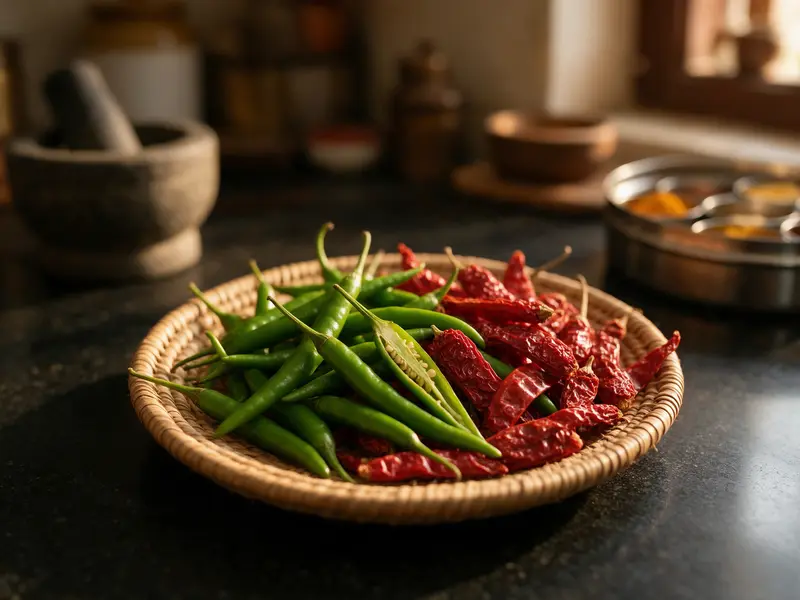
Dried red chilli
Wrinkled, deep-crimson dried chillies that blister in hot oil, releasing a smoky, fruity heat and a glowing red warmth.
Also called: sukhi lal mirch (Hindi), vara milagai (Tamil), endu mirapakaya (Telugu), ona menasinakai (Kannada), unakka mulaku (Malayalam), shukno lonka (Bengali)
Taste: Whole chillies infused in hot oil flavour more gently than powder. Few sources say this.
Getting it ready
Prick the skins before they go into hot oil so they do not burst, and keep them whole: broken ones release seeds that make food far too hot. Byadgi or Kashmiri chillies give red colour with less heat.
Swaps
- mustard seeds Few sources say this.
- black pepper Few sources say this.
- ginger Few sources say this.
- tomato: garlic chutney variant; tomato version replaces dried chillies Few sources say this.
- green chilli Few sources say this.
Keeping
Keeps about two months. Store whole and dry in a roomy container so they neither break nor turn mouldy; a few in grain jars help repel insects.
- 60 days Few sources say this.
Another view: Some keep whole dried chillies 3–5 years airtight in a cool, dark place. Some keep whole dried chillies 2–4 years.
Goes well with
Used to finish
panta bhat, fried, dal and rice, fried crisp, jeera aloo, fried in mustard oil, crushed, coconut chutney, torn in half, in the tempering
Used in
Mosur dal, Bhaja muger dal, Dalma, Khatti meethi dal, Parippu curry, Tomato pappu, Sambar powder, Tomato rasam, Arhar dal, Dal and rice, Adai, Lemon rice, Panta bhat, Idli podi, Gujarati kadhi, Kadai masala, Goda masala, Jeeraga rasam, Kootu podi, Sonth chutney, Dal rasam, Mor rasam, Mysore rasam, Mulligatawny, Saag paneer, Saaru
Seasons
Winter (Nov–Feb), harvest; Winter (Jan–May), harvest; Monsoon (Oct–Dec), availability; Spring (Feb–Apr), harvest
Regions
South India, Rajasthan, Kashmir, Goa, Goa, Karnataka, Tamil Nadu, Telangana, Himachal Pradesh, Udupi
Take care
Stored chillies can carry moulds, including aflatoxin-producing ones after two months, so throw out damp or mouldy chillies. Roasting them gives off irritating smoke: open windows and protect eyes and nose.
Seasonal food wheel
- On the tongue: Spiced
- After the meal: Spiced
- Warmth: warming
- Texture: medium
- Best seasons: spring
Questions answered
Useful tips
- Tempering sliced bafauri. Slice steamed bafauri and toss it in a tempering of mustard seeds, sesame, curry leaves and dried red chilli. Few sources say this.
- Chilli in the milk to help curd set. Some cooks drop green chilli stalks or a broken dried red chilli into the milk, saying it helps curd set thicker; this rests on anecdote.
- Chillies burn fast when roasting for chutney. Dried red chillies burn quickly, so fry them on low heat, watch them closely, or add them last and let the pan's leftover heat finish them.
- Onion chutney bitterness and colour. Onion chutney can turn slightly bitter if you use too many onions or roast the chillies dark brown; the longer the chillies roast, the darker the chutney. Few sources say this.
- Curry leaves are done when crisp. In a tadka, fry curry leaves until they turn crisp.
- Dry red chillies in grain jars. Placing three or four dried red chillies, left whole, in grain jars can help deter insects. Few sources say this.
- Fry podi chillies until they puff. Roast dried red chillies for podi until they puff and turn crisp; sources differ on whether to stop before they darken or let them darken slightly.
- Goda masala chillies are roasted dark and smoky. For goda masala, roast dried red chillies with a couple of drops of oil until smoky and almost black, stopping before they burn. Few sources say this.
- Methi seeds burn fast and turn the powder bitter. Roast fenugreek seeds only until browned and remove them at once; over-roasted methi or chillies make the whole sambar powder bitter. Few sources say this.
- Clean and sort spices before roasting. Pick through the seeds for stones and debris, break open the chillies to remove the crowns and seeds, and throw out any damp or mouldy chillies. Few sources say this.
- Byadgi chillies give red colour with mild heat. Byadgi chillies are used for the deep red colour they give.
Another view: Some say Kashmiri chillies give the colour while byadgi supply the heat.
- Using milder chillies in a masala. If you replace hot chillies with milder ones such as byadgi or Kashmiri, use more of them.
- Do not chase a deep red rasam powder. Shop-bought rasam and sambar powders are generally hotter than homemade, as they carry more chilli.
- Grind chillies and spices separately. For Malvani masala, grind the roasted chillies and the other spices either into two separate powders mixed afterwards, or all together.
- Controlling the heat of kadai masala. Deseed the dried red chillies before roasting, or use Kashmiri chillies, for a milder kadai masala. Few sources say this.
- Kashmiri chilli: colour without much heat. Kashmiri chilli is mild, around 1,000-2,000 SHU, but gives a deep red colour, so swaps to hotter powders need care.
- Home tests for chilli powder. Sprinkle chilli powder on water: bright red streaks suggest added colour; rub the settled residue, where grit means brick or sand and a soapy white feel means soapstone.
- Keep dried chillies whole to control heat. Dried red chillies kept whole and infused in hot oil flavour more gently than powder; broken ones release seeds that can make food far too hot. Few sources say this.
- Soak dried chillies before grinding into chutney. Soak dried red chillies in hot water for about 10–15 minutes before grinding; they grind smoother and give the chutney its colour.
- Adjust chutney heat to taste. To tame a fiery chutney such as thecha, use fewer or seeded chillies, pale green rather than dark green ones, or add more lemon, nuts or fresh herbs.
- Balance fenugreek bitterness in chutney. Jaggery balances the bitterness of fenugreek in methi chutney; with fewer chillies, cut the fenugreek back too, since chilli heat offsets its bitterness.
- Choose dried red chillies. Choose glossy, deep red, crisp dried chillies without wrinkles. Few sources say this.
- Keep kosambari mild. Kosambari is traditionally mild: use few green chillies, swap them for a broken red chilli in the tempering, or use slit chillies and lift them out for children.
- Roasting for axone chutney. Roast tomatoes and chillies in the hot ash of a fire or on a tawa, piercing green chillies first and turning the tomato so it cooks evenly before peeling.
- Soften dried red chillies in hot water, or boil them, before grinding. For chilli paste, pour hot water over stemmed dried chillies and cover until soft, or deseed and lightly dry roast them, then boil roughly 10 minutes until plump and soft.
- Grind chilli paste with the chillies’ own soaking water. Save the reddish water the chillies soaked or boiled in, and blend the paste with it.
- Why use a paste of dried chillies. A chilli paste usually spreads colour and flavour more evenly through dals, curries, soups and vegetables than whole dried chillies or flakes do. Few sources say this.
- Ghee tempering and a second tadka for dal tadka. Dal tadka is tempered in about 2 tbsp ghee per cup of mixed dal; one version adds a second, serving-time tadka of ghee, cumin, hing, dried chillies and chilli powder.
- Green peppercorns for gentle heat. Crushed green peppercorns can stand in for red chilli where you want a milder, aromatic heat in curries and creamy gravies. Few sources say this.
- Cooking for someone who avoids chilli. Take out one portion before the chilli goes in, or put a chilli-and-ghee tadka on the table for others to stir in. Few sources say this.
- Balancing flavour and colour in paneer gravies. For a balanced curry, salt, sugar and chilli can be adjusted together, the masala cooked well after the spices go in, and Kashmiri chilli used for red colour. Few sources say this.
- Common Indian chilli types and what they give. Kashmiri chilli brings deep red and little heat, byadgi is vivid red and slightly hotter, Guntur is hot, and deggi mirch is mild and colourful. Few sources say this.
- Green or red kurma. Green chillies and ground coriander leaves give the traditional green South Indian kurma; red chillies give a red one. Few sources say this.
- Kashmiri chillies in pav bhaji masala. Kashmiri chillies give pav bhaji masala a brighter red; roast them until they swell up.
- Making a milder spice powder. For a milder blend use fewer dried chillies, or mild ones such as Kashmiri, and less chilli powder; cloves and cinnamon can be adjusted to taste.
- Adjusting heat in masalas and pastes. Set the heat of a masala with the chillies: add more dried chillies or chilli powder, or use fewer, milder Byadagi or deseeded chillies.
- Second tadka at serving. Spooning a final ghee tadka over dal just before serving is recommended.
- Swaps in a restaurant-style curry base. Paprika can stand in for Kashmiri chilli powder, and melon seeds make a cheaper replacement for cashew paste.
- Crisping chillies for malvani masala. Dry the chillies in hot sun for about 2 days until crisp, or roast them in a 100 C oven for about 10 minutes. Few sources say this.
- A little oil when roasting masala spices. Spices can be dry-roasted with no oil, but a few drops help them colour evenly, especially fenugreek and chillies in a big batch.
- Chilli and coriander in biryani masala. Kashmiri chilli keeps biryani masala from being too fiery; mix half regular chilli powder in for more heat, or use about 20 whole dried chillies instead. Few sources say this.
- Colour in tandoori masala. Kashmiri red chillies give tandoori masala a better colour; dry beetroot powder or red food colour deepens it further.
- Chillies in bisi bele bath powder. Byadgi chillies give bisi bele bath powder colour and mildness while Guntur chillies bring heat; deseed the roasted chillies if you prefer.
- Kashmiri chilli for colour. Kashmiri chilli powder or dried Kashmiri chillies give a deep red colour with mild heat, and can replace hotter chillies such as lavangi.
- Red colour without food colour. Kashmiri chilli powder and deep red tomatoes give a gravy its red colour without food colour; frying the chilli and turmeric straight in oil deepens it.
- Adjusting the heat of dum aloo. For more heat in dum aloo, add green chillies or swap some of the Kashmiri chilli, which mainly gives colour, for a hotter chilli.
- Natural red colour for pav bhaji. For a red bhaji without artificial colour, rely on Kashmiri chilli, either as powder or ground from soaked whole chillies.
- Kashmiri chilli is for colour, not heat. Kashmiri chilli powder is gentler than ordinary chilli powder and is used mainly for its red colour.
- Fry chilli powder briefly in hot oil. Frying chilli powder for just a few seconds in hot oil brings out its colour. Few sources say this.
Another view: Some add ground spices such as chilli powder last, not into very hot oil, as they burn.
- Grinding soaked red chillies. Grind soaked dried chillies with as little water as possible.
- Chillies for gojju colour. Byadgi or Kashmiri chillies usually give puliyogare gojju its colour; other chillies can change it. Few sources say this.
- Frying peanuts and chillies for puliyogare. Fry peanuts and red chillies in the oil until the peanuts are lightly browned. Few sources say this.
- Reserving masala for the final tempering. In masala chana dal, set aside some cooked onion-tomato masala and fry it again in ghee with Kashmiri chillies as the final tempering. Few sources say this.
- Seasoning kandali ka saag. Kandali ka saag can take a pinch of hing or some curry leaves; one or two dry red chillies instead of fresh keep it milder. Few sources say this.
- Kashmiri aloo dum. For Kashmiri aloo dum, parboil medium potatoes in salted water, fry them crisp in mustard oil, then cook them in yogurt gravy with Kashmiri chilli paste and browned onion.
- Tempering carries spice flavour into the fat. Many spice flavour compounds dissolve in fat, not water, so blooming spices in hot oil or ghee flavours the fat, which carries the aroma through the whole dish.
- How panta bhat is served. Panta bhat is topped with dried red chillies and garlic fried in mustard oil and eaten with aloo bhate or dal bora.
- Concentrated capsaicin can burn skin. Concentrated capsaicin can burn and blister bare skin, so avoid handling pure chilli extracts with bare hands.
- Long simmering does not reduce chilli heat. Capsaicin is very heat stable, so long simmering barely reduces a curry's chilli heat; losses under curry boiling were negligible.
Another view: Some find boiling chilli pieces for 5 minutes noticeably cuts their heat.
- Keep spices dry to stop mould. Spices must be dried to a safe moisture level and kept from reabsorbing moisture, especially in humid weather, to prevent mould and mycotoxins.