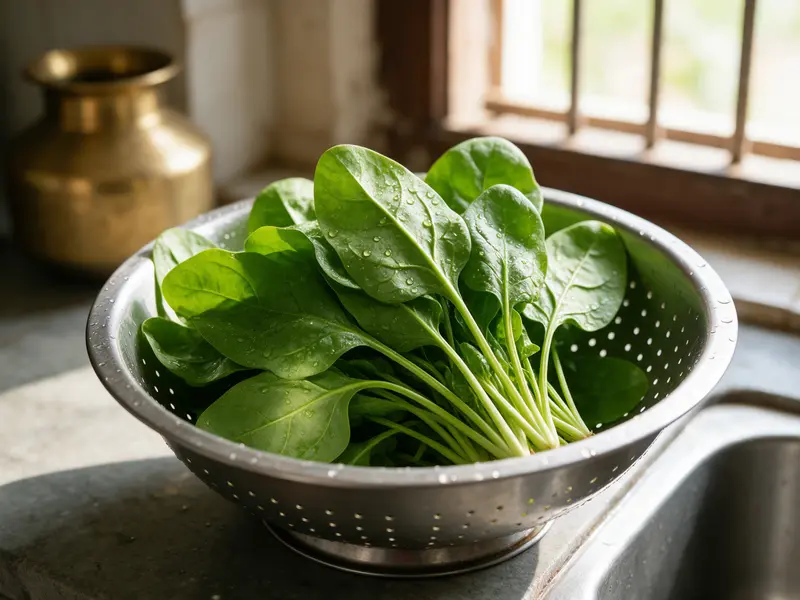
Spinach
Deep green spinach, tender and earthy, wilted in sizzling ghee with ginger and garlic into a lush, velvety, glossy saag.
Also called: palak (Hindi), pasalai keerai (Tamil)
Texture: Shrinks a lot on cooking as its water is released. Short cooking keeps it bright green; long cooking or acid turns it olive.
Taste: Fresh, green and slightly mineral.
Getting it ready
Cook uncovered for the first couple of minutes, then only briefly, and add lemon just before serving. Add it to dal toward the end, and stir in roasted nuts only just before serving.
Cooking with it
- Cook time: 2–2½ minutes
- Cook time: 2–8 minutes (open_pot)
If something goes wrong
Spinach loses its green colour
- Spinach cooked in water or for too long
- Wilt the leaves in the pan with no added water. to prevent Few sources say this.
- Or blanch for 4 minutes, chill at once in iced water, and only simmer gently once the purée is in. to prevent Few sources say this.
Keeping
Refrigerate promptly; it keeps about 4 to 8 days. Blanch and cool it before freezing, and ice-cube trays make handy portions.
- In the fridge: 4–8½ days
Goes well with
Used in
Sarson da saag, Moong dal soup, Saag paneer, Sai bhaji, Palak raita, Gundruk, Blanched vegetables, Palak roti, Papad methi ki sabzi, Kafuli, Dal palak, Besan chilla, Hara bhara kabab, Aloo palak, Chana palak, Besan chilla batter, Rail palaram, Zan, Vegetable khar, Oying, Galho, Akki roti, Idli, Millet and maize roti, Puri, Siddu, Sol kadhi Few sources say this., Thalipeeth, Thoran, Ven pongal
Seasons
Vasant (Mar–Mar), availability; Winter (Oct–Feb), availability; Winter (Nov–Feb), availability
Nutrition
A leafy green that adds fibre, iron and folate. Demo note.
Questions answered
- Why does my palak paneer taste bitter?
- Can palak paneer be frozen and reheated?
- Can I use frozen spinach for palak paneer?
- What is the difference between saag paneer and palak paneer?
- Why does palak paneer turn dark or khaki instead of bright green?
- Can I blanch and freeze cut beans, drumsticks or spinach for later?
Useful tips
- A few spinach leaves smooth a dal. Cooking a few fresh spinach leaves and ginger with lentils may give a noticeably smoother mouthfeel. Few sources say this.
- Dry spinach sabzi technique. Stir chopped spinach with the spices on high heat for 2 to 3 minutes before covering; once glazed, uncover and raise the heat to dry off the juices. Few sources say this.
- Spinach goes into dal near the end. Spinach or kale can be added to dal toward the end of cooking. Few sources say this.
- Wilt spinach for raita. For spinach raita, wilt chopped spinach in a cumin tempering, then let it cool before mixing into yogurt.
- Fresh spinach for sai bhaji. Sai bhaji usually tastes better with fresh spinach than with frozen. Few sources say this.
- Sauté spinach for raita rather than boiling it. For spinach raita, sauté fresh spinach with ginger and garlic 3–5 minutes until wilted and slightly golden; it tastes better than boiled or steamed. Few sources say this.
- Blanched spinach deepens green chutney's colour. Blending in a little spinach, ideally blanched first, gives green chutney a deeper green colour. Few sources say this.
- Regular spinach suits palak raita better than baby spinach. Use regular spinach for palak raita; baby spinach tastes very mild once cooked. Few sources say this.
- Spinach puree replaces water in palak roti dough. For spinach dough, blanched spinach can be squeezed well, pureed and kneaded in without extra water, as the puree moistens the flour. Few sources say this.
- Bathua or spinach can stand in for methi. If fresh methi is unavailable for dhebra, use bathua or spinach leaves instead. Few sources say this.
- Spinach softens bitter mustard greens. Use a generous share of spinach with mustard greens in saag to tone down their bitterness.
- Remove spinach stems for palak gravies. Strip mature spinach stems before making a palak paneer style gravy, since they can give a bitter or metallic taste; tender baby spinach stems are fine. Few sources say this.
- Keeping a spinach curry bright green. Adding a pinch of sugar or baking soda to the water used for blanching helps keep a spinach curry a brighter green. Few sources say this.
- Frozen spinach in place of fresh. About 75 to 80 g of thawed, well-drained frozen spinach equals 200 g of fresh leaves, since frozen spinach is already wilted and compact. Few sources say this.
- Smooth spinach gravy or dal. For a very smooth palak dal or gravy, blanch the spinach, drain it well and puree it before adding it to the masala.
- Washing spinach. Wash spinach well under running water, rinsing once or twice more depending on where it came from, to get rid of grit; use the leaves and drop the stems.
- Wilting spinach for aloo palak. For aloo palak, spread the spinach over the pan without stirring and cover it; once it wilts, raise the heat to cook off its water before mixing in the potatoes.
- Fresh, frozen or chard in place of spinach. Fresh spinach gives the best colour and texture, but thawed frozen spinach squeezed dry works with less water; some cooks report chard as a swap.
- Making aloo palak looser or as a gravy. Add a little water for a loose aloo palak, or blanch and puree the spinach, as for palak paneer, for a gravy version. Few sources say this.
- Cook spinach and potatoes in stages. In a spinach and potato dish, the two can be cooked separately, then folded together for a final covered simmer. Few sources say this.
- Cooking spinach in dal palak. Cook the spinach purée into the onion-tomato masala until it no longer smells raw; red chilli powder and garam masala can be added for more heat if you like. Few sources say this.
- Keep spinach gravy green. In chana palak, the longer the spinach cooks, the duller its green turns.
- Freeze spinach gravy in portions. Freeze plain spinach gravy in silicone cupcake moulds; the portions can later start other spinach curries. Few sources say this.
- Thali-style palak paneer. The everyday thali version of palak paneer leaves out cream.
- Baking soda in spinach khar. Baking soda is optional in spinach khar; the curry still tastes good without it. Few sources say this.
- Spinach-methi paneer in an iron wok. Cooked in an iron wok, spinach-methi paneer traditionally turns blackish green and nearly dry; roast the minced greens until deep green before adding the paneer. Few sources say this.
- Chill blanched spinach in iced water to keep it green. Cool spinach in cold water immediately after blanching.
- Refrigerating palak paneer. Palak paneer lasts two to three days in the fridge in a sealed container.
- Saag paneer versus palak paneer. Palak paneer uses spinach alone, while saag paneer may mix in mustard, fenugreek, radish or amaranth greens.
- Paper towels keep spinach from going slimy. Store spinach in an airtight box lined with paper towels above and below, and swap them when they get soggy. Few sources say this.
- Keeping spinach bright green. To keep spinach green, cook it briefly without added water, or blanch it and plunge it straight into cold or iced water.
- Palak nadru. Palak nadru is somewhat like dal palak.
- Palak puri. Palak puri dough is wheat flour mixed with spinach paste and spices, then deep-fried.
- Using pre-boiled potatoes in aloo palak. To save time, boil or pressure-cook the potatoes separately, then stir-fry the cubes with turmeric and chilli until lightly roasted before the other spices.
- Blanch leafy greens before freezing. Blanch and cool spinach or bathua before freezing; ice-cube trays make handy portions.
- Clean easy greens on weekdays. Spinach suits weekday cooking because it is quick to clean and cook, while fussier greens can wait for the weekend. Few sources say this.
- Cooking times for baby vegetable mashes. For baby mash, sweet potato with spinach takes about 3 pressure-cooker whistles; potato and peas need around 15 minutes steamed or pressure cooked. Few sources say this.
- Add roasted nuts to greens at the end. Add roasted nuts to spinach just before serving; added earlier they absorb moisture from the greens and turn soggy. Few sources say this.
- Fried urad dal as a spice base. Fry a spoon of urad dal in ghee about 2 minutes until lightly golden, with cumin, coriander seed, pepper, chilli and coconut, as a spice base for spinach dal. Few sources say this.
- Bulk up a green herb sauce with greens. Blend one to two cups of spinach or other leafy greens into a mint and coriander paste, with water as needed, for a fuller green curry sauce. Few sources say this.
- Colouring and flavouring puris. Puris take colour and flavour from additions to the dough, such as spinach, fenugreek, beet, carrot or herbs, and sometimes from frying in ghee, mustard, coconut or sesame oil. Few sources say this.
- Bathua makes greens dishes smoother. Bathua (lamb's quarters) has naturally starchy leaves, so it is mixed with spinach or mustard greens to make dishes smoother. Few sources say this.
- Add crunch to raita with nuts or seeds. Coarsely crushed roasted peanuts stirred into lauki raita, or sesame seeds sautéed with the spinach for palak raita, add a nutty crunch.
- Leaves used for gundruk. Gundruk is made from mustard (including rayo saag), radish, turnip or cauliflower leaves, or spinach.
- Siddu filling variations. Spinach, methi or crumbled paneer can replace the dal filling, and sweet siddu are filled with coconut, walnut, sesame and jaggery.
- Taming bitterness in sarson saag. To tame the bitterness of sarson saag, mix in milder greens: about two parts mustard leaves to one part bathua, plus some spinach.
- What freezes well: saag yes, potatoes no. Saag made with spinach and other mashed vegetable dishes freeze well, but potatoes do not. Few sources say this.
- Gatte variations and uses. Gatte dough can be flavoured with spinach or fenugreek, and the gatte can go into kadhi or pulao or be fried as a snack. Few sources say this.
- Vegetables in khichdi. Spinach, carrot or onion can be added to khichdi. Few sources say this.
- A hara bhara kabab mixture that holds its shape. Squeeze the spinach well, cook the greens until dry, cool them and the potatoes before mixing, and mash coarsely rather than to a paste.
- Coloured rail palaram. For colourful rail palaram, knead spinach or beetroot into the flour. Few sources say this.
- Bengali shak. Shak means any leafy green, spinach or mustard greens for example, wilted in a spoon of oil tempered with nigella.
- Traditional saag paneer. Traditional saag paneer has far more spinach than paneer, and the cooked spinach is pulsed only lightly so it is minced rather than a smooth puree. Few sources say this.
- Winter brings greens and dark-red carrots. Indian winter brings the most local greens and spinach and dark-red carrots, so greens are put into family meals all season.
- Winter greens and vegetables shape North Indian home cooking. Traditionally, North Indian winter kitchens cook mustard greens, bathua, spinach, fresh methi, coloured carrots, peas, green chickpeas, cauliflower and potatoes while the season lasts.
- Post-monsoon produce as the air cools. As the monsoon ends, kitchens traditionally turn to pumpkin, fresh fenugreek, spinach, sweet potato, turnip and mustard greens, which come in as the air cools. Few sources say this.
- Goan everyday thali. An everyday Goan thali is steamed rice and curry with sol kadhi, salad and a spinach dish in Goan style.
- Cheera thoran. Cheera thoran is a stir-fry of spinach.
- Bhuji. Bhuji is cooked from spinach-like bhuji leaves together with colocasia leaves.
- Kali. Kali is spinach and fenugreek cooked in an iron kadhai, its gravy thickened with rice or wheat flour paste.