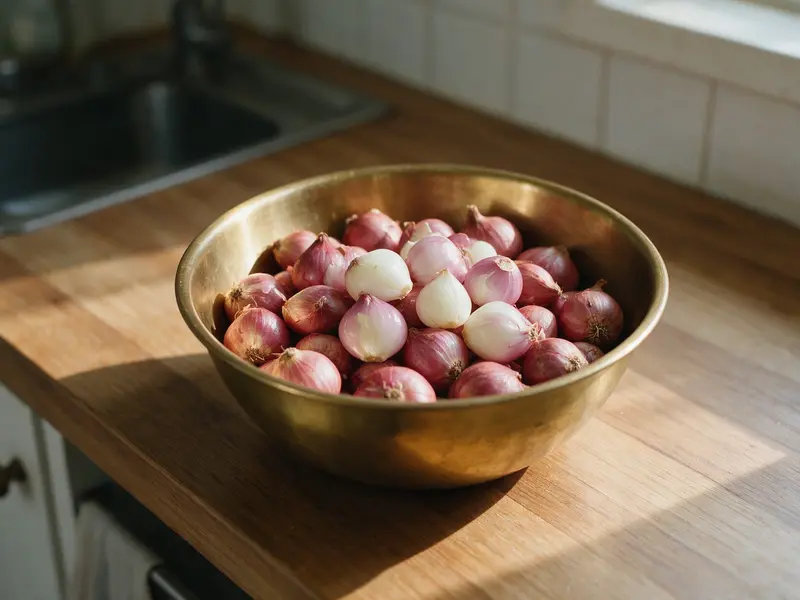
Shallots
Tiny blush-pink shallots, glossy and sweet, melting into tamarind-dark sambar with a gentle, honeyed depth and soft, fragrant warmth.
Also called: chinna vengayam (Tamil), chuvannulli (Malayalam)
Taste: Deeper and sweeter than regular onions. Few sources say this.
Texture: Cooking softens them and frees their sugars, while much of the sharp bite fades.
Getting it ready
Cook for about 3 to 5 minutes. In South India they go into sambar with vegetables such as drumstick, okra and pumpkin.
Cooking with it
- Cook time: 3–5 minutes Few sources say this.
Swaps
- onion: subject pearl onions replaced by onion; beans thoran
Goes well with
Used to finish
millet porridge, finely chopped, pazhaya sadam, crushed raw, ragi koozh, finely chopped, kambu koozh, finely chopped
Used in
Adai, Pazhaya sadam, Sambharam, Coconut chutney, Gongura pachadi, Carrot chutney, Masala vada, Ragi koozh, Kambu koozh, Kuzhi paniyaram, Murungakkai sambar, Turai chana dal, Udupi sambar, Olan, Dal tadka, Avial, Thoran, Idiyappam, Bhindi do pyaza, Kadala curry, Urulai roast, Coconut masala paste, Pakhala
Festivals
Onam (Kerala)
Tradition
In South India they are known as sambar onions. Pazhaya sadam is traditionally eaten with small onions, while shallots are left out of sambharam served at a sadhya.
Seasonal food wheel
- On the tongue: Spiced
- After the meal: Spiced
- Warmth: warming
- Texture: medium
- Best seasons: spring
Questions answered
Useful tips
- Shallots make a deeper sambar. Sambar made with shallots usually tastes deeper and sweeter than one made with regular onions. Few sources say this.
- Shallots give dal a sweet aroma. Shallots are sometimes considered essential in a dal tempering because they give the dal a sweet aroma. Few sources say this.
- Don't skip the shallots in chutney. Shallots are key in red coconut chutney; if you have none, use some regular onion instead.
- Vegetables for sambar. Sambar commonly includes vegetables such as carrot, brinjal, pumpkin, okra, drumstick and shallots or small onions.
- Grind adai aromatics first. For adai, either pulse the shallots, cumin, curry leaves and red chillies first and then add the soaked grains, or grind everything together in one go.
- Leave shallots out of sambharam for storing or sadhya. Leave the shallots out if sambharam will be stored or served at a sadhya. Few sources say this.
- Add curd and fresh seasonings at serving time. Stir curd, shallots, chilli or lemon into koozh or pakhala just before serving, or up to an hour ahead, and do not reheat.
- Roasting coconut for a dark curry masala. On low heat, roast grated coconut with shallots, garlic, fennel, chillies and curry leaves for about 25 minutes, stirring constantly, until it is golden brown and very fragrant.
- Vathal kuzhambu is a quick no-dal curry. Vathal (puli) kuzhambu is a fast tamarind curry made without toor dal, using sun-dried vathal with shallots and brinjal or okra. Few sources say this.
- Onions in thoran. Small onions or shallots sweeten thoran gently; sauté them on low heat just until translucent, or grind them with the coconut.
- Roasted coconut masala for kadala curry. For kadala curry, fry coconut with shallots, garlic, dried red chillies, coriander and curry leaves until golden, then grind to a coarse paste.
- Onions in the tempering can be left out for a satvik dish. Onions or shallots in a dal tempering can be left out to make a satvik (no-onion) version. Few sources say this.
- Reusing leftover pickle masala and oil. Leftover mango pickle masala and oil go into cooked dishes, dough, pulao, samosas and pakoras, and pearl onions dropped into the empty jar are ready in about 4 days. Few sources say this.
- Pearl onion pickle. Salt-stuffed pearl onions coated in hot spiced mustard oil are sun-cured until the spices plump and the onions are crisp-tender, 3 to 5 days; they release juice, which is normal. Few sources say this.
- Fry vathal berries in sesame oil before the tamarind gravy. Sundakkai or manathakkali vathal are first fried briefly in sesame (gingelly) oil until they puff, darken and turn crisp, then the gravy is built around them.
- Pazhaya sadam is eaten with small onions and chillies. Pazhaya sadam is eaten with onions and green chilli.
- Why cooked onions taste sweeter. Heat breaks down the rigid cells of onions, carrots and similar vegetables and frees their sugars, while many pungent sulphur compounds dissolve, break down or evaporate. Few sources say this.
- Keeping ulli theeyal. Cooked ulli theeyal keeps up to a week in the fridge; reheat before serving. Few sources say this.
- Kara chutney essentials. Garlic defines Chettinad kara chutney; cut it down if you like but do not leave it out, and use small red onions or shallots for the best flavour.