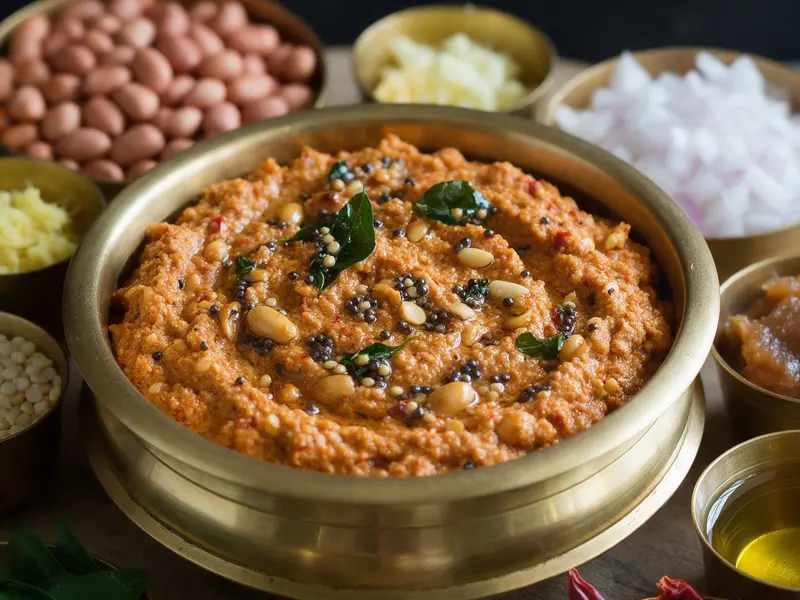
Peanut chutney
Golden roasted peanuts ground with red chilli, garlic and tamarind into a rich, earthy Andhra spread, finished with sputtering mustard and hing.
Taste: Spiced with green chilli. Seasoned with curry leaves and mustard seed. Crisp. Made mostly from groundnuts, urad dal and green chilli.
In every version: cumin seeds, curry leaves, dried red chilli, garlic, groundnuts, mustard seeds, urad dal, vegetable oil.
Peanut Chutney (Andhra, fried with onion, ginger)
Ingredients
- 1 tablespoon oil
- 1 cup raw peanuts, with skin
- 4-5 dried red chillies, Guntur traditional
- 2 teaspoons ginger, chopped
- 2 teaspoons garlic, chopped
- ¼ cup onions, chopped
- 2 teaspoons tamarind pulp
- ½ teaspoon salt, or to taste
- ¾ cup filtered water
- 2 tablespoons oil
- 1 teaspoon brown mustard seeds
- ½ teaspoon cumin seeds
- ¼ teaspoon asafetida (hing)
- 1 teaspoon white urad dal
- 10-12 curry leaves
Method
- Heat a tablespoon of oil over medium heat and fry the peanuts until lightly browned; lift them out into a bowl.
- In the same pan fry the red chillies, ginger, garlic and onion for 3-4 minutes and add them to the peanuts.
- Leave the fried mixture to cool for about 10 minutes.
- Blend with the tamarind pulp, salt and the filtered water until smooth, adding more water if too thick; taste for salt and blend again. Spoon into a bowl.
- Heat the remaining oil over medium heat; add mustard, cumin and hing for a few seconds, then urad dal until browned, then curry leaves for 2-3 seconds.
- Pour the tempering on the chutney, mix and serve.
Keeping: ;
Served with: uttapam, vada, idli, dosa, punugulu, pesarattu, pakora, bonda, paratha
To finish: tadka (tempering) (poured hot over)
Peanut Chutney (dry-roasted peanuts, garlic, cumin)
Ingredients
- ½ cup raw peanuts (groundnuts), or roasted skinned peanuts
- 1½ teaspoon oil
- 1 small clove garlic, or 1/4 inch peeled ginger
- 1 to 2 green chilies or dried red chilies
- ¼ teaspoon salt, adjust
- ½ teaspoon cumin seeds (jeera)
- 1/2 to 3/4 cup water
- 1½ tablespoons urad dal or chana dal optional
- ½ teaspoon tamarind optional
- 1 to 2 sprigs curry leaves optional
- 1 teaspoon oil optional
- ¼ teaspoon mustard optional
- 1 red chili, broken optional
- 1 pinch hing (asafoetida) optional
- 1 small clove garlic, crushed optional
- 1 sprig curry leaves optional
Method
- Heat a teaspoon of oil and fry the chillies, dal and garlic over medium-low heat until the dal is golden and smells toasty; set aside on a plate.
- In the same pan roast the peanuts on medium, stirring all the time, adding curry leaves halfway, until they crackle, turn golden and smell nutty; take care at the end as they over-roast fast.
- Stir the cumin into the hot peanuts and turn the stove off.
- Cool everything.
- Grind with garlic, salt and half to three-quarters of a cup of water (use strained tamarind water if adding tamarind) to a thick, smooth chutney; adjust salt and chilli.
- Optional: fry mustard, broken chilli, crushed garlic and curry leaves in a teaspoon of oil until the leaves crisp; off the heat add hing and pour over.
Keeping: ;
Served with: uttapam, vada, idli, dosa, punugulu, pesarattu, pakora, bonda, paratha
To finish: tadka (tempering) (poured hot over)
Peanut Chutney (with coconut and milk)
Ingredients
- ½ cup peanuts/groundnut
- 3 to 4 green chillies
- 4 garlic cloves, small
- ¼ tsp cumin seeds
- 1 tbsp coconut optional
- salt, as needed
- ¼ cup boiled and cooled milk optional
- water, as needed
- 2 tsp cooking oil
- ½ tsp mustard seeds
- ½ tsp urad dal
- 1 red chilli
- curry leaves, a few
Method
- Heat a kadai for about a minute, lower the flame and dry roast the peanuts until golden and crackling; turn off the heat and leave them in the hot pan to crisp.
- When cool, rub handfuls between your palms to slip off the skins.
- Saute the green chillies in a teaspoon of oil.
- Pulse the cumin, coconut, chillies, peanuts, garlic and salt once to crumble, then add a little milk and water and grind smooth (leave out milk if you want to keep it 2-3 days).
- Temper mustard seeds, urad dal, red chilli and curry leaves in oil, add to the chutney and loosen with water as needed.
Keeping: ;
Served with: uttapam, vada, idli, dosa, punugulu, pesarattu, pakora, bonda, paratha
To finish: tadka (tempering) (poured hot over)
Tips
- Keeping chutneys and podis ready helps on rushed mornings, when side dishes are often the hardest part. Few sources say this.
- Bhel poori comes from Mumbai's streets; toss it with its chutneys only just before eating or it goes soggy.
- Raw chutneys are made fresh each meal; cooked chutneys keep in the fridge if no water gets in, from about a week up to months.
- Let cooked chutney cool fully to room temperature before packing it into a clean, sterilised glass jar and refrigerating.
- Add tamarind sparingly and only when the main sour ingredient, such as tomatoes or gongura, is not tart enough; too much drowns other flavours.
- To avoid a watery cooked chutney, cook tomatoes or fruit until pulpy and most liquid has gone, cool completely, then blend without water.
- Red-stemmed gongura is sharper and tangier than the green-stemmed kind, and very bright green leaves are sourer; balance with more green chillies, or add tamarind if not tart.
- Serve kancha aamer and olive chutneys at room temperature or chilled, never hot.
- Tamarind's sourness offsets the sugar in a sweet chutney and also helps it thicken. Few sources say this.
- If a chutney thickens on standing or in the fridge, loosen it with a little hot water before serving, adding it a teaspoon at a time.
- Sources differ: one keeps tomato thokku a week or longer chilled and never at room temperature; another allows about 2 days unrefrigerated and two months chilled, best within one.
Another view: For thokku, some say a week or more in the fridge and not at room temperature; others allow about 2 days at room temperature and a couple of months chilled.
Keeping
- In the fridge: 2–3 days
- Room temperature: 0–2 hours Few sources say this.
Swaps
- vegetable oil: Coconut oil is commonly used to temper peanut chutney in the south.
Where it comes from
- Maharashtra (characteristic) Few sources say this.
- Tamil Nadu (characteristic) Few sources say this.
- Andhra Pradesh (characteristic)
- Andhra Pradesh
Festivals
Diwali, Holi, Makar Sankranti, Raksha Bandhan, Navratri, Janmashtami, Ganesh Chaturthi, Pongal
Questions answered
- Why might peanut chutney become watery, discoloured, bitter or spoil quickly?
- Should ingredients for peanut chutney be raw, roasted, cooked or ground, and why?
- How do ingredient proportions determine the texture and flavour of peanut chutney?
- How should peanut chutney be stored, and what practices help maintain its quality?
- How can the balance of salt, sourness, sweetness, heat and aroma in peanut chutney be adjusted?