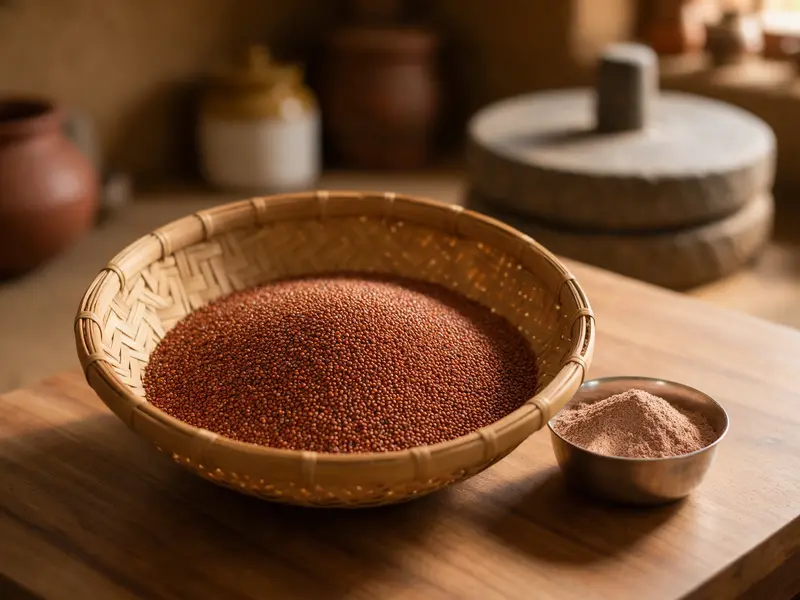
Finger millet (ragi)
Earthy, cocoa-brown ragi, fine and velvety, simmering into smooth, comforting porridge and rustic rotis with a deep, malty, nutty flavour.
Also called: ragi (Kannada), kezhvaragu (Tamil), keppai (Tamil), nachni (Marathi), mandua (Hindi)
Taste: Malty and nutty.
Texture: Fine flour that thickens as it cooks.
Getting it ready
Whisk ragi flour into a smooth slurry with a little liquid, then pour it into boiling water, whisking, so porridge stays lump-free. Use fresh, finely ground flour for rotis.
Cooking with it
- Pressure cook whistles: 4 whistles (pressure_cooker) Few sources say this.
- Water ratio: 3 cups water per cup (open_pot) Few sources say this.
Swaps
- whole wheat flour (atta): zan Few sources say this.
Keeping
Ragi keeps around five months on average, though sources vary from about five weeks to a year.
- 38½–360 days
Goes well with
Used in
Ragi roti, Ragi porridge, Ragi roti dough, Thalipeeth, Ambali, Ragi koozh, Ambil, Mandia pej, Ragi dosa, Ragi mudde, Ragi puttu, Arisa pitha, Zan, Ragi momos, Kodo ko roti, Nachni satva, Ragi laddu, Ragi murukku, Ragi chocolate pudding, Millet bhel, Multi millet khakhra, Millet laddu, Jowar bhakri, Millet and maize roti, Raab, Roti, Vermicelli kheer
Seasons
Monsoon (Sep–Jan), harvest; Winter (Nov–Feb), eaten; Monsoon (Nov–Dec), harvest; Monsoon (Jul–Sep), harvest
Regions
South India, South India, Rajasthan, West Bengal, Odisha, Assam, Gujarat, Maharashtra, Maharashtra, Goa, Goa, Karnataka, Karnataka, Tamil Nadu, Tamil Nadu, Kerala, Andhra Pradesh, Telangana, Uttarakhand, Uttarakhand, Himachal Pradesh, Jharkhand, Manipur, Meghalaya, Nagaland, Sikkim, Arunachal Pradesh
Tradition
Ragi porridge is a traditional first food in parts of South India.
Nutrition
A source of calcium and fibre. Demo note.
Useful tips
- Ragi is rich in iron, calcium and fibre, and a bajra roti gives about 2 mg of iron, around. Ragi is rich in iron, calcium and fibre, and a bajra roti gives about 2 mg of iron, around a tenth of daily needs.
- Basic ragi porridge for infants. Finely powdered ragi cooked in water, stirred until it thickens, makes a simple ragi porridge. Few sources say this.
- Make a slurry first so ragi porridge has no lumps. Make a slurry of ragi flour in a little water first, then stir it into the boiling water for the porridge.
- Lump-free ragi malt. Whisk ragi flour into a smooth slurry first, then pour it slowly into already boiling water, whisking all the time.
- Savoury ragi ambli. For savoury ragi ambli, cook ragi in water, let it cool completely, then thin it with buttermilk.
- Sprouted ragi flour in malt. Sprouted ragi flour can replace plain ragi flour in ragi malt.
- Ragi porridge and ragi malt. Ragi flour is roasted before being cooked into porridge, and adding milk raises its nutritive value; malted ragi makes a drink commonly used as a weaning food. Few sources say this.
- Sour rice water as the base for ragi ambali and mandia pej. Some ragi drinks are soured with rice water: ragi is mixed into leftover rice cooking water and left covered to sour.
- Telling when cooked ragi or bajra is done. Cook ragi on low until glossy and thick with no raw taste; if a wet finger no longer sticks, it is cooked.
- Soak ragi before adding it to mandia pej. Soak the ragi for half an hour before stirring it into the cooking rice for mandia pej. Few sources say this.
- Ragi dosa batter consistency and whole grains. Thin ragi batter slightly more for dosa than for idli; whole ragi grains can be soaked and ground in place of flour.
- Coconut milk for ragi halbai. For ragi halbai, fresh grated coconut is ground with the soaked ragi to extract the milk. Few sources say this.
- Ragi halbai: extracting millet milk. For ragi halbai, soak finger millet 3–4 hours, grind it with fresh grated coconut, strain, and regrind the residue twice to collect the millet milk. Few sources say this.
- Ragi halwa and halbai are done when glossy. Ragi halwa or halbai is done when it leaves the pan and turns glossy; add ghee a couple of tablespoons at a time while stirring.
- Kezhvaragu halwa with jaggery. For a sweet ragi preparation, the flour can be dry-roasted until fragrant and stirred gradually into boiling, strained jaggery water. Few sources say this.
- Roasting ragi flour for ladoos. Roast ragi flour on low heat until it darkens and smells toasted, then cook it a few minutes more in ghee until no raw taste remains, before mixing with jaggery.
- How long ragi takes to sprout. Drained ragi showed tiny sprouts in about 10 hours in a closed hot box (temperature not stated); another report needed about 12 hours in warm weather and 28 in cold.
- Drying sprouted ragi. Spread sprouted ragi thinly and sun-dry it for a day or two; in strong hot sun 3-4 hours on a towel may do, or roast it until hot before milling.
- Grinding and sieving sprouted ragi flour. Mill sprouted ragi to a fine powder a little at a time so the mixer stays cool, and sieve it for a smoother malt.
- Add milk to ragi malt off the heat. For sweet ragi malt, cook the ragi first, take it off the stove, and only then stir in milk that has already been boiled. Few sources say this.
- Ragi mudde ratio: about 1 cup flour to 2 cups water. Ragi mudde uses roughly a cup of ragi flour for two cups of water; add a little more hot water, or a spoonful more flour, to adjust.
- Stovetop sweet ragi malt. Whisk about 4 tablespoons ragi flour into a little water, pour it into boiling water and cook gently 10–12 minutes, stirring, until thick, glossy and no longer raw-tasting.
- Lukewarm water for ragi roti. Knead ragi rotti dough with lukewarm water for a softer rotti; hot water is not advised. Few sources say this.
Another view: Some knead with boiling hot water, never cold.
- Checking ragi puttu flour is damp enough. Squeeze a handful of the moistened ragi flour: it should keep its shape, yet crumble apart again when you drop it.
- Preparing ragi flour for puttu. Dry roast the ragi flour briefly and let it cool, sprinkle it with warm salted water, then pulse it in a mixer to break up lumps.
- Ragi arisa pitha. For a ragi version of arisa pitha, swap half the rice flour for ragi flour.
- Vegetable mandua ki roti. One take on mandua (ragi) roti works curd, carrot, spring onion and green chilli paste into the dough.
- Cooking ragi tan. Flour the board with ragi, then place the shaped tan on a cast-iron tawa floured face upward.
- Stir ragi ambil as it cooks. Stir the ragi paste for ambil constantly while it cooks, or it catches on the pan.
- When ragi ambil is cooked. The ragi paste is done once it looks glossy and no longer smells raw.
- Resting ragi momo dough. Rest ragi-wheat momo dough covered or sealed in a bag for anywhere from 15 minutes to 2 hours before rolling.
- Handling fragile ragi momo dough. Add water little by little so ragi dough is smooth but not sticky, handle it gently, and roll wrappers thin.
- Steaming ragi momos and telling when they are done. Steam ragi momos on high for about 5 to 15 minutes, longer for thicker wrappers, and judge doneness by the change in colour.
- Serve ragi momos straight from the steamer. Eat ragi momos fresh from the steamer, because the ragi dough is slightly dry and they are at their best hot. Few sources say this.
- Two ways to start nachni satva. Nachni satva can start from ragi flour settled in water, or from whole nachni soaked and ground. Few sources say this.
- Coconut milk in nachni satva. More coconut milk makes nachni satva thinner and lighter, less makes it thicker and richer; canned or powdered coconut milk can replace fresh.
- When nachni satva is cooked. Cook nachni satva until the mass pulls away from the sides of the pan, then pour it out to set. Few sources say this.
- Avoiding lumps in ragi mudde. Before adding the ragi flour for mudde, stir a little flour-water paste into the boiling water to help prevent lumps.
- Shape ragi mudde while hot. Divide the cooked ragi and roll it into balls while it is still hot.
- Fry finger millet murukku on a low flame. Fry finger millet murukku over a low flame so the inside cooks properly.
- Ragi is relatively rich in iron. Raw ragi contains about 5 mg iron per 100 g, the most of the three millets tested in one study. Few sources say this.
- How long ragi ladoos keep. Ragi ladoos keep about a week at room temperature in cool weather and should be refrigerated in hot or humid weather.
- Ambali is the savoury ragi drink. Ambali is ragi boiled in water, left to cool completely, then thinned with buttermilk and salt, often with onion, chilli and coriander or a light tempering.
- Shelf life of sprouted ragi flour. Sprouted ragi flour made at home lasts around three months in a dry jar on the shelf, or roughly a year when refrigerated. Few sources say this.
- Lump-free ragi mudde. Whisk a little of the flour into the water as a slurry and bring it to the boil, then add the rest on low heat and beat until smooth.
- Soft ragi mudde without lumps. Stir a slurry of a little flour into salted boiling water, add the rest, simmer 3-4 minutes, then cook covered on lowest heat 2-3 minutes more.
- Use fresh, finely ground flour for flatbreads. Use fresh, finely ground flour for rotis; old or coarse atta, jowar or ragi flour gives dense, dry flatbreads.
- Back-slop ambali from the previous batch. Pour off the soaking water from today's ambali and stir fresh ragi flour into it to start the next day's batch. Few sources say this.
- Adding rice or other grains to ambali. Cook broken rice until soft before stirring in the soured ragi paste; cooked rice, other millets or oats can go in once it thickens.
- Winter rotis switch to millet and maize flours. In winter many households replace some or all wheat with bajra, jowar, ragi or maize flour for rotis, brush them with ghee, and use jaggery more.
- Kambu koozh. Koozh is cooked in a clay pot from ragi or cumbu flour with broken rice, and turns sour as it ferments.
- Add millet flour gradually and keep stirring to avoid lumps. Stir sorghum or finger millet flour into liquid gradually and keep stirring, or it forms lumps.
- Ragi ambli for Karnataka farmers in summer. In Karnataka, farmers traditionally drink ragi ambli, a thin millet drink, before or after summer field work. Few sources say this.
- Millet porridges thicken as they cool. Ragi and jowar porridges set as they cool, so take them off the heat while still pourable and loosen with water or buttermilk.
- Chill fermented millet paste to stop it over-souring. Once the ragi paste has soured, refrigerate it until cooking, especially in hot humid weather; it still keeps souring slowly in the fridge.
- Ghat ke paranthe. Ghat ke paranthe are wheat and finger millet parathas stuffed with a brown lentil, eaten at breakfast.
- Goan millets on sloping land. Goan farmers grew vari and nachni on high, sloping land where rice is hard to grow.
- Major and minor millets. Millets are small-seeded cereal grasses; sorghum, pearl millet and finger millet count as major millets, while foxtail, little, kodo, proso and barnyard are the minor ones.
- How ambali and koozh are soured. Cook the millet into a thick dough or balls, keep them covered with water overnight, then mash and strain into a smooth base.
- Signs a millet ferment is ready. Fermented koozh or ambali is ready when it smells pleasantly sour and the soaking water is cloudy and mildly tangy; it will not double like idli batter.