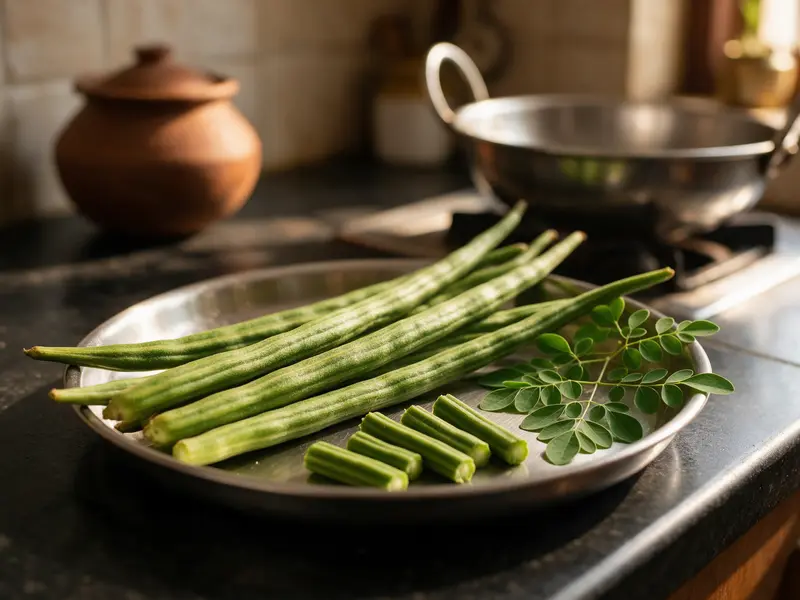
Drumstick
Long, slender drumsticks simmered in tamarind-bright dal, their soft, fragrant inner flesh waiting to be drawn out between the teeth.
Also called: munagakaya (Telugu), murungakkai (Tamil), sahjan (Hindi)
Taste: Mild and slightly grassy, a little like asparagus.
Texture: Firm pods with soft flesh inside. Scrape the flesh off the skin as you eat.
Getting it ready
Cut drumsticks a little over 5 cm long so they hold together in shukto. They can also be cooked into rasam with the dal and tamarind for a heartier rice meal.
Cooking with it
- Cook time: 15 minutes (open_pot) Few sources say this.
Goes well with
Used in
Varan, Shukto, Sambar, Murungakkai sambar, Khatkhate, Udupi sambar, Pappu charu, Dalma, Avial, Mor kuzhambu, Thoran
Seasons
Vasant (Apr–Apr), availability; Grishma (May–May), availability; Summer (Mar–Jun), availability; Monsoon (Oct–Nov), availability; Winter (Oct–Nov), availability; Summer (Mar–Apr), harvest
Regions
- South India
Festivals
Onam (Kerala)
Tradition
Drumstick is a typical vegetable in dalma, alongside pumpkin, raw banana, papaya, yam or brinjal.
Keeping
Wrap in paper and keep in the fridge. Use within 4 to 5 days.
Nutrition
A vegetable that adds fibre and vitamin C. Demo note.
Questions answered
Useful tips
- Drumstick is cooked when a seed slips out. One doneness check for cooked drumstick is to press a piece: a seed popping out easily suggests it is ready. Few sources say this.
- Little or no water for drumstick leaf poriyal. Cook drumstick leaves over low heat with almost no water; they cook in their own moisture, and extra water makes the poriyal soggy.
- Drumstick leaves hold their texture. Drumstick leaves stay firm when cooked, rather than collapsing the way most greens do. Few sources say this.
- How to eat cooked drumstick. Grip a cooked drumstick piece in your teeth and draw it out to scrape off the soft pulp and seeds, then leave the stringy skin. Few sources say this.
- Preparing drumstick leaves. Leaves are usually pulled from their stalks and the thicker stems discarded, as these stay tough. Few sources say this.
- Vegetables make a heartier rasam. Drumstick pieces can be simmered into tamarind rasam and served with rice.
- Vegetables for mor kuzhambu. Ash gourd is classic in mor kuzhambu; cucumber, colocasia, chow chow, drumstick or okra fried separately in the tempering can stand in, or no vegetable.
- Cutting and adding avial vegetables in order. Cut avial vegetables into thick two-inch batons; part-cook the slow ones, yam, drumstick and beans, before adding plantain, cucumber, ash gourd and pumpkin.
- Variations of theeyal. Theeyal can be made without coconut, and sauteed okra, drumstick, pumpkin or yam can be added as vegetables.
- Dalma vegetables. Dalma typically includes vegetables such as pumpkin, raw banana, papaya, drumstick, yam or brinjal, cut into medium to large pieces.
- Thickening a thin sambar with rice flour. For a watery sambar, mix one or two teaspoons of rice flour with water, stir it in and bring to a boil. Few sources say this.
- Shukto: add-ins and cutting. For shukto, cut drumsticks into pieces about 5 cm (2 inches) long. Few sources say this.
- Choosing drumsticks. Buy young, tender drumsticks whose pods look full and plump.
- Preparing drumsticks. Trim both ends, scrape or peel away a thin skin (pods from your own tree may not need this), and cut into finger-length pieces of 2-4 inches.
- Moringa flowers in Bengali spring kitchens. Bengali spring kitchens traditionally cook moringa flowers (shojne phool) as fritters and chorchori, eaten with dal and rice. Few sources say this.
- Avial. Avial is a thick medley of vegetables in coconut gravy, finished with curry leaves and coconut oil.