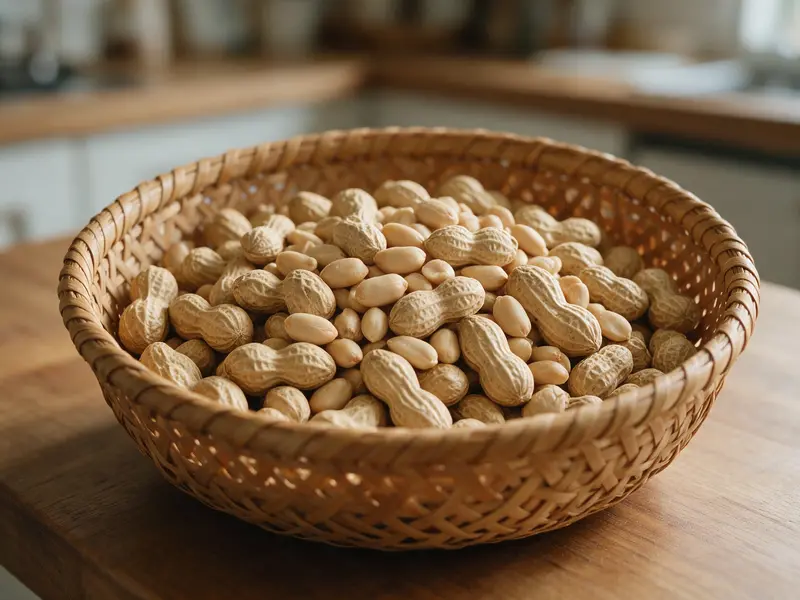
Groundnuts
Earthy groundnuts roasted until crackling and golden, their warm, nutty fragrance and satisfying crunch scattered over poha, sago and spiced salads.
Also called: moongphali (Hindi), nilakadalai (Tamil), palli (Telugu), shenga, verkadalai (Tamil)
Texture: Fried and masala peanuts get crisper once they cool, so judge them after cooling.
Getting it ready
Roast on low heat until crunchy, cool, peel, and grind in short pulses, since long grinding turns them oily. Fry them first and mix them back in at the end so they stay crunchy.
Cooking with it
- Cook time: 7–8½ minutes Few sources say this.
- Pressure cook whistles: 1–4 whistles (pressure_cooker)
- Pressure cook whistles: 4½–5½ whistles (pressure_cooker) Few sources say this.
Swaps
- green peas: peanuts replaced by green peas in some regions Few sources say this.
- cashew nuts: nellikai sadam Few sources say this.
If something goes wrong
Groundnuts grow mould or carry aflatoxin risk
- Nuts stored with moisture above about 15 percent Few sources say this.
- Dry groundnuts to 10 percent moisture or less and store them where they cannot pick up damp. to prevent Few sources say this.
Keeping
Keep them thoroughly dry, below about 15% moisture, and airtight, and use within a reasonable time, as oily nuts go rancid. One source gives about 10 days.
- 10 days Few sources say this.
Goes well with
Used to finish
koshimbir, coarsely crushed, bisi bele bath, fried in ghee, samak rice pulao, fried crisp, kachumber salad, roasted and crushed
Used in
Bisi bele bath, Kanda poha, Mirchi ka salan, Sabudana khichdi, Sabudana vada, Samak rice pulao, Peanut-sesame-coconut paste, Peanut chutney, Dry garlic chutney, Shengdana chutney, Thecha, Raw mango chutney, Carrot chutney, Til ladoo, Beetroot raita, Koshimbir, Sundal, Moong sprouts salad, Poha chivda, Kothimbir vadi, Thalipeeth, Handvo, Nellikai sadam, Phool makhana namkeen, Boiled peanut chaat, Lemon rice, Roti
Seasons
Monsoon (Sep–Oct), harvest; Winter (Nov–Feb), eaten; Post-monsoon (Oct–Nov), availability; Winter (Nov–Feb), availability
Regions
Gujarat, Maharashtra, Andhra Pradesh, Telangana
Festivals
Lohri (Haryana), Makar Sankranti
Seasonal food wheel
- On the tongue: Cool
- After the meal: Rich
- Warmth: warming
- Texture: coarse
- Best seasons: late winter, early winter, rains
Useful tips
- Damp groundnuts and aflatoxin. Groundnuts stored with more than about 10% moisture let Aspergillus flavus mould grow and produce aflatoxin, so keep them thoroughly dry. Few sources say this.
- Aflatoxin in groundnuts and grains. Harmful mould toxins can form in groundnuts and grains kept damp, so discard any mouldy groundnuts and grains.
- Dry heat on tawa, stone or coals. Chapati, roti, naan, jowar bhakri, corn, tubers and groundnuts are cooked by uncovered dry heat on hot metal, stone, coals or ash. Few sources say this.
- Sorghum flake chivda. Deep-fry the sorghum flakes on their own and set aside; fry the dals, groundnuts, cumin and red chillies until brown, then add onion and chilli paste.
- Pakam undalu. Pakam undalu are made from jaggery, groundnuts and steamed rice flour.
- Tamil lemon rice. Tamil lemon rice is cooked rice mixed with a tadka, groundnuts and lemon juice.
- Fry peanuts first for poha. Peanuts usually stay crunchy if fried first, set aside and stirred back in at the end. Few sources say this.
- Thicken with nut purees near the end. Pureed nuts such as cashews or almonds can be used to thicken a curry or sauce.
- Roasting order for peanut-sesame-coconut paste. Roast the peanuts, sesame seeds and coconut before grinding them to a fine paste; the order varies between recipes. Few sources say this.
- Roast and coarsely grind peanuts for sabudana khichdi. Roast peanuts on low heat until crunchy, let them cool, peel and grind them coarsely for sabudana khichdi.
- Add rock salt with the sago and peanut powder. In sabudana khichdi, add the salt together with the soaked sago.
- Pulse peanuts briefly. Grind roasted peanuts in short pulses only; long grinding turns them oily.
- Target syrup temperatures for crystalline sweets, caramels and brittles. Cook fudge-type crystalline sweets to about 112 °C, chewy caramels to about 118 °C and hard nut brittles such as chikki to about 143 °C. Few sources say this.
- Batter-coated peanuts. Fry batter-coated peanuts in oil at about 163–177 °C, hot enough that a drop of batter bubbles and rises at once; they need about a minute. Few sources say this.
- Fried snacks crisp further as they cool. Fried papdi strips and masala peanuts get crisper once they cool, so judge them after cooling.
- Masala peanuts: thick batter, shallow-fried in batches. Coat roasted peanuts in a thick batter of besan, rice flour and cornflour and shallow-fry in batches, 2–3 minutes on medium, until crisp. Few sources say this.
- Make-ahead tricks for fresh chutneys. To make coconut chutney ahead, grind it without water, refrigerate, and thin it just before serving; for peanut chutney, roast the night before and grind in the morning.
- Guntur chillies for Andhra peanut chutney. Guntur dried chillies are the traditional choice for Andhra-style peanut chutney. Few sources say this.
- Roast and grind chutney ingredients separately. Fry or dry-roast each chutney ingredient separately where possible, since they cook at different speeds and none should burn; some grind each on its own too.
- Roast peanuts slowly and fully for chutney. Dry-roast peanuts on moderate to low heat, stirring, for about 7–8 minutes; under-roasted peanuts taste raw, and high heat or a moment too long burns them.
- Rub skins off roasted peanuts. Rub the skins off roasted, cooled peanuts between your palms and blow them away; the tannin-rich skins can make chutney bitter.
- Check nuts for freshness before chutney. Choose raw peanuts that smell fresh, feel heavy and show no damp or insect damage, and taste walnuts first, as they turn rancid quickly.
- Add crunch to raita with nuts or seeds. Coarsely crushed roasted peanuts stirred into lauki raita, or sesame seeds sautéed with the spinach for palak raita, add a nutty crunch.
- Peanut powder gives spring onion curry its nuttiness. In a Maharashtrian spring onion curry, roasted peanut powder usually supplies the nutty taste. Few sources say this.
- Salt the peanut boiling water well. Boiled peanuts usually need well-salted water, otherwise they taste bland. Few sources say this.
- Peanut choice for chaat. Fresh or raw peanuts both suit a boiled peanut chaat; for crunch, use roasted peanuts with skins instead.
- Two ways to toast peanut-sesame-coconut paste. Either dry-roast peanuts first and then sesame, poppy seeds and dry coconut on low heat, or saute the coconut with onion till golden first.
- Roasting and skinning peanuts for chikki. Dry-roast peanuts on medium-low, stirring, until the skins loosen and the nuts show light brown spots; then crack them lightly and shake off the skins.
- Coating masala peanuts. Soak peanuts so the skins stay on and the masala clings, or in a hurry wash them and toss the flours in while still wet.
- Chaat masala on masala peanuts. Sprinkle chaat masala over the peanuts while they are still hot.
- Peanuts or cashews in rice dishes. Peanuts and cashews can stand in for each other in tomato rice or coconut rice, though the taste shifts; some cooks treat peanuts as essential in tomato rice.
- Peanuts in palak dal. A handful of peanuts gives crunch to an otherwise smooth palak dal; they are optional. Few sources say this.
- Jaggery for chikki. Use solid, dark cone jaggery such as Kolhapuri for chikki; it gives a glossy dark bar that binds well.
- Frying masala peanuts slowly. Fry masala peanuts on low to medium heat in oil that is not very hot, stirring now and then; slow frying makes them crisp.
- Fried snacks are done when bubbling stops. Fried peanuts or banana chips are usually ready once golden and the bubbling in the oil has died down; lifting them out earlier can leave them soggy. Few sources say this.
- Cooking peanuts with the dal for dal dhokli. A handful of peanuts can cook with the dal in the pressure cooker, tied in muslin or set in a small bowl so they lift out whole.
- Microwave masala peanuts. Microwave coated peanuts on high for 6 to 7 minutes, flipping at 3; they feel soft while hot and crisp only after cooling. Few sources say this.
- Oil helps masala cling to peanuts. Mix a couple of teaspoons of oil into masala peanuts so the coating sticks. Few sources say this.
- Flavouring bread upma. Cook bread upma in butter or ghee for richness, and add a pinch of sambar powder or pav bhaji masala for extra flavour.
- Fillings for mirchi bajji. Potato, paneer or tomato fillings can replace the cumin paste in mirchi bajji, and ground roasted peanuts with sesame can replace roasted gram in the stuffing.
- Frying peanuts and chillies for puliyogare. Fry peanuts and red chillies in the oil until the peanuts are lightly browned. Few sources say this.
- Rice flour keeps masala peanuts apart. Add a final teaspoon of rice flour so coated masala peanuts do not clump. Few sources say this.
- Baked masala peanuts. Coated masala peanuts can be oven-baked at 180 °C for about 20 minutes instead of fried. Few sources say this.
- Sarva pindi. Sarva pindi is a pancake of rice flour, chana dal and peanuts, pressed into a deep pan with holes poked through it.
- Tempering order for millet lemon rice. Fry the urad dal on low heat until light brown, fry raw peanuts early, and add sesame seeds last for about a minute.
- Buying and storing nuts and oilseeds. Nuts and oilseeds are oily and go rancid with long keeping: choose evenly coloured ones, sun-dry them, store airtight and dry, and use within a reasonable time.
- Aflatoxin and mycotoxins in stored grains and nuts. Fungi growing on crops such as cereals and nuts can produce poisons called mycotoxins.
- Bagara baingan spice mix keeps in the fridge. The roasted peanut, coconut and seed spice mix for bagara baingan can be made in bulk and refrigerated for up to six months. Few sources say this.
- Koshumbir is a Maharashtrian cucumber-peanut salad. Kakri ki koshumbir, cucumber and peanuts with a mustard-seed tadka, is a Maharashtrian salad that can be served with a moong dal dish and rice. Few sources say this.
- Roasted peanuts doneness cue. Peanuts are roasted when they turn golden to darker with small black spots and sound crisp and crackling as you stir.
- Leave milk out of chutney meant for storing. A little boiled, cooled milk makes peanut chutney pale like hotel chutney; milk chutney must be refrigerated at once and used promptly, never left at room temperature. Few sources say this.
- Syrup stage for crisp chikki. For crisp chikki take the jaggery syrup to the hard-ball stage, about 121-129 °C; near 149 °C (hard crack) it becomes extra crisp, and beyond that glass-hard.
- Keeping boiled peanut chaat. Boiled peanuts keep 1-2 days chilled; once mixed with vegetables the chaat lasts a few hours, though one source allows about 2 days.
- Fresh green peanuts are best cooked soon. Unripe fresh peanut pods do not last long, so cook them while fresh. Few sources say this.
- Storing masala peanuts. Cool masala peanuts slightly, then store them in an airtight jar; they can keep up to a month.
- What gives bagara baingan its flavour. Bagara baingan gets its nutty depth from peanuts, sesame and coconut (some add cashews), with tamarind for tang.
- Bagara baingan. Bagara baingan stuffs tender brinjals with ground peanut and coconut and cooks them in a rich paste.
- Maharashtrian festive thali. Maharashtrian festive thalis largely skip onion and garlic and lean on coconut, groundnuts, sesame or poppy seeds.
- Potatoes with peanuts for Navratri. Crusty potatoes with peanuts suit the Navratri fasts, when grains are not eaten. Few sources say this.
- Neem and jaggery first on Gudi Padwa. Gudi Padwa begins with neem and jaggery (kadu gul), bitter and sweet, a reminder to accept both hardship and joy.