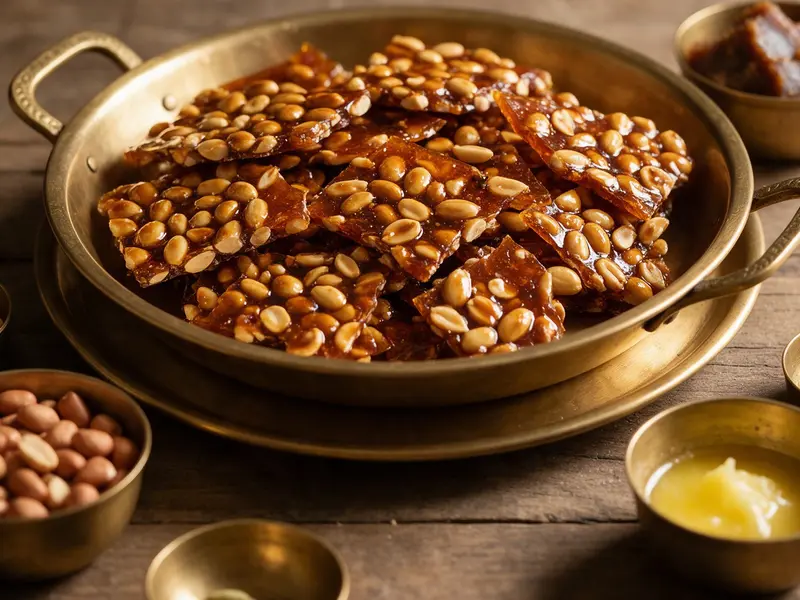
Chikki
Roasted peanuts bound in dark glossy jaggery, rolled thin and snapped into amber shards with a deep caramel crunch.
Taste: Deeply sweet with jaggery. Made mostly from jaggery, groundnuts and ghee.
In every version: groundnuts, jaggery.
Chikki (peanut, with cardamom)
Ingredients
Method
- Dry-roast the peanuts in a heavy pan on low, stirring all the time, until the skins start to loosen.
- Cool completely, rub off the skins and set the peanuts aside.
- Line a tray with butter paper or grease a steel plate with ghee.
- Melt the jaggery with the water in a large kadai on low, stirring (add the optional ghee and cardamom now).
- Simmer about 5 minutes on low until glossy and thick.
- Drop a little syrup in water; it should form a hard ball that snaps. If not, boil a minute more and test again.
- Turn off the heat, add the peanuts and stir until all are coated.
- Tip onto the tray at once, spread and press flat with a small cup.
- After about a minute, cut into 6-8 mm thick pieces while warm.
- Once cool, serve or keep in an airtight container.
Keeping:
Tips for this version
- Mark the cuts in a chikki slab before it cools completely; it only cuts cleanly while still warm.
- Drop a little jaggery syrup into cold water: it is ready when it sets hard, brittle and snaps; rubbery or stretchy drops need another minute.
- Chikki keeps about one to three months in an airtight container at room temperature.
- Dry-roast peanuts on medium-low, stirring, until the skins loosen and the nuts show light brown spots; then crack them lightly and shake off the skins.
- Pour and flatten chikki at once because it sets fast, mark it after about a minute while warm, and leave it about 30 minutes to set before breaking.
- Use solid, dark cone jaggery such as Kolhapuri for chikki; it gives a glossy dark bar that binds well.
- Grease the board and rolling pin with ghee, roll the hot chikki between parchment to about 1/4 inch, and mark the cuts while warm.
- Make a doubled chikki recipe in separate batches; a big volume of jaggery syrup is hard to stir and burns easily.
Chikki (crushed peanut, rolled)
Ingredients
Method
- Coarsely grind the roasted peanuts in a mixer and set aside.
- Melt the crushed jaggery with the ghee in a kadai on medium, stirring constantly, until it melts and foams.
- Test drops in water; if rubbery when cool, cook on low a minute and test again. Ready drops are solid and crunchy.
- On medium, stir in the crushed peanuts.
- Spread on a ghee-greased board and roll with a greased pin into a square about 1/4 cm thick.
- While slightly warm, mark the cutting lines before it cools fully.
- Leave to set 30 minutes, then break apart along the lines; conditions not stated.
- Keep in an airtight container.
Keeping:
Tips for this version
- Mark the cuts in a chikki slab before it cools completely; it only cuts cleanly while still warm.
- Drop a little jaggery syrup into cold water: it is ready when it sets hard, brittle and snaps; rubbery or stretchy drops need another minute.
- Chikki keeps about one to three months in an airtight container at room temperature.
- Dry-roast peanuts on medium-low, stirring, until the skins loosen and the nuts show light brown spots; then crack them lightly and shake off the skins.
- Pour and flatten chikki at once because it sets fast, mark it after about a minute while warm, and leave it about 30 minutes to set before breaking.
- Use solid, dark cone jaggery such as Kolhapuri for chikki; it gives a glossy dark bar that binds well.
- Grease the board and rolling pin with ghee, roll the hot chikki between parchment to about 1/4 inch, and mark the cuts while warm.
- Make a doubled chikki recipe in separate batches; a big volume of jaggery syrup is hard to stir and burns easily.
Chikki (Gujarati, halved peanuts)
Method
- Dry-roast the peanuts on medium-low, stirring, until the skins slip off when pressed, with light brown spots and a roasted smell.
- Cool until warm, crack lightly in a zip bag with a rolling pin into halves, then shake in a strainer and discard the skins; pick off any left.
- Set a bowl of cold or iced water by the stove and lay out two parchment sheets, a rolling pin and a knife or pizza cutter.
- Melt the jaggery in a pan on medium-low, stirring constantly, until it darkens and starts to thicken.
- Turn the heat to lowest and test drops in cold water every few seconds; they should harden and snap cleanly (about 260-265 F).
- Add the peanuts at once, switch off the stove and mix quickly to coat.
- Tip onto one parchment sheet, cover with the other and roll hot to about 1/4 inch.
- Mark cut lines while warm.
- Cool completely, then break along the lines.
- Keep in an airtight container at room temperature.
Keeping:
Tips for this version
- Mark the cuts in a chikki slab before it cools completely; it only cuts cleanly while still warm.
- Drop a little jaggery syrup into cold water: it is ready when it sets hard, brittle and snaps; rubbery or stretchy drops need another minute.
- Chikki keeps about one to three months in an airtight container at room temperature.
- Dry-roast peanuts on medium-low, stirring, until the skins loosen and the nuts show light brown spots; then crack them lightly and shake off the skins.
- Pour and flatten chikki at once because it sets fast, mark it after about a minute while warm, and leave it about 30 minutes to set before breaking.
- Use solid, dark cone jaggery such as Kolhapuri for chikki; it gives a glossy dark bar that binds well.
- Grease the board and rolling pin with ghee, roll the hot chikki between parchment to about 1/4 inch, and mark the cuts while warm.
- Make a doubled chikki recipe in separate batches; a big volume of jaggery syrup is hard to stir and burns easily.
If something goes wrong
Chikki turns chewy, rock hard or sticky
- Jaggery syrup undercooked
- Cook until a drop in cold water turns brittle and snaps; if it stays rubbery, cook a minute more on low and test again. to rescue
- Syrup overcooked
- Lower the heat once the syrup thickens and test every few seconds. to prevent
- Powdered or soft jaggery used
Another view: Some use jaggery powder as well as block jaggery. Some recipes call for soft jaggery. Some recipes use powdered jaggery.
- Use firm cone jaggery of the Kolhapuri kind. to prevent Few sources say this.
Another view: Some specify soft jaggery rather than firm.
- Use firm cone jaggery of the Kolhapuri kind. to prevent Few sources say this.
Keeping
- Room temperature: 30–60 days
Where it comes from
- Madhya Pradesh (characteristic)
Seasons
- Winter
Festivals
Diwali, Ganesh Chaturthi, Janmashtami, Makar Sankranti, Raksha Bandhan, Ugadi, Holi, Maha Shivratri, Dussehra, Teej, Navratri, Nag Panchami, Pola, Bhai Dooj
Useful tips
- Setting chikki. Pour and flatten chikki at once because it sets fast, mark it after about a minute while warm, and leave it about 30 minutes to set before breaking.
- Jaggery for chikki. Use solid, dark cone jaggery such as Kolhapuri for chikki; it gives a glossy dark bar that binds well.
- Cook large chikki batches separately. Make a doubled chikki recipe in separate batches; a big volume of jaggery syrup is hard to stir and burns easily. Few sources say this.
- Rolling chikki. Grease the board and rolling pin with ghee, roll the hot chikki between parchment to about 1/4 inch, and mark the cuts while warm.
- Cut chikki while warm. Mark the cuts in a chikki slab before it cools completely; it only cuts cleanly while still warm.
- How long chikki keeps. Chikki keeps about one to three months in an airtight container at room temperature.
- Roasting and skinning peanuts for chikki. Dry-roast peanuts on medium-low, stirring, until the skins loosen and the nuts show light brown spots; then crack them lightly and shake off the skins.
- Hard-ball test for chikki syrup. Drop a little jaggery syrup into cold water: it is ready when it sets hard, brittle and snaps; rubbery or stretchy drops need another minute.