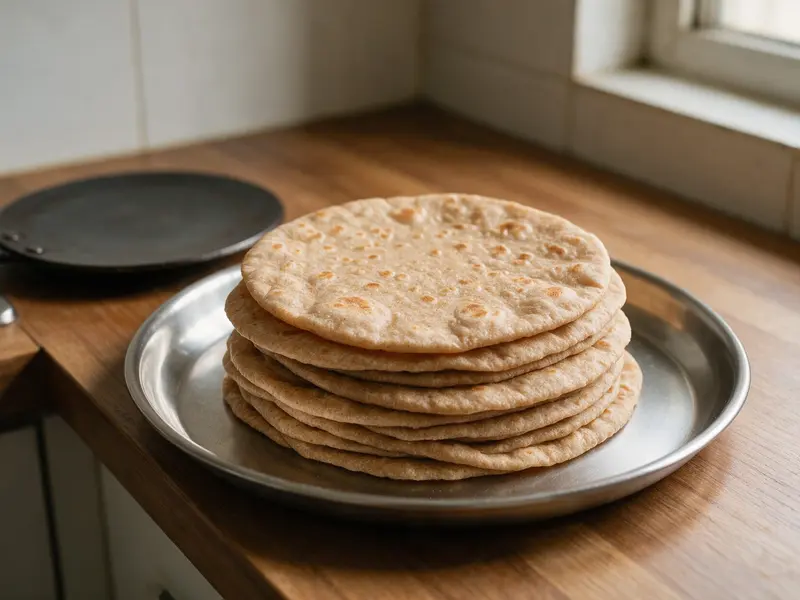
Roti (cooked)
Soft, freshly puffed rotis, lightly blistered from the tawa and brushed with ghee, warm, tender and fragrant with toasted wheat.
Also called: chapati, phulka
Getting it ready
Leave refrigerated chapatis at room temperature ten minutes and brush with ghee or oil before reheating. Leftover rotis can be sliced into ribbons for chapati upma.
Keeping
Keeps about a day at room temperature and 2 to 5 days in the fridge, though sources vary widely. Freeze in single-meal portions; sources disagree on how long frozen rotis keep.
- Frozen: 8–10 days Few sources say this.
Another view: Some say lightly cooked, well-wrapped breads keep up to two months frozen. Some keep cooked rotis up to 3 months frozen. Some keep half-cooked frozen rotis at least a month, best within 4 weeks.
- At room temperature: 0–2½ days
- In the fridge: 2–5 days
Goes well with
Used in
Regions
North India, Maharashtra
Tradition
In North India everyday dishes are usually eaten with roti, and being asked whether you will eat roti is an invitation to a whole meal.
Seasonal food wheel
- On the tongue: Hearty
- After the meal: Hearty
- Warmth: neutral
- Texture: medium
- Best seasons: summer, autumn, rains
Questions answered
Useful tips
- Tawa too hot: roti browns before it puffs. An overheated tawa colours a roti before it has puffed, so steam escapes and it turns hard and half puffed; uneven or thin edges leak steam too. Few sources say this.
- Add roti strips to upma near the end. Add the roti strips once the vegetables are nearly tender, sprinkle a little water and cook covered briefly to soften them. Few sources say this.
- Judge roti heat by the bubbles, not the clock. Turn up the heat if no bubbles show within roughly 20 seconds of the roti going on; leaving rotis on the tawa too long makes them dry and stiff.
- Bhura roti ghee from leftover rotis. Bhura roti ghee turns leftover rotis into a sweet with powdered sugar and ghee.
- Roti can mean a whole meal. Roti can stand for a whole meal; being asked whether you will eat roti is an invitation to eat, not just to have bread. Few sources say this.
- How a phulka differs from a chapati. A phulka is a smaller, thinner bread finished over an open flame so steam blows it into a ball; it is usually served dry, while chapatis get ghee. Few sources say this.
- Cut leftover chapatis into ribbons for upma. For chapati upma, roll leftover chapatis tightly and slice them into ribbons. Few sources say this.
- Stir chutney powder into curd for a spread. Stir shengdana (peanut) chutney powder into curd for a quick spread for roti or bread. Few sources say this.
- Puffing rotis on an electric hob. Without a flame, give the roti about 2 minutes then 1–1.5 minutes on the tawa, and puff it on a footed rack over a second hot ring. Few sources say this.
- Malidalu. Malidalu are balls of broken chapati mixed with jaggery, cashews, pistachios and ghee.
- Kaccha khana. Kaccha khana is everyday food: roti, khichdi or rice, dal and a vegetable.
- Paratha hard: too little heat or the wrong flame after flipping. Cook parathas on a medium-hot tawa: low heat dries them out and hardens them, while a fierce flame burns the outside before the inside cooks.
- Freeze meals in single labelled portions. Freeze cooked food such as curries and dal in meal-sized portions labelled with contents and date, so you thaw only what you need.
- Let chilled chapatis warm up before reheating. Leave refrigerated chapatis at room temperature for at least ten minutes and brush with ghee or oil before reheating to keep them soft. Few sources say this.
- Okra-potato sabji pairings and leftovers. Okra with potatoes is typically eaten with dal and chapatti; leftovers work in a wrap or toastie with tomato chutney. Few sources say this.
- Which breads go with which dal. Thick masala urad dal is usually eaten with flatbreads such as naan, chapatti or paratha rather than rice; cumin moong dal suits yogurt and chapatti. Few sources say this.
- Ways to use leftover rotis. Leftover rotis can be torn or crumbled and stir-fried with a tempering.
- Habits that keep rotis soft. For soft rotis, add a little oil and lukewarm water to the dough, rest it 20–30 minutes, puff them fast, brush with ghee while hot and keep them stacked. Few sources say this.
- Chutneys, pickles and raita lift plain food. A spoonful of chutney or pickle turns plain flatbread into a snack and lifts a simple dal; raita does the same for a curry. Few sources say this.
- Thin chickpea curry with chapatis. A thin chickpea curry can be eaten with chapatis rather than rice. Few sources say this.
- Half-cook rotis for the freezer. Cook rotis about 15 seconds a side, cool them completely, stack with butter paper between and freeze; use them within roughly a month. Few sources say this.
- Rotis in foil and an airtight box. One source says rotis kept wrapped in foil and then sealed in an airtight box stay fresh for about a week. Few sources say this.
- Storing cooked rotis. Plain rotis without ghee freeze up to 3 months interleaved with parchment; ghee-brushed rotis keep a day at room temperature wrapped or boxed. Few sources say this.
- North India eats its dishes with breads. In North India, dubbed the country's bread basket, everyday dishes are usually eaten with roti or paratha. Few sources say this.
- Breakfast in Bihar. In Bihar breakfast often starts with sattu in some form, or plain roti with seasonal vegetables.