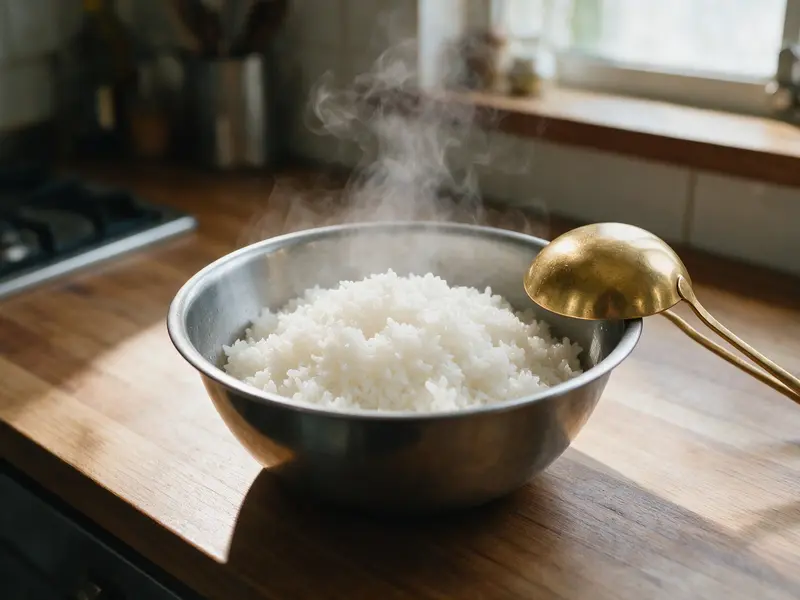
Cooked rice
Soft, pearly steamed rice, warm and fragrant, each tender grain ready to soak up silky curd, tangy rasam or golden ghee.
Also called: saadam (Tamil), annam
Texture: It firms as it cools and its starch realigns, so leftovers can seem dry; cooled long-grain rice stays hard.
Getting it ready
Reheat leftovers covered with a splash of liquid, stirring partway, or turn them into fried or lemon rice. Cool rice to room temperature before mixing in curd.
Cooking with it
- Pressure cook whistles: 2 whistles (pressure_cooker)
- Water ratio: 1¾ cups water per cup (pressure_cooker) Few sources say this.
If something goes wrong
Leftover rice cools too slowly
- Rice left to cool in one large batch instead of shallow portions Few sources say this.
- Spread the rice into shallow containers and refrigerate promptly. to prevent
Food poisoning (vomiting) after eating leftover or fried rice
- Bacillus cereus spores survive cooking and grow while rice stays warm, forming heat-stable toxin
- Eat rice hot, or spread it thin and refrigerate within about an hour. to prevent
- Eat refrigerated rice within a day. to prevent
- Reheat only once, to steaming hot; discard rice left warm too long, as reheating does not destroy the toxin. to rescue
Leftover rice too dry and lumpy for phodnicha bhaat
- Rice dried out in the fridge Few sources say this.
- Separate the lumps with a fork and sprinkle in a tablespoon or two of water as you stir-fry. to rescue Few sources say this.
- Freshly cooked hot rice used Few sources say this.
- If using just-cooked rice, cool it well first so it does not go sticky. to prevent Few sources say this.
Rice dish turns mushy or sticky
- Warm rice mixed with the masala
- Spread the rice out on a wide plate and let it cool fully before mixing. to prevent
- Pressure left to release on its own too long in an electric pressure cooker Few sources say this.
- Release the remaining pressure after 10 minutes. to prevent
- Canned peas cooked with the rice Few sources say this.
- Cook the rice alone and fold in the peas afterwards. to prevent Few sources say this.
Keeping
Cool it quickly in shallow containers and refrigerate, covered, at 5 °C or colder. It keeps about 1–5 days in the fridge (sources vary widely) or about 3 months frozen.
- In the fridge: 1–7 days
- Frozen: 89½–90½ days
- At room temperature: 0–0.04 days
Goes well with
Used in
Pazhaya sadam, Appam batter, Ragi koozh, Mandia pej, Pakhala, Torani, Poita bhat, Panta bhat, Nellikai sadam, Southekayi dosa, Tomato rice, Puliyogare, Dosa batter, Jowar sankati, Akki roti, Ambali, Appam, Coconut rice, Idli, Kheer and payasam, Lemon rice, Pathiri, Pulao, Tahari, Vegetable biryani
Regions
- Maharashtra
Tradition
Neeragaram is traditionally described as a body coolant for hot days. Kali is leftover rice soaked in water and fermented overnight.
Take care
Bacillus cereus spores survive cooking and can form toxins that reheating may not destroy, so never leave cooked rice warm for long. Reheat it only once, until steaming throughout.
Seasonal food wheel
- On the tongue: Hearty
- After the meal: Hearty
- Warmth: cooling
- Texture: coarse
- Best seasons: summer, autumn, rains
Questions answered
- What can I make with leftover rice?
- How should I cool and refrigerate leftover rice safely?
- How long can cooked rice safely remain at room temperature?
- What is the safest way to cool and store cooked rice after preparation?
- How should leftover cooked rice be cooled and stored, and for how long?
- How can cross-contamination be avoided when handling cooked rice safety?
Useful tips
- Softeners: poha, sago or cooked rice. A little soaked poha, sago or cooked rice ground with the grains softens idli, dosa and appam, but too much makes idlis sticky.
- Kheer from cooked rice. For kheer from cooked rice, simmer it with milk on low heat about an hour, stirring often and scraping the sides and base so it does not catch. Few sources say this.
- Reheating cooked rice. Reheat cooked rice with a thin layer of water, covered, in the microwave for 1 to 2 minutes.
- Cool cooked rice promptly. Cool and refrigerate cooked rice promptly; toxins that form in rice left out too long may survive reheating.
- Cool and store cooked rice quickly. Cool cooked rice quickly in shallow portions and refrigerate it promptly, because Bacillus cereus spores survive cooking and can make heat-resistant toxins.
- Cooked rice and Bacillus cereus. Cooked rice left warm or at room temperature too long can grow Bacillus cereus, so cool it promptly, refrigerate it without delay and discard rice left out too long.
- Fridge temperature for cooked rice. Store cooled cooked rice covered or sealed at 4-5 C or colder, never above 8 C, on a shelf above raw foods.
- Mumbai vegetable pulao from cooked rice. A quick vegetable pulao from cooked rice is a Mumbai street dish, often served with potato curry, green chutney and raita. Few sources say this.
- Two-stage cooling for cooked rice. Cool cooked rice quickly: UK advice is to chill it within about 1 hour and eat it within 24 hours; US guidance allows cooling to 21 °C in 2 hours and to 5 °C within 4 more. Never leave it overnight in a switched-off cooker. Few sources say this.
Another view: Usual guidance is to chill cooked rice quickly and not leave it out overnight; soaked-rice dishes such as pakhala, panta bhat and pazhaya sadam keep cooled rice in water overnight by design, and no safe soaking limit is given.
- Cooling and refrigerating cooked rice. Spread cooked rice on a tray to cool (about 25 to 30 minutes for 3 cups), refrigerate it promptly airtight and use within 1 to 3 days. Few sources say this.
Another view: Cooked rice keeps up to 5 days airtight in the fridge.
- Freezing cooked rice. Freeze cooled cooked rice in flat 1-cup bags; it keeps up to 6 months frozen.
- Cooked rice in akki roti. Cooked, mashed rice can be kneaded into the rice flour for akki rotti.
- Hot-holding cooked rice. Keep rice for serving above 60-63 C, for example in a switched-on rice cooker, and discard food that has sat below 60 C over 4 hours.
- Cool rice fast by rinsing it under cold water. To chill cooked rice quickly, run cold water over it in a colander, drain it well, then box, label and refrigerate it.
- Frozen plain rice can turn mushy. Cooked rice frozen on its own can turn mushy and taste stale when reheated. Few sources say this.
Another view: Some freeze cooked grains well, in flat portions.
- Thicken vegetable purees with mashed rice. Mashed cooked rice, a spoon or two at a time, can be used to thicken a vegetable puree. Few sources say this.
- Rice yield. One cup of raw rice usually gives about three cups of cooked rice. Few sources say this.
- Fermenting koozh in cold weather. In winter koozh ferments slowly: add a fistful of mashed cooked rice or poha to speed it up; in cold climates it is sometimes fermented twice.
- Cool the rice before it goes into the water. For pakhala, panta bhat or torani, drain cooked rice and let it cool fully to room temperature before covering it with water.
Another view: Usual guidance is to chill cooked rice quickly and not leave it out overnight; soaked-rice dishes such as pakhala, panta bhat and pazhaya sadam keep cooled rice in water overnight by design, and no safe soaking limit is given.
- Use day-old rice for soaked-rice dishes. Panta bhat, poita bhat and pazhaya sadam start from leftover rice cooked the day before; freshly cooked rice does not ferment the same way.
- Rice for nellikai sadam. Use rice cooked just tender, cooled completely; leftover chilled rice is ideal, and freshly cooked rice should be fluffed and spread out with a little oil first.
- Softer first millet idlis with rice or poha. For early batches of millet idli, mix a little cooked rice or poha into the batter to make the idlis softer. Few sources say this.
- Leftover rice in chapati dough. Kneading leftover cooked rice into chapati dough keeps the breads softer for longer and helps them puff, thanks to its starch and moisture. Few sources say this.
- Cooked starch for appam. The cooked starch for appam can be made from broken rice, semolina, leftover cooked rice, or 1 to 2 tbsp of ground soaked rice paste cooked. Few sources say this.
- Cool rice for flavoured rice dishes. Spread cooked rice on a wide plate to cool well before mixing coconut rice or puliyogare, so it does not turn sticky; leftover rice works well.
- Vangi bath from leftover rice. Vangi bath is a good use for leftover rice; with cooked rice on hand it is ready in roughly 10 to 15 minutes.
- Other bases for akki roti. Akki roti can also be made from leftover cooked rice or from idli rava instead of rice flour.
- Kali and ganji: fermented rice foods. Kali is leftover cooked rice soaked in water and fermented overnight; ganji is fermented rice cooking water.
- Store leftover rice: water in the fridge, dry in the freezer. Refrigerate cooked rice with a little water in an airtight box, or freeze it without any water. Few sources say this.
- Translucent grains are cooked; a chalky centre is not. Cooked rice grains usually look translucent throughout; a white, chalky centre suggests they need more time. Few sources say this.
- Vegetarian bai. Vegetarian Mizo bai uses cauliflower stalks and florets, potato, beans, chillies and cooked rice.
- Tamil lemon rice. Tamil lemon rice is cooked rice mixed with a tadka, groundnuts and lemon juice.
- Reheat starchy leftovers covered. Reheat rice and similar leftovers covered, with a splash of liquid if the food can absorb it, stirring partway.
- Reusing cooked grains. Match a second use of cooked grain to its actual texture after storage: dry and separate, sticky, or soft. Few sources say this.
- Cook rice very soft for curd rice. For curd rice, cook the rice until very soft and mushy, softer than for plain rice.
- Cool rice before adding curd. Let the rice cool to room temperature before mixing in the curd.
- Use cooled rice for lemon rice. Recipes differ on rice for lemon rice: day-old or fully cooled rice avoids clumping and mushiness, though many versions use warm or cool rice successfully. Few sources say this.
- Cooling cooked white rice raises its resistant starch.. Cooling cooked white rice raises its resistant starch.
- Eat takeaway and delivered food promptly. Eat takeaway rice and delivered food soon after it arrives, and notice how long it travelled and whether it was kept hot or cold.
- Freeze rice only if chilled within an hour. Freeze rice or biryani only if it was cooled quickly and stored within about an hour of cooking.
- Rice cooker keep-warm will not reheat rice. A rice cooker's keep-warm mode does not get hot enough to reheat rice; use the cook or steam setting with a splash of water. Few sources say this.
- Turn leftover rice and idli into new dishes. Turn leftover rice into fried or lemon rice, and leftover idli into chilli idli.
- Make curd rice from hard leftover rice. When making curd rice from firm leftover rice, mix in milk first, then the curd; one source pulses it briefly in a mixer if it will not mash.
- Neeragaram is a traditional drink for hot days.. Neeragaram is a traditional drink for hot days. Few sources say this.
- Cover the rice container in pot-in-pot. Cover the rice container with a lid or foil so condensation does not drip in. Few sources say this.
- Keep cold rice dishes soft. Cooled long-grain rice hardens and does not soften by adding liquid; for rice served cool, mix in the moist dressing while the rice is still hot, or use medium-grain rice. Few sources say this.
- Fold finishing garnishes into rice dishes gently. Mix finishing ghee, garam masala, tempering or coriander into rice and khichdi gently, with a fork or slow stirring, so grains keep their shape and garnish spreads evenly.
- Thick, coarse thogayal and thuvaiyal. Thogayal (thuvaiyal) and similar rice chutneys are ground thick and coarse with little or no water, never runny, which suits mixing with rice.
- Cover soaked rice fully with water. Pour enough water to cover the rice completely, about 2 cm above it, and gently break up lumps.
- Cook panta rice extra soft. For panta bhat, cook the rice about 10 minutes longer than usual until very soft.
- Signs soaked rice is ready. Soaked rice is ready when small bubbles show on top and it tastes gently tangy; stop before it turns properly sour.
- Eat the soaking water with the rice. The fermented soaking water is part of the dish: crush the rice in it and eat or sip it rather than pouring it away.
- Making torani from fermented rice. Strain the fermented rice, keep its water, mash or blend the rice with curd and seasonings, and return it to the water.
- Ways to use leftover rice. Leftover rice can become lemon rice, curd rice, muthiya or rice tikki.
- Loosen chilled rice before tempering it. For phodnicha bhaat, use cooled rice, separate the clumps with a fork, and splash in a tablespoon or two of water if fridge rice has dried. Few sources say this.
- Mash the rice warm and cool the tempering for curd rice. Mash the rice while still warm so it stays creamy rather than hardening once curd goes in, and do not pour a hot tempering straight over the curd. Few sources say this.
- Switch off a little early on induction. Induction stops heating almost at once when switched off but the pan keeps its heat, so turn rice and gravies off slightly early. Few sources say this.
- Match sambar thickness to what it is served with. Keep sambar thicker when it goes over rice and a little looser for idli, dosa or vada, and avoid adding so much water that the flavour thins out. Few sources say this.
- Rest pulao before fluffing. Give pulao a few minutes to rest before stirring, then fluff gently with a fork so the grains stay whole.
- Tomato rice versus tomato bath. Tomato rice mixes cooked, cooled rice gently into the masala so it does not mash; cooking raw rice with the tomatoes gives tomato bath instead.