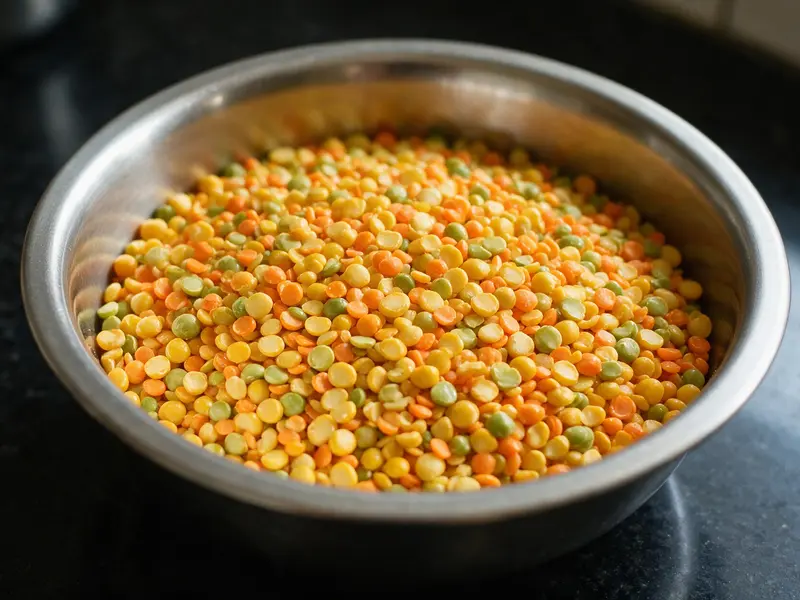
Mixed dal
A golden medley of lentils simmered as one, silky, nutty and earthy by turns, richly layered beneath a crackling ghee tempering.
Taste: Each lentil adds something: toor silkiness, chana nuttiness, masoor and urad earthiness, moong sweetness. Few sources say this.
Getting it ready
Soak up to about 1.75 hours, then pressure-cook with about 3 cups water per cup for 3–5 whistles. Overnight soaking cuts cooking time by a quarter or more.
Cooking with it
- Cook time: 5–12 minutes (electric_pressure_cooker)
- Cook time: 10 minutes (electric_pressure_cooker) Few sources say this.
- Cook time: 50–52½ minutes (open_pot) Few sources say this.
- Pressure cook whistles: 4–5 whistles (pressure_cooker)
- Pressure cook whistles: 3–5 whistles (pressure_cooker)
- Water ratio: 2½–4 cups water per cup (pressure_cooker)
Used in
Seasons
Winter (Nov–Feb), eaten
Seasonal food wheel
- On the tongue: Cool
- After the meal: Light
- Warmth: neutral
- Texture: medium
Useful tips
- Haryanvi mixed dal. For Haryanvi mixed dal, boil several lentils together, then crush them lightly; the mashing gives its rich texture, finished with plenty of spices and ghee.
- Panchmel dal: what each lentil adds. In panchmel dal each lentil contributes something: toor silkiness, chana nuttiness and shape, masoor and urad earthiness, moong sweetness. Few sources say this.
- Panchmel with fewer lentils. Panchmel dal can be made with fewer than five lentil types; keep the total lentil quantity about the same, roughly one to one and a quarter cups.
- Soaking dals for ammavadai. Soak the mixed dals for ammavadai about 3 hours. Few sources say this.
- Masoor and moong dal cook in the same time. Red masoor and yellow moong dal are often cooked together because both soften in about the same time. Few sources say this.
- Panchratna dal measures. One panchratna dal uses a quarter cup each of split black urad, whole green moong, whole green lentils, toor and chana dal, with 4–5 cups water for the 1.25 cups. Few sources say this.
- Soaking adai grains together overnight. For adai, soak the rice and mixed dals together overnight.
- Water or stock for cooking dal. Most dal recipes use plain water; half a stock cube is occasionally crumbled in for a savoury note, though water may keep the spices tasting fresher. Few sources say this.
- A family measure for dal. A rough home measure for dal is one fistful of uncooked dal per person. Few sources say this.
- Timing dal in an electric pressure cooker. Electric cookers take longer to come up to pressure than stovetop ones, and dal soaked overnight can need about a third less cooking time. Few sources say this.
- Soaking shortens cooking time. Overnight soaking cuts cooking time by a quarter or more because water no longer has to travel to the bean's centre during cooking.
- Khichdi on Makar Sankranti. Khichdi is cooked in most homes on Makar Sankranti and offered as prasad for the harvest, often also donated; its ghee is regarded as warming in winter.