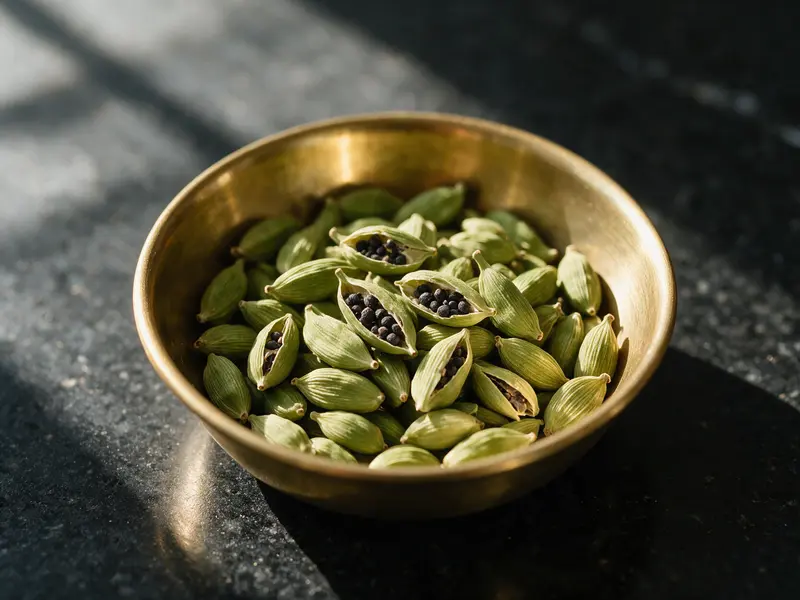
Green cardamom
Pale green pods cradling sticky black seeds, cracked open to release a cool, camphor-sweet perfume that drifts through warm milk and syrup.
Also called: choti elaichi (Hindi), elaichi (Hindi), elakkai (Tamil)
Taste: A eucalyptus-camphor perfume that comes out once the pods are crushed.
Texture: Small green pods with sticky black seeds inside.
Getting it ready
Crush or grind the pods to release their perfume; ten pods give about 1½ teaspoons ground, and only a little is needed. Whole pods need just a few seconds of sizzling in oil before the onions go in.
Swaps
- saffron: semiya payasam; paal payasam
- nutmeg Few sources say this.
Keeping
Keep cardamom out of the daily spice box, as whole pods, and grind the seeds only when needed. Store seeds sealed somewhere cool, dry and dark, and ground cardamom airtight.
Goes well with
Used to finish
golden milk (haldi doodh), a sprinkle, lassi, a pinch, kheer and puddings, powder, mango chutney preserve, coarsely crushed, ragi porridge, a pinch, ground, shrikhand, crushed, sonth chutney, freshly crushed, sooji halwa, crushed, sprinkled
Used in
Bhaja muger dal, White gravy (mughlai), Makhani gravy, Kadai masala, Bengali garam masala, Kerala garam masala, Mishti doi, Panakam, Mango chutney preserve, Saag paneer, Panchmel dal, Sooji halwa, Kheer, Rabdi, Gulab jamun, Masala chai, Cholar dal, Bengali khichuri, Gajar ka halwa, Kulfi, Kofta mixture, Ragi porridge, Gond ladoo, Golden milk (haldi doodh), Garam masala
Seasons
Monsoon (Aug–Nov), availability; Winter (Oct–Feb), harvest
Regions
Uttar Pradesh, Kashmir, Assam, Karnataka, Tamil Nadu, Kerala, Kerala, Sikkim, Coorg, Awadh, Southeast Asia (where it comes from)
Festivals
Makar Sankranti (Maharashtra)
Tradition
Cardamom flavours tea, payasam and many festive sweets across India.
Nutrition
Used in small amounts, so its nutritional contribution is minor.
Questions answered
- How long do green cardamom pods last?
- Why are fennel, cloves and cardamom chewed after meals?
- Should cardamom be ground with its husk or only the seeds?
- How should cardamom be stored to retain its aroma, colour and potency?
- Can I use ground cardamom instead of whole pods in a gravy, and how much?
- At what stage of cooking should cardamom be added, and why does timing matter?
Useful tips
- Green cardamom needs crushing; black cardamom is smoky. Green cardamom releases its eucalyptus-camphor perfume only when crushed or ground; black cardamom is larger, smoky-woody and much milder.
- The flavour of green cardamom. Green cardamom tastes sweet, bright and pungent with eucalyptus, mint and pepper notes, and works in savoury dishes and desserts alike, most famously masala chai.
- Cardamom in Kashmiri garam masala. Use only the seeds of black cardamom, but grind green cardamom whole since its thin shell grinds with the seeds. Few sources say this.
- Which spices and vegetables are used on fasts varies by family. Cumin, black pepper and green cardamom are common vrat spices, but whether turmeric, hing, mustard seeds, garam masala, ajwain, tomato, ginger or carrot are allowed varies by family.
- Bihari dal uses whole spices from the start. Bihari cooks tend to flavour dal with whole spices.
Another view: Some grind cardamom and warm spices into a powder added at the finish.
- Keep saffron apart and cold. Keep delicate spices like saffron and cardamom out of the daily dabba; refrigerate saffron and homemade masalas and let the jar warm before opening.
- How to make panakam. Dissolve about one cup jaggery in four cups water, strain, then add pepper and cardamom; dry ginger is usually added too. Few sources say this.
- How to make kokum sharbat. Mash soaked kokum rinds, cook them with sugar on low heat about 15 minutes until thick, cool fully, sieve, then dilute and season. Few sources say this.
- Boiled milk chai. For cardamom chai, boil water and milk with crushed pods, then simmer the leaves on low about 30 seconds for light or a minute for robust tea. Few sources say this.
- Let whole spices sizzle only seconds. Whole spices such as bay leaf, cinnamon, peppercorns, cloves and cardamom usually need only a few seconds of sizzling in oil before the onions go in. Few sources say this.
- Tea-stall masala chai. Boil water with crushed ginger, cardamom and cloves, brew tea and sugar 2 minutes, add milk and simmer 2–4 minutes; stalls use much water, little milk. Few sources say this.
- Dose for a dried-herb tea. Use about 1 teaspoon of dried herb per cup for most herb teas, up to about a heaped tablespoon per 240–480 ml; pour near-boiling water over and cover.
- Order botanicals in a simmered syrup. For a botanical syrup, simmer sturdy items like lemongrass, crushed cardamom, hibiscus and zest first, add delicate rose petals, rosewater and cinnamon only for the last few minutes. Few sources say this.
- Chewing cardamom seeds sweetens the breath.. Chewing cardamom seeds sweetens the breath.
- How much cardamom a pod gives. Each cardamom pod holds about twenty seeds; ten pods give about 1½ teaspoons of ground cardamom, and only a little is needed. Few sources say this.
- Kheer from cooked rice. For kheer from cooked rice, simmer it with milk on low heat about an hour, stirring often and scraping the sides and base so it does not catch. Few sources say this.
- Herbal honey: steep roots in warm honey for weeks. Pack sliced roots into a wide jar, cover with warmed honey and leave 2 to 3 weeks; the honey takes on their flavour for tea and cooking. Few sources say this.
- Slit chillies and crack cardamom for tadka. Slit whole green chillies and crack cardamom pods before adding them to hot fat, so they do not burst and splutter. Few sources say this.
- Keep rasmalai flavourings light. Use cardamom, saffron and similar flavourings sparingly in rasmalai so the taste of the milk stays in front. Few sources say this.
- Add dry ginger and cardamom with the jaggery syrup. In gond ladoo, dry ginger powder and cardamom go in with the jaggery syrup when everything is mixed together. Few sources say this.
- Coconut-jaggery filling for enduri. Cook the coconut and jaggery on medium for about 5-7 minutes until it browns, then stir in cardamom; one source cools it fully before filling. Few sources say this.
- Soak fennel with cardamom for saunf sharbat. Soaking the fennel together with cardamom gives the sharbat a rounder, fuller flavour. Few sources say this.
- Saunf sharbat flavour add-ins. You can add crushed black pepper, cardamom, or a spoonful of kokum or lemon juice to saunf sharbat. Few sources say this.
- Quick homemade stand-in for garam masala. No garam masala? Mix equal parts of ground cumin, coriander, black pepper, cardamom, cinnamon and clove, and use that in curries.
- A quick stand-in mix for garam masala. To replace 1 tbsp garam masala, combine 2 tsp ground coriander, 1 tsp ground cumin, a quarter teaspoon each of cardamom and black pepper, and an eighth of cinnamon. Few sources say this.
- What goes into garam masala. Garam masala rests on cloves, cardamom, cinnamon, cumin, coriander and peppercorns; some blends also bring in fennel, mace, nutmeg, star anise or mustard. Few sources say this.
- Restaurant-style finish for makhani gravy. For a restaurant-style gravy, blend with chilled water and sieve it, cook out the raw taste, use whole fresh cardamom, and crumble kasuri methi just before adding. Few sources say this.
- Choose seed-only cardamom powder and use it soon. Cardamom ground from seeds alone usually tastes better than powder with husks, and any powder loses aromatic oils over time, so it is best used quickly. Few sources say this.
- Some cooks leave saffron untoasted. Delicate spices such as saffron or cardamom seeds are often better left untoasted. Few sources say this.
Another view: Some prefer saffron untoasted; others dry-roast it before grinding.
- Bengali garam masala proportions. Bengali garam masala uses its three spices in equal measure, ground without roasting; scale them together for bigger or smaller batches.
- Spice in kallappam batter. Fennel or cumin can replace cardamom in kallappam batter, but use only one spice at a time. Few sources say this.
- Jaggery for chikki. Use solid, dark cone jaggery such as Kolhapuri for chikki; it gives a glossy dark bar that binds well.
- Sugar for rava ladoo. Use sugar at about half the quantity of rava, ground fine with the cardamom so it mixes evenly.
- Flavouring bajra gur roti. A pinch of salt or a little cardamom brightens the flavour of bajra gur roti. Few sources say this.
- Puran poli filling. Puran poli filling is chana dal cooked with jaggery, sometimes with sugar too, flavoured with cardamom, inside a flour dough with ghee.
- Garam masala: four core spices, many versions. Garam masala is usually built on cloves, cinnamon, black pepper and green or black cardamom, and every region and family has its own version; homemade is often preferred to bought. Few sources say this.
- Keep cardamom whole and grind as needed. Keep cardamom as whole pods and crack and grind the seeds only when needed; store seeds sealed somewhere cool, dry and dark, and ground cardamom airtight. Few sources say this.
- Meethe chawal. Meethe chawal is basmati cooked with ghee and sugar, flavoured with saffron and cardamom.
- Palda. Palda is a thick, smooth dish much like kadhi, with potatoes and cardamom.
- Zarda. Zarda is a sweet rice cooked in milk and sugar and flavoured with almonds, raisins, pistachios, cardamom and saffron.
- Singodi. Singodi is a cardamom-scented sweet of khoya, grated coconut and sugar.
- Garijalu. Garijalu are filled with grated coconut and sugar scented with cardamom.
- Taftan. Taftan is a flaky naan flavoured with cardamom, saffron and poppy seeds.
- Chak-hao kheer. Chak-hao kheer is made with rice, milk, cardamom, raisins, nuts and sugar.
- Where cardamom grows. Green cardamom is a ginger-family plant native to shaded rainforest from India and Sri Lanka to Malaysia; it needs hot, humid shade and steady moisture. Few sources say this.
- Spicing coffee with cinnamon or cardamom. Sprinkle ground cinnamon over the coffee grounds before brewing, or brew cardamom pods or seeds with the coffee as is done in India and the Middle East. Few sources say this.
- Kulfi is a Delhi favourite. Cardamom with pistachio is the classic, traditional flavour of kulfi.
- Thandai at Holi. Thandai, milk steeped with almonds, fennel, pepper, rose and cardamom, is drunk at Holi as the weather warms and is popularly thought of as cooling.
- Panakam and neer mor for Ram Navami. Panakam, a jaggery drink with cardamom, dry ginger and pepper, and neer mor, thin spiced buttermilk, are offered on Ram Navami as summer coolers.
- Adhara pana on the chariot. Adhara pana, a sweet drink of curd, milk, sugar candy and cardamom, is made on the Rath Yatra chariot, offered and shared with devotees. Few sources say this.
Another view: Some describe an offering of milk, chhena, sugar or jaggery, banana, camphor and spices in pots that are broken on the chariots, not shared. Some describe pana as milk, banana, cheese, spices and sugar placed in pots on the chariots, which are then broken, with no curd and no sharing.
- Bihari balushahi. In Bihar, balushahi is filled with lightly sweetened khoya, cardamom and cinnamon, sometimes saffron, and then deep fried.