Tea
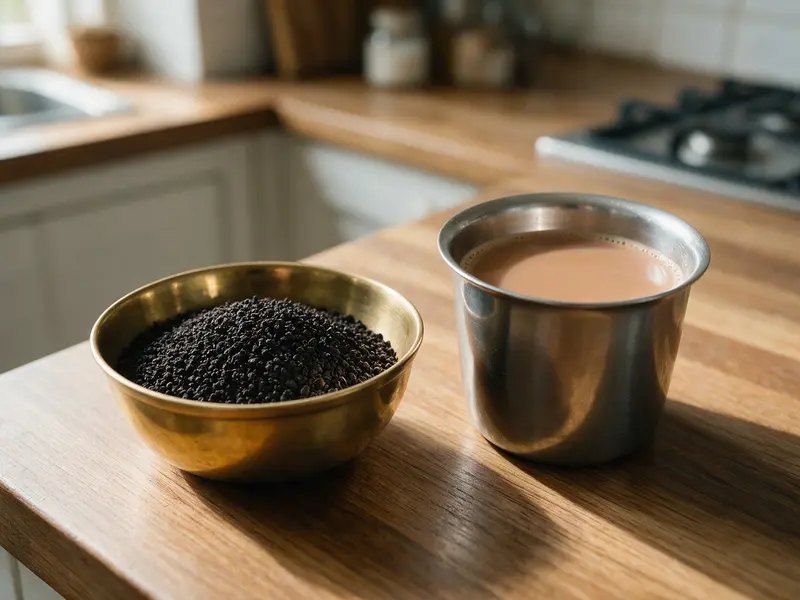
Strong amber chai simmered with milk, crushed cardamom and ginger, sweet, fragrant and steaming, the warm rhythm of an Indian day.
Also called: chai
Taste: Turns bitter if the leaves steep too long.
Getting it ready
Use about a teaspoon of leaf per cup for a strong brew. For chai, boil water with crushed ginger and cardamom, brew the tea about 2 minutes, then add freshly boiled milk.
Cooking with it
- Cook time: 1–3 minutes Few sources say this.
If something goes wrong
Tea tastes too bitter
- Leaves steeped too long
- Steep one to three minutes and strain off the leaves. to prevent
- Simmer the spices first and add the black tea only for the last few minutes. to prevent Few sources say this.
- Milk boiled again and again Few sources say this.
- Use milk that has been boiled just once. to prevent Few sources say this.
Goes well with
Used in
Seasons
Monsoon (Jun–Oct), harvest; Winter (Nov–Feb), eaten; Spring (Feb–Apr), harvest; Summer (May–Jun), harvest; Spring (Mar–Mar), harvest
Regions
Kashmir, West Bengal, Assam, Maharashtra, Tamil Nadu, Kerala, Himachal Pradesh, Ladakh, Sikkim
Seasonal food wheel
- On the tongue: Light
- After the meal: Spiced
- Warmth: warming
- Texture: smooth
- Best seasons: spring
Questions answered
- Can coconut sugar be used in tea?
- How much dried rose petals should I use for tea?
- What is the difference between chai and masala chai?
- Why does milk curdle in masala chai, and how do I stop it?
- Can masala chai be made without milk or with a plant milk?
- When should ginger and spices be added when making chai, and in what order should water, tea and milk go in?
Useful tips
- Why chai curdles and how to stop it. Chai splits from acids like lemon, strong tannins, fierce or long boiling, cold milk poured into very hot tea, or old milk; warm the milk and add it slowly.
- Tea strength by leaf quantity. About one teaspoon of leaf for three cups gives a light golden tea; one teaspoon per cup gives a strong, dark brew. Few sources say this.
- Use freshly boiled milk for tea. Add milk that has just been boiled to tea; milk heated again and again separates its fat and spoils the cup. Few sources say this.
- Soft, freshly boiled water makes better tea and coffee. Soft water makes better tea and coffee than hard water, and freshly boiled water tastes livelier than reboiled water. Few sources say this.
- Brewing long-leaf tea. Warm the pot with boiling water, then steep long-leaf tea under a cosy 2 minutes for light and up to 4 minutes for strong tea. Few sources say this.
- Boiled milk chai. For cardamom chai, boil water and milk with crushed pods, then simmer the leaves on low about 30 seconds for light or a minute for robust tea. Few sources say this.
- Tea-stall masala chai. Boil water with crushed ginger, cardamom and cloves, brew tea and sugar 2 minutes, add milk and simmer 2–4 minutes; stalls use much water, little milk. Few sources say this.
- How much chai masala to use. Use roughly a quarter to half a teaspoon of chai masala per cup of water. Few sources say this.
- Add tea leaves to chai only at the end. Add black tea only for the last few minutes of simmering or steeping a spiced chai, so it does not turn too bitter. Few sources say this.
- Gentle-heat chai. Warm the spices, tea and water in a covered pan 10 to 15 minutes below the boil, strain it, sweeten with honey and top it with frothed milk. Few sources say this.
- Simmer sonth with the tea leaves. Simmering dry ginger powder with the tea leaves can give chai a deeper colour and aroma. Few sources say this.
- Stronger sonth gur chai. For a stronger cup, use less milk and brew the tea longer. Few sources say this.
- Boil ginger in the water before milk goes into chai. For ginger chai, simmer the ginger in plain water first, from one to about five minutes, and pour in the milk only after, so the tea does not curdle.
- Water, milk and tea for two cups of chai. For two cups of chai, use roughly 1⅓ to 1¾ cups water, ½ to ¾ cup milk and about 3 teaspoons of tea leaves.
- Oat milk works best for dairy-free chai. Oat milk is the plant milk that best survives boiling in chai, though the cup is less creamy than with dairy.
- Making chai with plant milk. Brew spiced tea in water, warm the plant milk separately short of boiling, and strain the tea into it; soy and almond versions may still split.
- How much chai masala per cup. Use about 1/4 to 1/2 teaspoon chai masala per cup, boiled with the tea leaves.
- Tea leaves boil with spices first. In tulsi masala tea, boil the tea leaves with the spices before adding the tulsi and milk. Few sources say this.
- Tea for dark chole. Boiling chickpeas with tea gives them a dark colour.
- Tea bags darken chole. Tea bags in the chickpea pot only darken the chole and add no taste; dried amla gives the dark colour instead. Few sources say this.
Another view: Some say black tea adds a mild bitter note as well as colour; some cooks add amla to deepen the colour.
- Keep junk food, sugary drinks, tea and coffee away from babies. Keep packaged and junk foods, sweet drinks, biscuits, cakes, tea and coffee out of babies' and toddlers' diets; they offer little nutrition.
- How Indians take tea. Indians take black tea strong, sweet, milky and often spiced, traditionally with whole milk; even in the coffee-drinking south, tea runs through the day. Few sources say this.
- Chai versus masala chai. Chai simply means tea, and masala chai is the milky kind, brewed with ginger and whole spices. Few sources say this.
- Preparing jaggery for tea. Use finely grated jaggery so it dissolves smoothly; a block can also be dissolved in a little water and filtered, while powder goes straight in.
- Do not boil the leaves for kahwa. Add green tea leaves to kahwa off the heat and never boil them again; boiling or steeping beyond about 3 minutes turns it bitter.
- Simmering spices in water to blend flavours. Simmering spices and aromatics in the liquid lets their flavours pass into the dish, which is why masala and ginger are simmered in water before tea is made.
- Noon chai: Kashmir's pink salted tea. Noon chai is a Kashmiri salted breakfast tea (noon means salt); its pink colour comes from baking soda in a strong green-tea decoction. Few sources say this.
- Butter tea for Losar visitors. Visitors on the first day of Losar are offered butter tea and sweet tea. Few sources say this.
- Ginger, masala and herbal teas in the rains. During the rains, households traditionally drink more ginger tea, masala chai and herbal teas.
- Morning tea in Sikkim. In Sikkim the day starts with a big mug of tea, sweet or salted, with or without milk, sometimes with pepper.
- Serving mathri. Mathri are eaten with mango pickle.
- Kashmiri kahwa. Kahwa, green tea with almonds, cardamom, cinnamon and saffron, is popular in Kashmir; it is boiled with its spices and kept at a covered low boil about 2 minutes. Few sources say this.