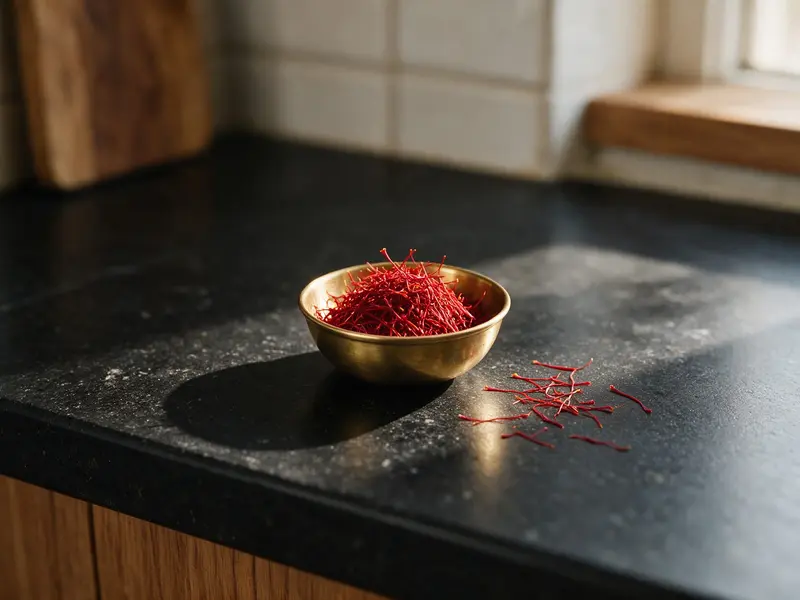
Saffron
Fine crimson threads that bleed molten gold into warm milk, carrying a honeyed, hay-sweet floral perfume through pulao and sweets.
Also called: kesar (Hindi), kungumapoo (Tamil), zafran (Urdu)
Taste: Floral in scent, best kept by steeping in only tepid milk. Few sources say this.
Getting it ready
Steep the threads in tepid milk about 30 minutes, since hotter milk dulls the scent, or dry-roast about a minute and grind for a stronger effect. Its yellow shows best in pale milk sweets, sauces and pulao.
- Few sources say this.
Keeping
Keep it out of the daily spice box; refrigerate it and let the jar warm before opening.
Goes well with
Used to finish
- golden milk (haldi doodh), a pinch of strands
- lassi, a few crushed strands
- kheer and puddings, bloomed in warm milk, stirred in
- qubooli, a sprinkle
- rabdi, crushed strands
- shrikhand, a few whole strands
- kamal kakdi kofta curry, crushed and diluted, a drizzle
- ghevar, strands
- kalakand, crushed strands
- rasgulla, a few strands
- sandesh, brushed or dabbed
- cham cham, a few strands
- modak, 1-2 threads on top
- basundi, a few strands
- kheer, steeped in warm milk, stirred in
- bhapa doi, a drizzle
Used in
Shrikhand, Lassi, Mishti doi, Kheer, Gulab jamun, Qubooli, Jalebi, Imarti, Malpua, Moong dal halwa, Petha, Phirni, Kalakand, Milk peda, Besan ladoo, Motichoor ladoo, Rabdi, Rasmalai, Cham cham, Khaja, Rava kesari, Double ka meetha, Modak, Basundi, Mohanthal, Balushahi, Kashmiri kahwa, Kesar doodh, Khubani ka meetha Few sources say this., Mango lassi, Puri
Seasons
Monsoon (Oct–Oct), harvest
Regions
Kashmir, Kashmir, Awadh
Tradition
Saffron is a favourite in Kashmiri cooking, as in kahwa and sweet saffron puris. In Himachal Pradesh, roasted nuts in thick saffron syrup over basmati rice is a traditional dessert.
Take care
Use small amounts; one cookbook warns it is narcotic in large doses. Official adulteration guidance lists dried maize cob tendrils as a known adulterant and gives a home test.
Seasonal food wheel
- On the tongue: Light
- After the meal: Balanced
- Warmth: warming
- Texture: medium
Questions answered
Useful tips
- Keep saffron apart and cold. Keep delicate spices like saffron and cardamom out of the daily dabba; refrigerate saffron and homemade masalas and let the jar warm before opening.
- Saffron for a yogurt marinade. Dry-roast and grind saffron, then steep it in whisked yogurt at least 30 minutes before using. Few sources say this.
- Bringing out saffron. Steep saffron threads in a little milk about 30 minutes before adding to sweets, or dry-roast them about a minute until crisp, then grind them for a stronger effect.
- Steep saffron in tepid milk. Steeping saffron in milk that is only tepid helps keep its floral scent, which hotter milk tends to dull. Few sources say this.
- Where saffron colour shows best. Saffron gives a golden colour to milk-based sweets and pulao.
- Toast or steep saffron for rice. Steep saffron in warm milk for about 10–15 minutes before adding it to a dish such as pullao.
- Saffron for kheer. For kheer, steep saffron threads in warm, not boiling, milk for about 15 minutes before adding.
- Saffron colour in phirni and kheer. Add saffron to phirni while it is still pourable so the colour spreads evenly; the colour keeps deepening as the pudding chills. Few sources say this.
- Add saffron milk to peda gradually. Add saffron milk to the peda mixture a little at a time, letting each lot be absorbed first. Few sources say this.
- Saffron can mask cooked-milk flavour. Saffron is sometimes left out of basundi, as it can mask the cooked-milk taste. Few sources say this.
- Crush saffron threads before use. Lightly crush saffron threads to get more colour and aroma from them.
- Choosing saffron. Good saffron threads are usually deep red with a strong scent. Few sources say this.
- Some cooks leave saffron untoasted. Delicate spices such as saffron or cardamom seeds are often better left untoasted. Few sources say this.
Another view: Some prefer saffron untoasted; others dry-roast it before grinding.
- Saffron with paneer near the end. A few saffron strands can be added with the paneer near the end of cooking. Few sources say this.
- Saffron milk for colour in millet pulao. Saffron soaked in milk gives Kashmiri millet pulao a soft golden colour.
- Put saffron in the cups for kahwa. For kahwa, drop the saffron into the serving cups rather than the pot, so none of it is lost when the tea is strained. Few sources say this.
- Fake saffron from maize tendrils. Official adulteration guidance lists dried maize cob tendrils as a known adulterant of saffron and gives a home test.
- Use saffron only in small amounts. Saffron is used only in small amounts, as large doses are harmful.
- Layer and seal a biryani. Layer half the rice, then the filling, then the rest of the rice; drizzle saffron milk, seal with foil and lid, and bake or cook on very low heat. Few sources say this.
- Keep rasmalai flavourings light. Use cardamom, saffron and similar flavourings sparingly in rasmalai so the taste of the milk stays in front. Few sources say this.
- Natural colours for tutti frutti. Tutti frutti's artificial colours add no taste, so leave them out for white tutti frutti or use saffron, turmeric or beetroot juice instead.
- Soak dried apricots overnight for khubani ka meetha. Rinse dried apricots and leave them in water overnight; one recipe adds saffron to the soaking water.
- Finishing a cup of kahwa. Finish every cup of kahwa with almond slivers and one or two saffron strands; honey is optional, for a lightly sweet cup.
- Perfuming Kashmiri pulao. Kashmiri pulao is scented with saffron and kewra.
- Saffron nut rice of Himachal Pradesh. Roasted nuts in thick saffron syrup poured over basmati rice is a traditional Himachal Pradesh dessert. Few sources say this.
- The scent of Kashmiri food. The characteristic scent of Kashmiri cooking comes from fennel seed and dried ginger (sonth), with saffron, nutmeg and mace as other favourites. Few sources say this.
- Kashmiri khameeri puri. Sweet leavened saffron puris are a Kashmiri speciality, traditionally fried in ghee and eaten with dry vegetables.
- Sheermal. Sheermal is a sweet, saffron-scented Awadhi flatbread baked in an iron tandoor, with milk and saffron water sprinkled on as it bakes.
- Meethe chawal. Meethe chawal is basmati cooked with ghee and sugar, flavoured with saffron and cardamom.
- Zarda. Zarda is a sweet rice cooked in milk and sugar and flavoured with almonds, raisins, pistachios, cardamom and saffron.
- Maharashtrian shrikhand. Maharashtrian shrikhand is sweetened yogurt flavoured with saffron, cardamom and charoli.
- What kahwa is. Kahwa is green tea scented with saffron and whole spices, served with almonds or walnuts, and households make over twenty versions.
- Kashmiri millet pulao. Kashmiri millet pulao is a one-pot dish of little millet with nuts, dried fruit, saffron and fresh fruit.
- Rava kesari. Rava kesari is semolina cooked with ghee, dry fruits and saffron; some versions add pineapple or banana.
- Taftan. Taftan is a flaky naan flavoured with cardamom, saffron and poppy seeds.
- Ghee for flavour in fried sweets. Frying jalebi or boondi in ghee, half ghee and half oil, or oil with 2 to 3 tablespoons of ghee added gives a better ghee flavour.
- Millet payasam: cook slowly until the grains break down. For kodo or barnyard millet payasam, cook the millet slowly in milk on low heat until the grains break down.
- Why synthetic colours are more stable than natural. Synthetic colours such as tartrazine and Ponceau 4R hold up to heat and pH, while natural colours fade sooner with heat, light, oxygen, metals or pH changes.
- Pulao versus biryani. Pulao simmers rice until it soaks up a seasoned liquid, with light spices such as bay leaf and cardamom; biryani layers part-cooked, drained rice over a separately cooked masala.
- Kashmiri kahwa. Kahwa, green tea with almonds, cardamom, cinnamon and saffron, is popular in Kashmir; it is boiled with its spices and kept at a covered low boil about 2 minutes. Few sources say this.
- Golden meethe chawal for Baisakhi. Yellow dishes such as meethe chawal, coloured with saffron or turmeric, are often cooked at Baisakhi to echo the ripe wheat harvest. Few sources say this.
- Meethe chawal offered to Saraswati in North India. In North India, including Punjab and Haryana, saffron- and turmeric-yellow meethe chawal is offered to Saraswati and then served to the family.
- Kojagiri Purnima moonlit milk in Maharashtra. On Kojagiri Purnima, Maharashtrian households traditionally keep milk flavoured with sugar and saffron in the moonlight and then drink it. Few sources say this.
- Yellow food for Basant Panchami. Basant Panchami food is yellow because the colour is tied to the mustard fields blooming in spring, sunlight and turmeric.