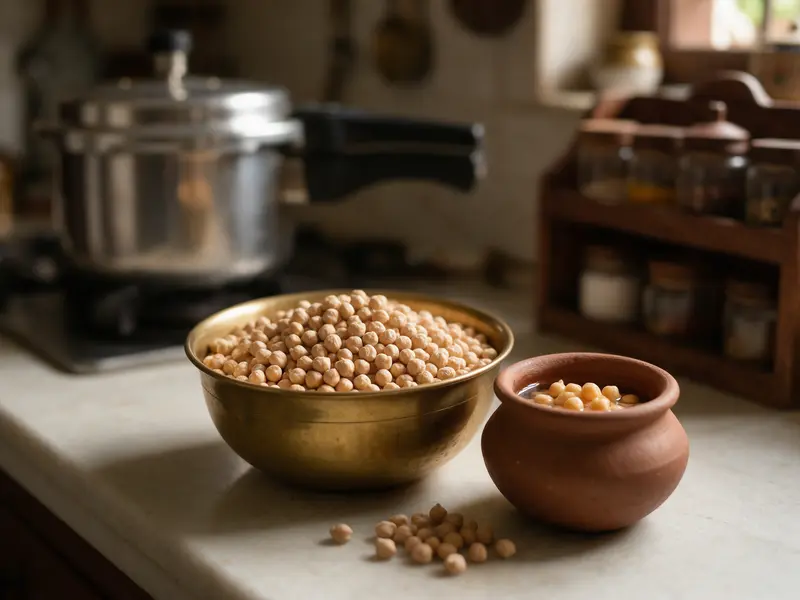
Chickpea (kabuli chana)
Plump, cream-coloured chickpeas simmered until meltingly tender, drinking in dark, tangy, roasted spices for a hearty, deeply savoury chole.
Also called: kabuli chana (Hindi), safed chana (Hindi), chhole (Hindi), vellai kondakadalai (Tamil)
Texture: Soaked, partly dried and roasted, the gram puffs open into roasted chana. The liquid from canned chickpeas helps thicken a sauce.
Taste: Nutty and mild.
Getting it ready
Soak about 7.5–10.5 hours, then pressure-cook with about 3 cups water per cup for 3–6 whistles; they are best pressure-cooked. Tea bags in the pot give chole a darker colour.
Cooking with it
- Cook time: 240–480 minutes Few sources say this.
- Cook time: 28–45 minutes (electric_pressure_cooker)
- Cook time: 10–29 minutes (electric_pressure_cooker)
- Cook time: 35–45 minutes (electric_pressure_cooker) Few sources say this.
- Cook time: 37–150 minutes (open_pot)
- Cook time: 2–23 minutes (pressure_cooker)
- Pressure cook whistles: 1–6 whistles (pressure_cooker)
- Pressure cook whistles: 8–10 whistles (pressure_cooker) Few sources say this.
- Water ratio: 3–3½ cups water per cup (pressure_cooker)
Keeping
- In the fridge: 7 days
Another view: Some keep cooked chickpeas 3–4 days in the fridge, or 3 months frozen.
Goes well with
Used in
Sundal, Chana chaat, Fruit chaat, Chotpoti, Papdi chaat, Pavakkai pitlai, Poosanikai kootu, Chole, Pani puri, Chana palak, Ghugni, Millet bhel, Aloo tikki, Besan ladoo, Choliya sabzi, Kadala curry, Khaman, Ragda pattice, Sai bhaji Few sources say this.
Seasons
Summer (Apr–Jun), harvest; Summer (Mar–Jun), eaten
Regions
Rajasthan, Madhya Pradesh, Uttarakhand
Festivals
Baisakhi (Punjab), Kati Bihu (Assam)
Nutrition
A legume that brings protein and fibre. Demo note.
Questions answered
Useful tips
- Chickpea flour behaves like besan. Chickpea (garbanzo) flour can be used just as besan is, for thickening and for coating.
- Thicken chickpea curries without extra ingredients. Thicken a chickpea curry by crushing some chickpeas with a spoon, or by blending about a cup of it and returning it to the pot.
- Kolkata potato, paneer and chickpea curry with kachori. A potato, paneer and chickpea curry is popular in Kolkata, where it is often eaten with soft kachori; rice or chapatti is lighter. Few sources say this.
- Thin chickpea curry with chapatis. A thin chickpea curry can be eaten with chapatis rather than rice. Few sources say this.
- What makes chana chaat different from a chickpea salad. Green chilli, black salt, chaat masala, raw onion and lemon are what set chana chaat apart from a plain chickpea salad. Few sources say this.
- Chickpea choices for chana palak. Chana palak is made with white chickpeas; canned chickpeas also work.
- Mash some pulses to thicken. To thicken a dal or chickpea curry, crush some of the cooked pulses against the side of the pot with a ladle.
- Dried yellow peas for small chickpeas. Dried yellow peas can replace small chickpeas in street-style chickpea dishes. Few sources say this.
- Tea bags darken chole. Tea bags in the chickpea pot only darken the chole and add no taste; dried amla gives the dark colour instead. Few sources say this.
Another view: Some say black tea adds a mild bitter note as well as colour; some cooks add amla to deepen the colour.
- Kulchas with chole. Kulchas are eaten at North Indian roadside stalls with chickpea curry, pickles and green chutney. Few sources say this.
- But arak. But arak means chickpea plant leaves.
- Tea bags darken chole. Adding tea bags while cooking chickpeas gives chole a darker colour.
- How roasted chana gets its puffed texture. For roasted chana, the gram is soaked and partly dried before roasting, which gives its puffed, open texture. Few sources say this.
- Soaking and cooking dried white peas. Soak dried white peas at least 4 hours, better overnight, with a little baking powder, then simmer up to an hour. Few sources say this.
- Use the can liquid from chickpeas. The liquid from canned chickpeas can be added along with them, as it helps thicken the sauce. Few sources say this.
- Saucepan for small dals, cooker for big beans. Small dals like moong and masoor cook fine in a saucepan, but chickpeas and kidney beans are best pressure-cooked and need more water. Few sources say this.
- A little baking soda with chickpeas. One cookbook adds about a quarter teaspoon of baking soda to 1.25 cups of soaked chickpeas in the pressure cooker. Few sources say this.
- Chana chaat: cook the chickpeas until dry. For chana chaat, cook the chickpeas with spices, a little water and tamarind about 4 minutes until the juices evaporate, then fold in the raw tomato mix. Few sources say this.
- Serving temperature for chana salads and chaat. Sundal-style chana tastes best slightly warm; chana chaat can be served at once or chilled for about an hour, keeping onion, tomato, puri, sev and coriander to add at serving.
- Rinse canned chickpeas for chaat. For chaat, rinse and drain canned chickpeas well before using them. Few sources say this.
- Coat chaat with dry spices before chutneys. In chana chaat, toss the chickpeas with the dry spices first, then gently stir in the chutneys. Few sources say this.
- Cooking kumro chokka. After the chickpeas are added no water is needed: cover and cook gently until the vegetables soften yet keep their shape.
- Cooking potato with chickpeas for aloo chana. Cook raw potato cubes in the cooker with soaked chickpeas until soft, or stir cooked potato and chana into the masala and simmer covered on very low heat.
- Tea for dark chole. Boiling chickpeas with tea gives them a dark colour.
- Use white peas, not chickpeas, for ragda. Ragda needs dried white peas (vatana); other pulses, chickpeas included, are not a swap.
- Mash some chickpeas to thicken chole. Mash about a fifth of the cooked chickpeas once with a ladle to thicken the chole gravy and improve its taste.
- Save the bean cooking water for the gravy. Keep the water the chickpeas or beans cooked in and use it to adjust the gravy's thickness.
- Dried chickpeas versus canned. Chickpeas cooked from dry have a better texture than tinned ones; about 3/4 cup dried, soaked around 8 hours, replaces one can.
- Quick soak for chickpeas. If you forgot to soak chickpeas, boil them 5 minutes, then leave them covered off the heat for an hour. Few sources say this.
- Older pulses take longer to cook. Old dried chickpeas or kidney beans take longer to cook, so cooking time depends on the beans' age and quality.
- Quick chana palak. With cooked or canned chickpeas, chana palak comes together in about 20 to 30 minutes.
- Soaking pulses and then cooking them, by boiling or pressure cooking, removes more oligosa. Soaking pulses and then cooking them, by boiling or pressure cooking, removes more oligosaccharides than soaking alone; reported combined reductions range from about half to around 80 percent.
- Sprouting raises iron availability but not zinc. Sprouting pulses and grains makes their iron more available, but in lab tests it lowered zinc availability.
- How soaking softens dried beans. Soaking makes dried beans cook faster; water enters first through the scar where the bean joined the pod, then through the seed coat, so thin-skinned beans soften sooner. Few sources say this.
- What counts as a dal. Small legumes are all called dal; large ones like chickpeas and kidney beans keep their own names until they are split, when they too become a dal. Few sources say this.
- Where pindi chana gets its dark colour. The near-black colour of pindi chana comes from dry-roasting anardana, cumin, amchur, garam masala and chilli until coffee-brown, about 3 minutes. Few sources say this.
- How to tell chickpeas are cooked. Cooked chickpeas should mash easily between your fingers with no hard centre; if not, cook a few more whistles.
- How long cooked dal and boiled beans keep in the fridge. Food-safety bodies give 3-4 days in the fridge for cooked leftovers; one household source keeps mashed dal 2-3 days and boiled chickpeas or rajma 4-5 days.
- Storing a batch of cooked pulses. Freeze half a batch of cooked pulses and refrigerate the rest; keep beans in their liquid for curries and drained for salads. Few sources say this.
- Checking that beans are cooked through. A properly cooked bean squashes easily between your fingers; if it resists, give it a few more whistles or minutes after the pressure has dropped on its own.
- Madra. Madra is soaked chickpeas or vegetables cooked well in oil with spices.
- Vegetarian patoler dolma. A vegetarian patoler dolma stuffs patol with grated coconut and chickpeas before frying.