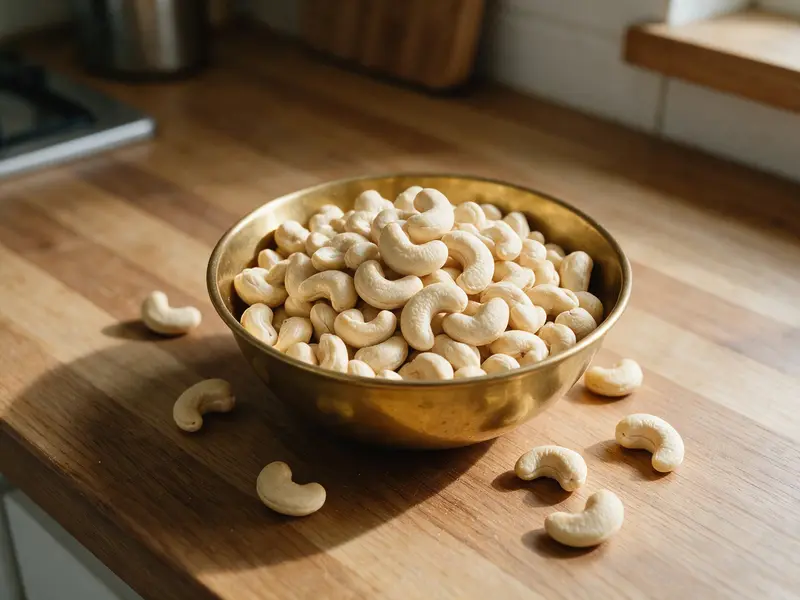
Cashew nuts
Plump, creamy cashews fried to a warm golden blush, their buttery sweetness melting into silken, ivory gravies and festive halwa.
Also called: godambi (Kannada), kaju (Hindi), mundiri (Tamil)
Texture: Ground to a paste, cashews thicken a curry and add creamy richness without cream.
Getting it ready
Puree raw cashews near the end of cooking, since adding them early over-thickens. Fried in medium-hot oil, raw cashews turn golden in about a minute; fry each kind of nut separately. Melon seeds, almonds or poppy seeds can stand in.
Swaps
- poppy seeds: subject cashew nuts replaced by poppy seeds; vegetable kurma
- groundnuts Few sources say this.
- almonds: subject cashews replaced by almonds or poppy seeds; veg kurma
- melon seeds
Goes well with
Used to finish
- kheer and puddings, fried in ghee
- bisi bele bath, quartered and fried in ghee until brown
- curd rice, fried in ghee
- samak rice pulao, dry roasted
- ven pongal, fried light golden
- sooji halwa, whole or broken
- besan burfi, chopped or sliced
- kamal kakdi kofta curry, roasted in ghee
- plastic chutney, dry roasted until light golden
- gajar ka halwa, fried in ghee
- coconut barfi, fried in ghee, chopped
- payesh, fried golden in ghee
- ada pradhaman, fried in ghee, poured with the ghee
- semiya payasam, fried in ghee
- rava kesari, fried in ghee
- aamras, scatter
- thayir semiya, scatter
Used in
White gravy (mughlai), Makhani gravy, Ragi porridge, Bisi bele bath, Dahi vada, Sooji halwa, Gajar ka halwa, Rava dosa batter, Rava idli batter, Kofta mixture, Cashew paste, Tomato khejur chutney, Plastic chutney, Moong dal halwa, Kaju katli, Besan ladoo, Chhena poda, Narkel naru, Payesh, Patishapta pitha, Paal payasam, Ada pradhaman, Semiya payasam, Rava kesari, Sakkarai pongal
Seasons
Winter (Jan–Mar), harvest
Regions
Uttar Pradesh, Maharashtra, Goa, Goa, Goa (where it comes from)
Festivals
Carnival (Goa)
Seasonal food wheel
- On the tongue: Hearty
- After the meal: Hearty
- Warmth: warming
- Texture: coarse
- Best seasons: late winter, early winter, rains
Questions answered
Useful tips
- Kaju katli doneness. Kaju katli dough is done when a pinch rolled between the fingers forms a soft, non-sticky ball; a sticky, loose dough was taken off too early.
- Shape kaju katli and peda while warm. Roll kaju katli dough and shape pedas while the mixture is still warm; once cool it sets and resists shaping.
- Knead kaju katli only briefly. Knead kaju katli dough only two or three times; overworking it harms the texture. Few sources say this.
- Kaju katli keeps a few days. Kaju katli can be made three to four days ahead of a festival. Few sources say this.
- Kaju katli: one-string syrup method. In the syrup method, cook the sugar syrup to one-string stage before adding cashew powder; adding the powder earlier gives a sticky dough. Few sources say this.
- Kaju katli: boil-only method. In the quick method, add the cashew powder as soon as the sugar water comes to the boil, without simmering the syrup further. Few sources say this.
- Fixing dry or crumbly sweet dough. Fix dry kaju katli or crumbly peda with a few drops of milk or a spoon of ghee, or knead in milk powder if sticky; added milk shortens keeping time.
- Grind cashews at room temperature. Take cashews out of the fridge one to two hours before grinding; cold cashews give a rough, sticky kaju katli dough.
- Sift for a smoother sweet. Sift cashew powder or besan for a smoother kaju katli or besan burfi.
- Leave the film in the pan. Leave the thin film that sticks to the pan when making kaju katli; scraping it in spoils the texture. Few sources say this.
- Thicken with nut purees near the end. Pureed nuts such as cashews or almonds can be used to thicken a curry or sauce.
- Nut and seed pastes thicken without cream. Cashew, melon seed or poppy seed paste thickens a curry and adds richness without cream; melon seeds can stand in for cashew or poppy.
- Frying nuts for snacks. Fry each kind of nut separately, or chop them to one size; raw cashews turn golden in medium-hot oil in about a minute.
- No-cook cashew burfi. Traditional cashew burfi uses tricky sugar syrup; a no-cook version processes cashews, icing sugar and milk powder with a spoon or two of warm water into a dough. Few sources say this.
- Home-style korma versus restaurant korma. Restaurant korma tends to be sweet and pale, sometimes with raisins; home-style korma often gets its creaminess from cashews, white poppy seeds and onions blended into the base. Few sources say this.
- Toasting nuts for garnish. Fry garnish nuts in ghee over medium heat, stirring, until golden and aromatic, then take them off the heat; or brown almonds in a hot oven or under the grill.
- Pulse cashews briefly. Pulse cashews in short bursts and stop as soon as powder gathers on the lid; over-grinding makes them oily, and a slightly coarse dry powder is fine.
- Nuts in date milkshake. You can add almonds, cashews or walnuts to the blender with the dates. Few sources say this.
- Cashew paste replaces curd for body in gravies. To replace curd in a curry or gravy, simmer or soak cashews, drain and blend them smooth; the paste thickens and enriches much as curd would.
- Fry cashew paste only until lightly pink. Soak cashews about an hour in warm or hot water, then blend them into a paste.
- Pressure-cooker malai kofta gravy. For the gravy, pressure cook tomatoes, cashews, yogurt and ½ cup water for 6 minutes, release quickly, then blend and strain. Few sources say this.
- A no-onion, no-garlic curry base. Cook plenty of tomatoes with ginger and whole spices, add cashews plus melon and sesame seeds, and blend to a thick curry base free of onion and garlic. Few sources say this.
- Dairy-free curd for biryani gravy. For a biryani gravy made without curd, cashew yogurt with a neutral oil can stand in and gives a similar result. Few sources say this.
- Fine or coarse kurma masala. One recipe grinds the coconut-cashew paste very fine for a smooth gravy; another recipe's tips call for a coarse grind so spices stay distinct.
- Liquid for blending cashew paste. Blend soaked cashews with water for cashew paste; the amount of water sets how thick it is.
- Cashews needed for paste. About 12 to 15 soaked cashews give roughly 3 tablespoons of paste, enough for one gravy. Few sources say this.
- Cashews optional in korma paste. Cashews add creaminess to korma paste but can be left out for a lighter paste. Few sources say this.
- Substitutes for malai or cream. Heavy cream can replace malai, and powdered almonds or cashews or cashew cream can replace dairy cream in a curry.
- Peanuts or cashews in rice dishes. Peanuts and cashews can stand in for each other in tomato rice or coconut rice, though the taste shifts; some cooks treat peanuts as essential in tomato rice.
- Rava dosa variations and fillings. For onion rava dosa, scatter chopped onion on the greased tawa before pouring; grated coconut, cashews or a potato filling can also be added.
- Melon seeds in a gravy paste are optional. Melon seeds in a gravy paste are optional; if you have none, use an extra spoonful each of almonds and cashews.
- Roasted gram and cashews in puliyogare. Roasted gram goes into the grinder as is, without further roasting, and cashews can be added to puliyogare for richness.
- Cashew-based smooth gravy. For a kofta gravy base, cook the cashews with the onions, then blend smooth.
- Creamier lauki kofta gravy. Fry a few cashews with the onion and tomato before blending, and stir in a little cream at the end, for a richer, milder kofta curry.
- Kolhapuri gravy body and paneer version. Without cashews or cream, veg kolhapuri gravy stays fairly thin; the same masala also makes paneer kolhapuri. Few sources say this.
- Sorghum flake peda. Roast sorghum flakes and grind fine, add ghee slowly to the sweetened powder until it shapes into small balls, and top with cashew or almond.
- Savoury millet boondi. Season the drained boondi with salt and chilli powder, then add oil-roasted cashews and curry leaves.
- Syrup stage decides whether a sweet sets soft or hard. Under-cooked syrup leaves sweets soft, soggy or unset; over-cooked syrup or too high a flame makes them hard, dry or crystallised.
- Bengali basanti pulao. Basanti pulao, a festive Bengali rice named for spring, is cooked in ghee with whole spices and finished with turmeric or saffron, raisins, cashews and a touch of sugar. Few sources say this.
- Paneer makhani versus paneer butter masala. Makhani and butter masala are sometimes treated as separate dishes, makhani using only tomato, cashew and cream, butter masala also allowing onion and poppy or melon seeds. Few sources say this.
Another view: Some treat paneer makhani and paneer butter masala as different dishes; others use the names for the same dish.
- Cashews and melon seeds for body. Cashews and melon seeds ground into a curry base make it rich and velvety.
- Rava idli. Rava idli combines rava with curd and cashews.
- Cashews in Goa. Goans eat cashews plain, salted, roasted or flavoured, and also cook them into a halwa.
- Sorghum flake pongal. Pongal can use sorghum flakes instead of rice, equal half cups of flakes and moong dal; soften the dal, then cook the flakes in with milk until very soft.
- Tender cashew dishes in Maharashtra on Akshaya Tritiya. In Maharashtra, tender cashew dishes such as olya kajuchi bhaji are often cooked for Akshaya Tritiya because fresh cashews are in season then. Few sources say this.