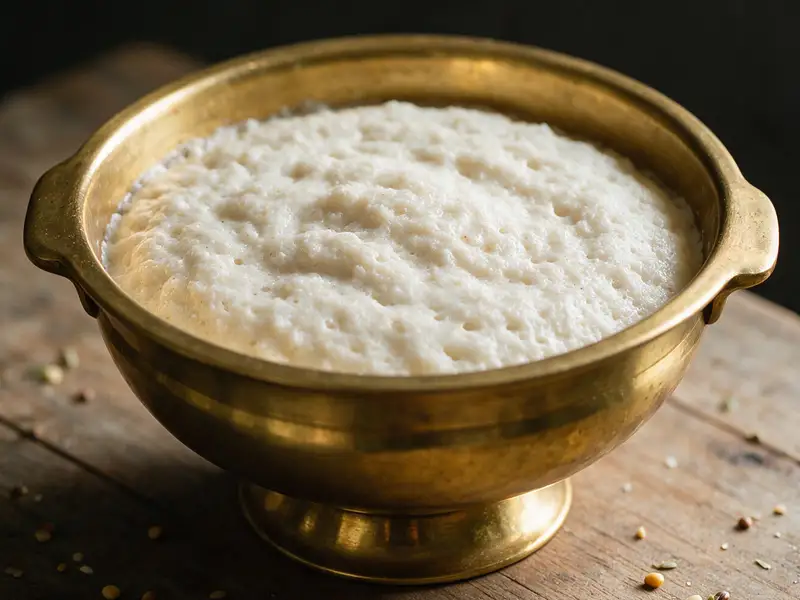
Fermented batter (generic)
How idli and dosa batters ferment, and what to do when a batter is slow to rise or turns too sour.
Also called: fermented batter, fermented batter (generic), fermented batters, leftover batter
If something goes wrong
Dosa or idli batter fails to ferment or ferments too slowly
- Temperature too low (cool room or cold weather slows the microbes)
- Keep the batter in a consistently warm but not hot place, checking the actual temperature. to prevent
- Move it to a warmer, safe spot and allow more time. to rescue
- Judge readiness by rise, aroma and texture rather than a fixed overnight time. to rescue
- Allow up to 18 hours, or keep it in an oven with the light on. to rescue
- Keep the batter somewhere warm, at about 25-30 C to prevent
- Add a ladle of old fermented batter as a starter. to rescue
- Keep it near the stove or another warm spot for a few more hours. to rescue
- Leave dhokla batter longer until it rises somewhat. to rescue Few sources say this.
- Move the batter to a warm spot such as a lit oven or warm water bath and give it more time. to rescue
- Add a few methi seeds when soaking or grinding. to prevent
- Ferment it in an Instant Pot on the low yogurt setting under a glass lid, or switch to the 1:3 ratio meant for winter. to prevent Few sources say this.
- Not enough time for the conditions
- Extend fermentation while watching for spoilage signs. to rescue
- Batter too salty or of unsuitable consistency
- Review the batter consistency and usual process for the next batch. to prevent
- Use over-watered batter for dosa rather than idli to rescue
- Thin a too-thick batter after fermenting, accepting less soft idlis. to rescue
- Grind with enough water and mix the batter well by hand. to prevent Few sources say this.
- Weak starting microbial population from ingredients or equipment
- Use filtered water and fresh dal; keep hands and equipment clean to prevent Few sources say this.
- Check the batter's history before extending fermentation; do not leave it warm indefinitely hoping it recovers. to rescue Few sources say this.
- Grind a little poha or cooked rice with the batter. to prevent Few sources say this.
- Stir in about a quarter teaspoon of baking soda before steaming. to rescue Few sources say this.
- Iodized or processed salt
- Use unrefined salt; add a little and adjust after fermentation. to prevent
- Too little softener or too much urad dal Few sources say this.
Another view: Some use less dal, finding the dal ferments more.
- Add more poha, or try a 3:1 rice-to-urad ratio. to prevent
- Chlorinated water
- Use filtered water for soaking and grinding. to prevent
- Millet batter judged by the wrong cue (it rises only slightly)
- Check millet batter for sourness and bubbles rather than expecting it to double. to rescue
- Old urad dal
- Use fresh urad dal, not old stock (one source buys small quantities) to prevent
- Use fresh dal. to prevent
Fermented batter turns too sour or over-ferments
- Fermented too long: microbes keep consuming sugars and producing acid, weakening the batter
- If it was safely handled and shows no spoilage, use it in a preparation that tolerates sourness; adding flour does not make it safe. to rescue
- Refrigerate as soon as the desired stage is reached. to prevent
- Stop when the batter has doubled and refrigerate it. to prevent
- Refrigerate the batter right away to limit further souring to rescue
- Fermented or stored too warm (hot kitchen speeds gas and acid production)
- Ferment in a cooler place, watch storage conditions and check more often. to prevent
- Refrigerate as soon as the desired stage is reached. to rescue
- Shorten fermentation in hot weather and refrigerate once doubled. to prevent
- Refrigerate millet batter as soon as about 8 hours of fermenting are done. to prevent Few sources say this.
- Store batter in the fridge: plain batter lasted about 2 days at 30 C versus about 10 days at 4 C. to prevent
- Shorten the fermentation or ferment in a cooler place. to prevent Few sources say this.
- Spoilage or unsafe storage Few sources say this.
- Discard batter with mould, odd colour, putrid smell, or an unknown storage history. to rescue Few sources say this.
- Salt added at grinding in hot weather (sources differ: some say salted batter sours sooner, others that salt slows fermentation and curbs souring)
Another view: Some say salt slows fermentation, so they add it at grinding in hot weather to curb souring.
- In hot climates, add salt only just before steaming. to prevent
Another view: Some add salt before fermenting in hot weather.
- Salt only the portion you are about to cook. to prevent
- In hot climates, add salt only just before steaming. to prevent
- Old or infested rice or dal Few sources say this.
- Check your stock and use fresh grains and dal. to prevent
Batter ferments unevenly
- Temperature varies across the container Few sources say this.
- Avoid large temperature swings. to prevent Few sources say this.
- Batter not homogeneous Few sources say this.
- Mix well before fermenting, then only gently afterwards to prevent
- Container too deep Few sources say this.
- Use a suitable clean container and check the whole batch, not just the top. to prevent Few sources say this.
Take care
- Do not keep leaving unfermented batter in warm conditions in the hope it will eventually ferment.
- Sourness alone cannot show a fermented batter is safe; discard batter with spoilage signs or uncertain safety.
- Discard fermented food or batter with unexpected mould, odd colour, putrid smell, unsafe or unknown storage, or any doubt; never taste it to check.
- Cooking, adding flour or repurposing cannot make spoiled or unsafely stored batter safe; only texture problems suit a different use.
Questions answered
- What can I do if I have too much fermented batter left?
- Can I use the same fermented batter for both idli and dosa?
- How can I use the same fermented batter for more than one dish?
- How can I use fermented batter before it becomes over-fermented?
- How can I tell whether fermented batter has become too sour to use?
- How can I safely use fermented batter that has been stored in the refrigerator?
Useful tips
- Fermented batter is acidic, soda batter alkaline. Observed batter pH fell from about 6 after soaking to about 4 after fermentation, so fermented batter is sour and acidic, whereas soda makes a batter alkaline. Few sources say this.
- Using over-fermented batter. Batter that is merely too sour or loose but was handled safely can go into a preparation that tolerates its acidity and texture.
- Salt fermented batter after it rises. Add table salt to idli, dosa or appam batter after it has fermented, just before cooking; salt stirred in right after grinding holds back fermentation.
- How a fermented batter rises without soda. In idli and dosa batter, lactic acid bacteria from the urad dal, chiefly Leuconostoc mesenteroides, make carbon dioxide that the thick batter traps; overnight it more than doubles.
- Sourness doesn't prove batter is safe. Sourness alone cannot show a fermented batter is safe; discard batter with spoilage signs or uncertain safety. Few sources say this.
Another view: Some say risen batter with a sour smell is fermented, not spoiled.
- Over-sour batter. Batter turns too sour when acid-forming microbes work too long or too warm; safely handled sour batter suits dishes that carry the tang.
- Diagnose batter problems one variable at a time. For a batter that disappoints, it helps to look at whether it rose, how its consistency shifted, how it spread, and whether it set and browned, then change a single variable. Few sources say this.
- Batter ferments unevenly. Batter that is not uniform, for example too watery or poorly mixed, ferments and rises unevenly; mix it well before fermenting. Few sources say this.
- Adding vegetables to batter. Vegetables give off water into a batter, so the batter usually needs to be thick enough to carry them, allowing for their moisture. Few sources say this.
- Do not stir fermenting batter needlessly. Mix fermenting batter only when the stage requires it, since stirring knocks out trapped gas bubbles.
- Chlorinated water slows fermentation. Chlorine in tap water can hold back fermenting microbes, so use filtered, boiled or spring water for batter.
- Enduri batter ferments faster in summer. Above about 30 °C in summer, enduri pitha batter ferments faster, so check it sooner. Few sources say this.
- Chakuli batter is ready when risen. Chakuli batter is ready once it has risen; good fermentation makes the pitha soft, spongy and mildly sour.
- Acid in khaman replaces fermentation. Because khaman is not fermented, an added acid such as citric acid or lemon juice supplies the tang and reacts with the soda to raise the batter.
- Fermenting batter in an electric pressure cooker. Ferment batter in the steel inner pot using the yogurt function and a glass lid, never the locking one, so rising batter cannot lock or jam the pot.
- Add salt and chillies to millet batter after fermenting. Salt the millet idli batter only once it has fermented, right before steaming; ground chillies, ginger, onion and coriander also go in after fermenting.
- Don't leave unfermented batter warm indefinitely. Do not keep unfermented batter warm indefinitely hoping it will ferment; follow the recipe's fermentation time and temperature, and discard batter that has not fermented within them. Few sources say this.
- Refrigeration slows but does not stop fermentation. Cold slows the microbes in fermented foods but neither stops them nor sterilises the food, so storage time still matters.
- Sourness is not a safety test. Your senses cannot confirm that food is safe: harmful contamination often does not change how food looks, smells or tastes.
- When to throw out a fermented food. Discard fermented food or batter with unexpected mould, odd colour, putrid smell, unsafe or unknown storage, or any doubt; never taste it to check.
Another view: Some guidance allows skimming small mould patches from the surface; other guidance treats mould during fermentation as unsafe and says to discard when unsure. The safer advice is to discard. Some skim off small mould patches and discard only heavily mouldy batches; the safer advice is to discard.
- Cooking or repurposing cannot fix spoiled batter. Cooking, adding flour or repurposing cannot make spoiled or unsafely stored batter safe; only safely handled batter with texture problems suits another use, and uncertain batter should be discarded. Few sources say this.
- Lactic acid: what sours curd and batter. Lactic acid, made by some microbes as they ferment sugars, is the acid in sour milk, curd and cheese; it acidifies food and helps protect it against mould. Few sources say this.
- Starter cultures and back-slopping. A starter culture is any bacterial or fungal culture that sets off fermentation; saving a little of the last batch to start the next is the oldest kind. Few sources say this.
- What fermentation does to flavour. Fermentation is microbes chemically changing food, typically yeast acting on sugar; it breaks large, bland molecules into smaller ones with much more flavour.
- Chemical leavening versus fermentation. Chemical leaveners raise a batter in minutes, while fermentation is slower and adds its own flavours; that speed is why Eno spread for idli and dhokla from the 1980s.
- Fermented versus soda bhatura. A quick soda-and-curd bhatura rises in about 30 minutes, but lacks the light sourness and soft-after-cooling crumb of a long-fermented dough.