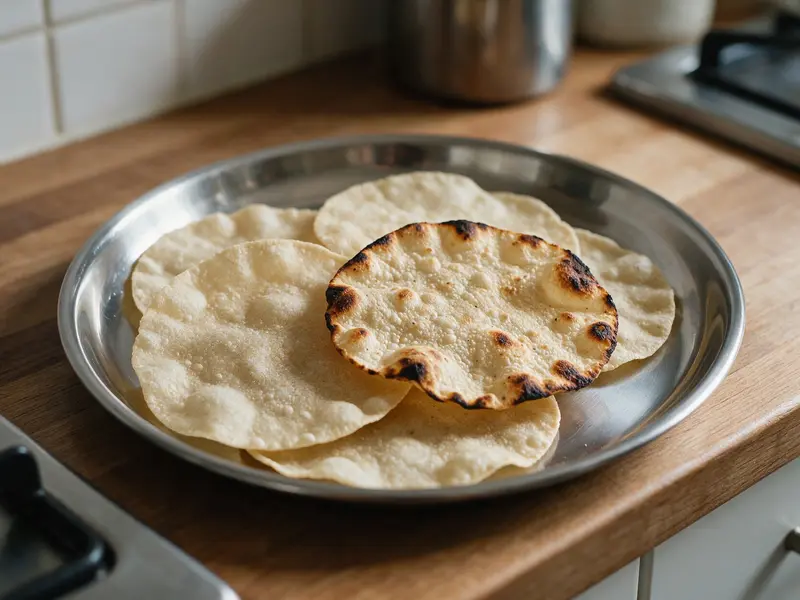
Papad
Paper-thin, blistered discs roasted over an open flame until crackling and golden, smoky, savoury and shatteringly crisp with every bite.
Also called: appalam (Tamil), happala (Kannada)
Getting it ready
Roast over a flame with tongs, working from the rim inward, or grill about 30 seconds or microwave about a minute on high. Oil used to fry papad turns gummy, so it is usually thrown away.
Keeping
A spoonful of rice grains or a small salt sachet in the jar absorbs moisture in humid weather.
Seasons
Summer (Mar–Jun), eaten
Regions
Punjab, Rajasthan, West Bengal, Gujarat
Festivals
Virundhu sappadu (Tamil Nadu)
Used in
Seasonal food wheel
- On the tongue: Tangy
- After the meal: Spiced
- Warmth: warming
- Texture: medium
- Best seasons: spring
Questions answered
Useful tips
- Drying papad in a day. Mix papad dough with clean water, roll thin and set out in the morning so it dries within one day. Few sources say this.
- Roasting papad. Roast papad over a flame with tongs, working from the rim inward; under a grill it needs about 30 seconds, in a microwave about a minute on high. Few sources say this.
- Discard oil used for frying papad. Oil used to deep-fry papad is usually thrown away rather than reused, because it turns gummy. Few sources say this.
- Rajasthani papad. Rajasthani papad is made liberally from powdered lentils.
- What to serve with pappu charu. Serve pappu charu over plain rice with ghee and papad, alongside a dry fry (vepudu) such as bendakaya fry. Few sources say this.
- Khichu. Khichu is most often made from rice flour, though jowar, bajra, ragi or wheat flour also work, and its dough doubles as papad dough.
- Light khichdi, kanji and soups in the rainy season. In the rainy season, households traditionally prefer light, filling meals: khichdi with ghee, papad, chokha and pickle, rice-and-lentil dishes, rice or millet kanji and soups.
- What to serve with vegetable biryani. Serve vegetable biryani with raita such as onion raita, plus salan or shorba, an eggplant curry, kachumber, papad or mango pickle.
- What to serve with veg pulao. Veg pulao goes with plain raita or curd, carrot or onion raita, dal, kadhi, kurma, paneer butter masala, soya chunks curry, pickle or papad.
- What a regular thali holds. A regular Indian thali holds roti, rice, dal and vegetables, with sides such as pickle, chutney or papad.
- Rice grains keep jars dry. Adding a few raw rice grains to a jar of salt, papads or similar dry staples helps absorb moisture.
- Vangi bath: cook rice and brinjal separately. For vangi bath, cook rice and brinjal separately: half the spice powder cooks with the brinjal, tamarind follows once it softens, and the rest goes into the rice. Few sources say this.
- Laying a sadya leaf. For a sadya the banana leaf is laid with its narrow tip to the left, and serving starts on the lower half.
- Taat vadhany, the Maharashtrian thali layout. Taat vadhany is the traditional Maharashtrian way of setting a thali, with salt at the top centre and the sweet at the lower left.
- Order of a Bengali feast. A Bengali feast starts with rice, ghee, salt and green chilli, then dal, then spiced vegetables, and nears the end with sweet-sour ambal and papad.
- Sun-drying papads and vadis around Akshaya Tritiya. Around Akshaya Tritiya, papads and vadis are sun-dried, using the strong summer sun of the season. Few sources say this.
- What to serve with avial. Serve avial with steamed rice, with Kerala sambar or vathal kuzhambu, and with pickle and papadums.