Eggs
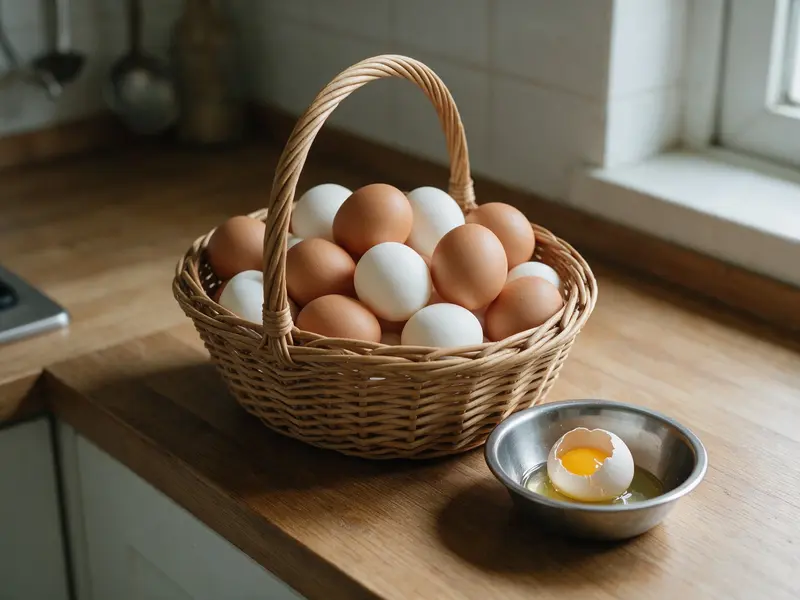
Golden-yolked eggs, gently boiled or simmered in fragrant masala, tender whites and rich, creamy centres enriching a warm, spiced curry.
Also called: anda (Hindi)
Texture: Whites set by 65 °C and yolks between 65 and 70 °C; overheating makes eggs dry and rubbery.
Getting it ready
Boil about 10 minutes; boiling too long leaves a green ring round the yolk. Mashed hard-boiled yolks stirred in with cream thicken and enrich a curry.
Cooking with it
- Cook time: 10 minutes (open_pot) Few sources say this.
If something goes wrong
Boiled eggs have a green ring round the yolk
- Eggs boiled too long Few sources say this.
- Time the boiling and cool the eggs promptly in cold water. to prevent Few sources say this.
Eggs go stale or spoil quickly
- Eggs held at room temperature Few sources say this.
- Refrigerate eggs promptly after buying. to prevent Few sources say this.
- Protective bloom washed off the shell Few sources say this.
- Do not scrub eggs before storing; buy clean, unbroken eggs. to prevent Few sources say this.
Keeping
Refrigerate promptly and do not scrub off the shell's natural coating; they keep about 3 weeks in the fridge.
- In the fridge: 7–28 days
Used to finish
- chotpoti, sliced
Used in
Seasonal food wheel
- On the tongue: Hearty
- After the meal: Hearty
- Warmth: warming
- Texture: smooth
- Best seasons: late winter, early winter, rains
Useful tips
- Boil eggs and potatoes once a week. Boil potatoes ahead and keep them refrigerated for later meals; one source also boils eggs at the start of the week, peeling them only when using.
- Refrigerate eggs and keep the bloom. Refrigerate eggs promptly and do not scrub off the shell's natural coating; without it microbes enter through the pores and the egg spoils. Few sources say this.
- Salmonella and eggs. Cracked eggs are easily contaminated, so handle them with care, and refrigerate cooked food promptly to limit bacterial growth. Few sources say this.
- How to tell a fresh egg. A fresh egg has a small air pocket and, once cracked, a firm centred yolk in thick white that holds its shape; stale eggs have runny white. Few sources say this.
- How heat sets proteins. Heat denatures and then sets proteins, mostly between 65 and 90 °C; overheating squeezes out their water and makes eggs or paneer dry and rubbery. Few sources say this.
- Prevent cross-contamination. Germs spread between foods and surfaces on hands, utensils or other foods, so never put cooked food back on a plate that held raw eggs.
- Many Hindus count eggs as meat. Many Hindus in India, most of them vegetarian, regard eggs as a kind of meat. Few sources say this.
- Keep fat and yolk out of egg whites you want to whip. Even a trace of yolk or fat stops egg whites whipping into a stable foam; fats and salts suppress foams. Few sources say this.
- Mashed yolks thicken an egg curry. Mash hard-boiled yolks with cream and stir them into the curry to thicken and enrich the sauce; the whites can be fried golden separately. Few sources say this.
- Temperatures at which egg sets. Egg white begins to set at 52 °C and is fully set by 65 °C; yolk sets between 65 and 70 °C. Few sources say this.
- Sugar raises the setting temperature of milk and egg mixtures. Sugar raises the temperature at which milk-and-egg custard mixtures set, so sweetened mixtures need more heat to firm up. Few sources say this.
- Cook egg dishes to 71 °C, with white and yolk firm.. Cook egg dishes to 71 °C, with white and yolk firm.
- How heat, acid and salt cook proteins. Heat, acid or salt unfold proteins into a mesh; set gently it holds water and stays tender, but more heat or acid squeezes water out and toughens food.
- Acid makes milk and egg proteins set sooner. Acidic fruit or vegetables make milk-based mixtures set or curdle more readily when heated.
- Monsoon food in Bengal: warming curries, fritters and chai. In Bengal, rainy monsoon days call for crisp fritters, usually with hot chai.