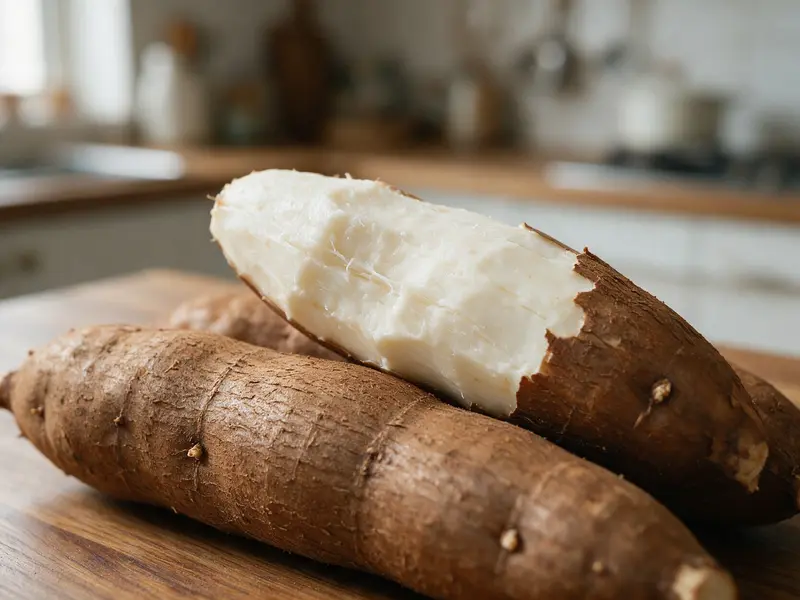
Tapioca
Starchy white tapioca root, dense and comforting, boiled until soft and fluffy, with a mild, nutty sweetness beneath its bark-brown skin.
Also called: kappa (Malayalam), maravalli kizhangu (Tamil)
Texture: Its starch thickens at a lower temperature than cereal starches, giving soft, clear, glossy pastes that freeze well.
Regions
Kerala, Kerala, Malabar, Travancore, South America (where it comes from)
Used in
Take care
The root contains cyanide. Chopping or mashing it and letting it stand lets its enzymes make it safe, and bitter varieties must be processed, for example by fermenting; roasting it whole in its skin leaves the cyanide in.
Seasonal food wheel
- On the tongue: Hearty
- After the meal: Hearty
- Warmth: neutral
- Texture: coarse
- Best seasons: late winter, rains, early winter
Questions answered
Useful tips
- Bitter tapioca must be processed. Damaged tapioca tissue releases hydrogen cyanide; bitter varieties must be processed, for example by fermenting, to drive it off before eating.
- Tapioca root contains cyanide. Tapioca root contains cyanide-forming compounds; prepare it only by a reliable, variety-specific method, and never treat roasting it whole in its skin as making it safe. Few sources say this.
- Cornflour versus arrowroot or tapioca starch. Cornflour gives cloudy gravies that set as they cool and reheat well but freeze badly; tapioca or arrowroot starch gives clear, glossy sauces that freeze well.
- Gourds, yam, tapioca and raw banana in monsoon cooking. Monsoon cooking traditionally relies on gourds, squashes, yam, tapioca and raw banana, plus okra and colocasia leaves; Bengal stuffs or fries teasel gourd (kakrol).
- Rescue split coconut milk with a starch slurry. Switch the flame off, remove the curdled bits, and gradually stir in about 1 tbsp tapioca starch or cornflour slaked in 2 tbsp water.
- Root and waxy starches thicken at lower heat and weep less. Potato, tapioca and waxy starches thicken at a lower temperature than cereal starches and give softer pastes that stale and weep less. Few sources say this.
- What starch is: amylose and amylopectin. Starch is the main carbohydrate in rice, wheat and potatoes, stored as tiny granules; it is made of two parts, straight amylose and branched, insoluble amylopectin.
Another view: Some describe amylose as linear and amylopectin as branched, and say amylopectin dissolves in cold water while amylose does not.
- How sago pearls are made. Cassava is rasped and sieved to free the starch, which is settled, formed into globules at 35–40% moisture, roasted in hot pans and dried to about 12% moisture.
- Sago is almost pure starch. The Indian sago standard requires at least 98% starch with no more than 0.3% protein and 0.2% crude fibre, so nearly everything else in the tuber is removed.