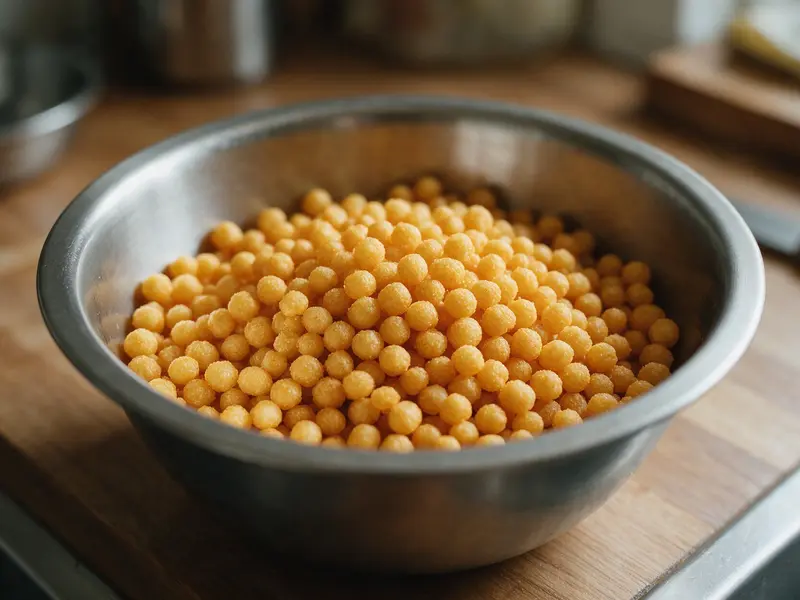
Boondi
Tiny golden pearls of fried gram-flour batter, crisp and nutty, softening into cool, creamy raita with a delicate, savoury crunch.
Taste: Shop-bought boondi is usually already salted. Few sources say this.
Texture: Crisp drops that soften quickly once soaked, then soak up yogurt.
Getting it ready
For soft boondi in raita, soak it 2 to 3 minutes in hot water, rinse and squeeze, then thin the raita with milk or water. Use less salt in a curry made with shop-bought boondi.
Cooking with it
- Rest time: 10 minutes Few sources say this.
If something goes wrong
Boondi forms strands instead of drops
- Batter poured without tapping the spoon Few sources say this.
- Hold the perforated spoon high and keep tapping it so the batter breaks into drops. to prevent
Boondi drops come out flat
- Batter too thin
- Mix in 1 to 2 tsp besan and fry a test batch. to rescue Few sources say this.
Boondi drops form tails
- Batter too thick
- Add water in very small amounts and fry a test batch. to rescue
Keeping
- At room temperature: 4–5 days Few sources say this.
Goes well with
Used to finish
kanji, crisp namkeen boondi, curries and gravies, sprinkled, raitas and pachadis, sprinkled, boondi raita, crisp, whole, bisi bele bath, sprinkled on top, dahi vada, whole
Used in
Regions
- South India (where it comes from)
Festivals
Tuesday Hanuman worship
Seasonal food wheel
- On the tongue: Rich
- After the meal: Rich
- Warmth: warming
- Texture: medium
- Best seasons: late winter, early winter, rains
Questions answered
Useful tips
- Batter consistency decides the shape of boondi. Use a flowing, pouring batter for boondi; a thick batter gives boondi with tails.
- Soft boondi for raita. Soaked boondi absorbs yogurt, so thin boondi raita with a little milk or water.
- Making round boondi. Hold the perforated spoon about 15 cm above the oil and keep shaking and tapping it as the batter goes through, so it falls as drops rather than strands. Few sources say this.
Another view: For round boondi, some hold the ladle about 3–4 cm above the oil, finding higher drops work worse.
- Cut the salt when using bought boondi. Shop-bought boondi is usually already salted, so use less salt in the curry. Few sources say this.
- Crunchy or soft boondi in raita. For crunchy boondi raita, keep the raita without boondi and fold it in, unsoaked, just before serving; for soft boondi, mix it in before chilling.
- Clean the jhara between boondi batches. Wipe the jhara clean between batches so the fine boondi do not stick together; dry it before it goes over the hot ghee. Few sources say this.
- Fry motichoor boondi briefly. Fry fine motichoor boondi just 30 to 40 seconds so they set without colouring. Few sources say this.
- Salt for crisp boondi. A pinch of salt in the batter helps the boondi crisp. Few sources say this.
- Don't overcook boondi in syrup. Cooking boondi too long in the syrup dries them out and they lose their soft centre. Few sources say this.
- Pulse soaked boondi briefly. Pulse the syrup-soaked boondi for only about 30 seconds so they break without turning to paste. Few sources say this.
- Soak boondi in warm water to soften it and remove oil. Soak fried boondi covered in warm water for about 9–12 minutes, then press it gently between your palms; this softens it and draws out excess oil.
- Tools for dropping boondi. No boondi ladle? Use a slotted spoon, skimmer or grater, and keep a second spoon for lifting the boondi out.
- Curry leaves for seasoned boondi. Fry curry leaves on the stem in the hot oil after switching it off, then crush them into the boondi. Few sources say this.
- Lump-free boondi batter. Sift besan and rice flour together before mixing boondi batter so it has no lumps.
- Shape boondi laddus lemon-sized. Shape the syrup-coated millet boondi into lemon-sized balls.
- Savoury millet boondi. Season the drained boondi with salt and chilli powder, then add oil-roasted cashews and curry leaves.
- Even boondi drops. Hold the ladle still rather than tapping it so the batter drips through evenly, and wipe its underside between batches so the holes stay clear. Few sources say this.
- Ghee for flavour in fried sweets. Frying jalebi or boondi in ghee, half ghee and half oil, or oil with 2 to 3 tablespoons of ghee added gives a better ghee flavour.
- Smallest jhara for motichoor. Use the smallest jhara (no. 0 or 1) for motichoor; larger holes make boondi ladoo instead. Few sources say this.
- Quick swap for the vadas. For speed, besan boondi or pakodi can go into the kanji instead of moong vadas. Few sources say this.
- Dry the jhara before it goes over hot ghee. Dry the perforated ladle (jhara) before each batch of boondi; water on it makes the hot ghee spatter. Few sources say this.
Another view: Some wipe the frying ladle with a wet cloth between batches to stop clumping.
- Do not refrigerate motichoor ladoo. Do not refrigerate motichoor ladoos; the fridge hardens them and they lose their softness. Few sources say this.
- Raita in Uttar Pradesh. Uttar Pradesh raita is made with cucumber, doodhi, pumpkin or boondi.